Wyckoff tells you where and why to look; price action gives you a precise trigger and stop. Combining them means you only act on a Wyckoff idea when the individual candles confirm it, which sharpens entries and defines risk.
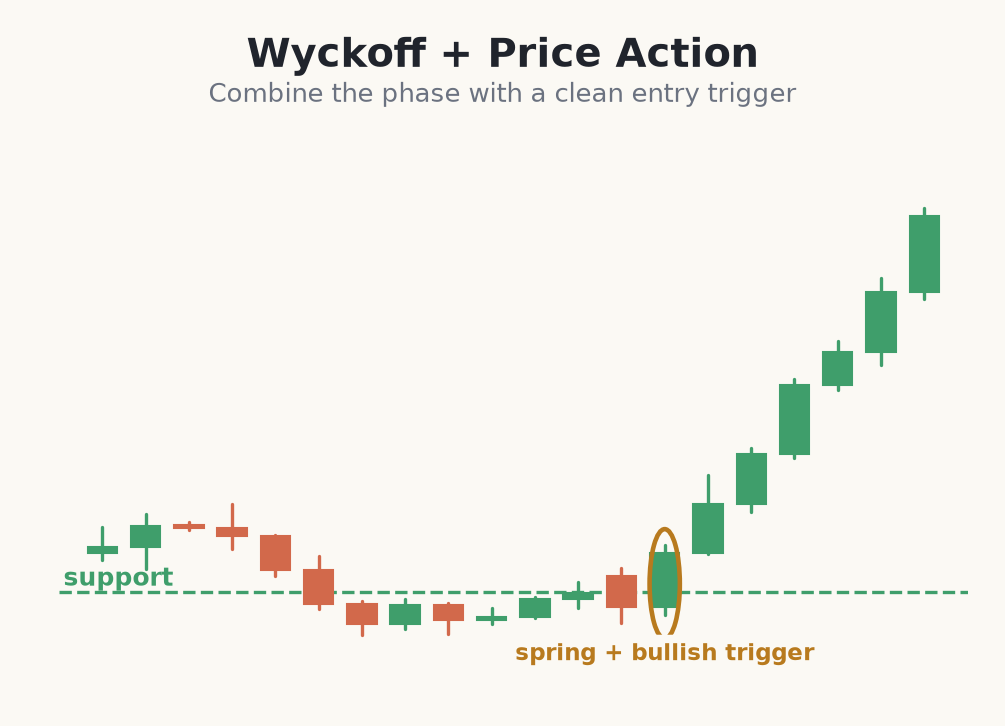
Pairing context with a trigger
Suppose you identify a spring at the bottom of an accumulation range. Rather than buying the moment price dips below support, you wait for a bullish reversal candle — a strong close back inside the range, or a pin bar off the spring low — to confirm buyers have actually shown up.
The distribution side works the same way. An upthrust plus a bearish rejection candle at resistance gives both the Wyckoff reason and the price-action confirmation to consider a short, with the candle's high marking a natural risk point.
- Context: spring, upthrust, SOS or SOW from the range read.
- Trigger: a confirming reversal or breakout candle.
- Stop: beyond the spring low or upthrust high the trigger relies on.
- Alignment: prefer trades that agree with the higher-timeframe trend.
How the trigger tightens your risk
The practical payoff of pairing the two is a tighter, cleaner stop. Instead of buying somewhere in the range and stopping under the whole thing, you wait for a reversal candle at the spring low and stop just below that candle's low. The Wyckoff context tells you the shakeout is likely genuine; the candle gives you a precise entry and a nearby invalidation. Smaller risk per share at the same account risk means a larger, safer size or a better reward-to-risk.
Spring context plus a pin-bar trigger
- 1EUR/USD accumulates between 1.0800 and 1.0920. Price springs to 1.0770 and snaps back — Wyckoff context says the shakeout is likely genuine.
- 2Rather than buying blind, you wait for the trigger: a bullish pin bar forms off the spring low with a long lower wick, closing back at 1.0815.
- 3You enter long at 1.0820, just above the pin bar's high, once the next bar confirms.
- 4Stop below the pin bar's low at 1.0765 — a tight 55 pips, far closer than a stop under the whole range would be. Risk = 55 pips.
- 5Account €1,000, risk 1% = €10. A 55-pip stop sizes to about 0.018 lots. Target the range top near 1.0920, ~100 pips, roughly 1.8:1; a break beyond improves it.
- 6Invalidation is clean: a close below 1.0765 and you exit — the candle you relied on has failed.
Use Wyckoff for context and price action for the trigger — act only when the candles confirm the story.
Common beginner mistakes combining the two
- Taking the context without a trigger. 'It's a spring' is not an entry. Without a confirming candle you are buying hope with a distant stop.
- Taking a trigger with no context. A pretty pin bar in the middle of nowhere is just a candle. It needs the Wyckoff location — spring, upthrust, SOS, SOW — to mean anything.
- Believing confirmation removes risk. Two tools agreeing lowers some false starts but guarantees nothing. Triggers fail; the stop still has to be there.
- Chasing after the trigger fires. Entering three bars late gives back the tight stop the candle offered. Enter at the trigger or skip it.
- Fighting the higher timeframe. A confirmed long against a strong daily downtrend is lower-odds. Prefer setups that agree with the bigger picture.
Combining tools reduces some false starts but removes no risk. Confirmation can still fail, and waiting for it sometimes means a worse price. The point is a cleaner, definable stop — not certainty about the outcome.