The final step is turning the method into a repeatable process. A checklist keeps you honest, stops you forcing trades, and makes it easy to review what worked and what didn't after the fact.
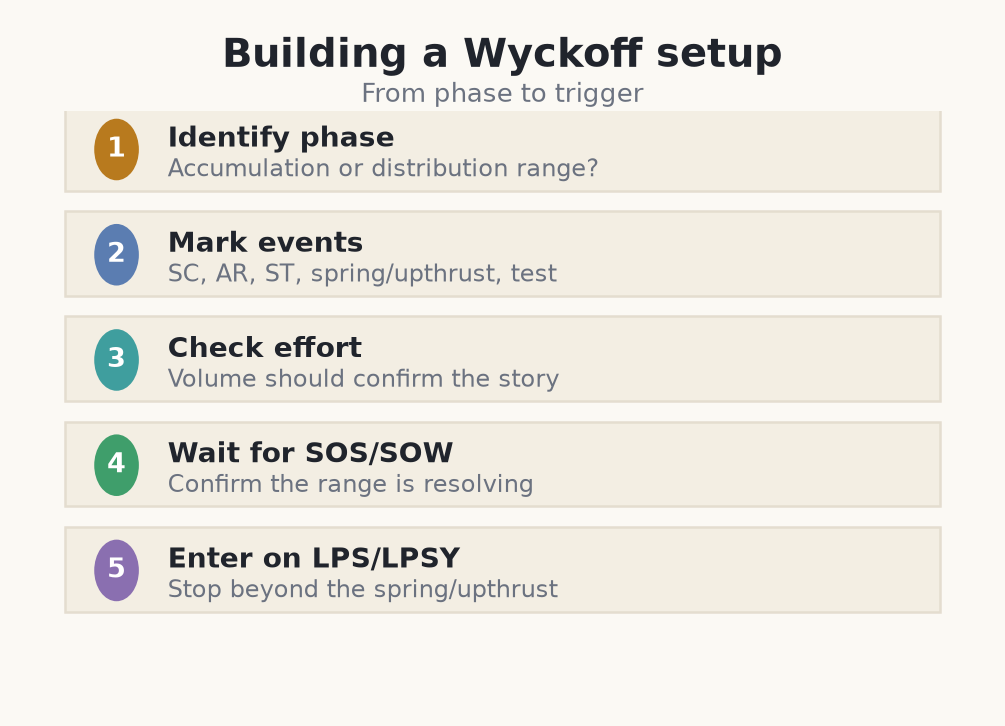
The five-step checklist
- 1. Identify the phase — accumulation, distribution, or a re-phase within a trend.
- 2. Apply the three laws — supply/demand direction, cause size, and effort vs result.
- 3. Wait for a key event — a spring, upthrust, SOS or SOW.
- 4. Get a trigger — a confirming price-action candle at the level.
- 5. Define risk — entry, stop beyond the event, and a target from the cause.
Notice that risk comes last but decides everything. The stop sits beyond the spring low or upthrust high, position size is set so a full stop is a small, survivable loss, and the target is a reasoned estimate from the cause — never a promise.
If any step is missing, there is no trade. A phase without a confirming event, or an event without a trigger, is a watch-list item — not a reason to commit capital. Discipline in skipping incomplete setups is what protects the account over time.
How to size and manage the trade
Sizing flows mechanically from the stop. Fix your account risk per trade — 1% of a €1,000 account is €10 — then divide by the distance from entry to stop to get position size. Never widen the stop to fit a bigger position; if the stop is too far for a sensible size, the trade is too expensive and you skip it. Once in, manage the same way every time: bank part near the cause-based target, trail the rest behind structure, and let the invalidation take you out without debate.
A full setup walked through the checklist
- 1Phase: a stock has accumulated for weeks between €60 and €65 after a decline — a candidate accumulation range.
- 2Laws: dips to €60 come on shrinking volume (supply/demand favours buyers), the €5 base stores decent cause, and a recent absorption bar showed effort without downside result.
- 3Event: a spring stabs to €58.80 and recovers inside; a low-volume test holds at €60.40.
- 4Trigger: a bullish outside bar closes at €61.20. You enter at €61.30, stop below the test at €59.90 — risk €1.40 per share.
- 5Risk: account €1,000, 1% = €10. €1.40 risk per share → 7 shares (≈€429). The €5 cause projects toward ~€66, roughly 3.4:1. You bank half at €66 and trail the rest.
- 6Invalidation: a daily close under €59.90 and you are out for a planned ~€10 loss — every step present, risk defined before entry.
Phase, laws, event, trigger, risk — five steps, and if any is missing there is no trade.
Common beginner mistakes building a setup
- Skipping steps because a chart 'looks ready'. A phase with no event, or an event with no trigger, is incomplete. Trading it anyway is how the checklist gets abandoned.
- Widening the stop to fit a bigger size. This inverts the whole method. Size follows the stop, never the reverse — if the stop is too far, skip the trade.
- Forcing setups out of boredom. No qualifying setup means no trade. Sitting on your hands is a position, and often the correct one.
- Treating the cause target as a guarantee. The projected objective is an estimate. Bank partials, trail the rest, and manage what price actually does on the way.
- Over-risking a 'high-confidence' read. A fully-checked setup still fails regularly. Risk the same fixed percentage every time so no single loss can hurt the account.
The Wyckoff method is a framework for interpretation, not a source of certainty. Schematics are idealised, real charts are messier, and no range resolves the same way twice. Used with strict risk management it can structure your thinking — but it offers no signals, guarantees, or shortcuts to easy money.