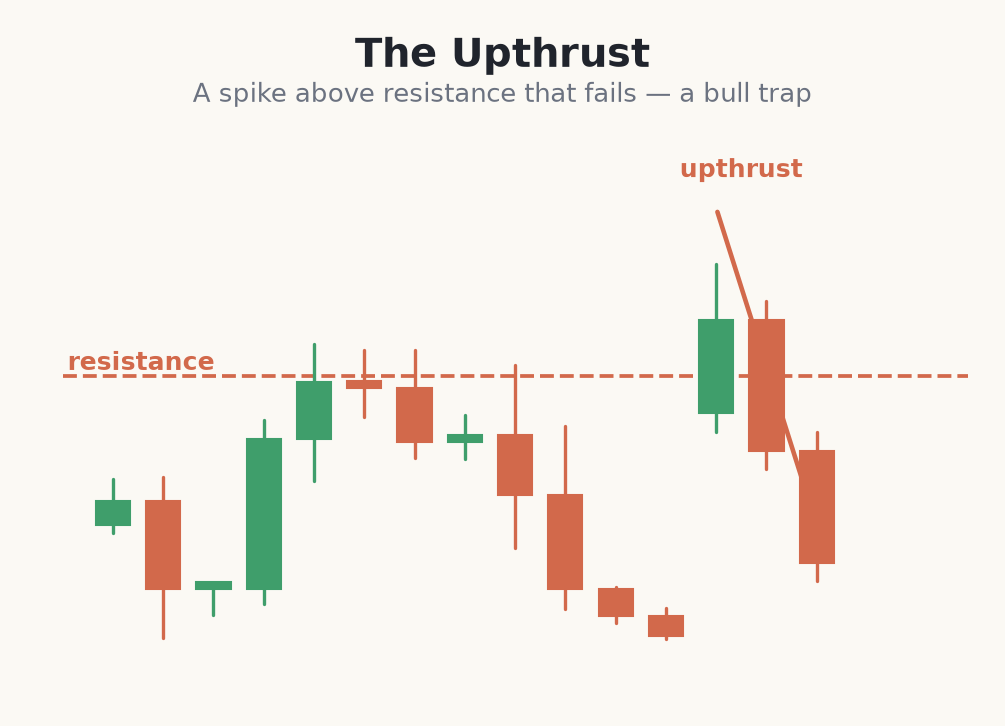
An upthrust is the mirror of a spring: a false break above resistance near the end of a distribution range. Price spikes above the obvious high, triggers breakout buyers and stops on shorts, then fails back into the range as supply overwhelms demand.
Why the upthrust works
The spike above resistance lures in eager buyers and lets the operator sell into that demand at premium prices. The quick failure back inside the range shows buyers could not sustain the breakout — an effort-versus-result signal that supply has taken control.
A powerful variant is the upthrust after distribution (UTAD), which occurs late in the range on a final push to new highs that promptly fails. The more decisively price rejects the breakout, the stronger the signal.
Entry and stop logic
Traders often enter short as price falls back below resistance, or on a weak rally that fails to reclaim it, and place the stop above the upthrust high. A close back above that high invalidates the setup — a clean, pre-defined risk boundary.
How to spot a genuine upthrust
A genuine upthrust appears at the end of a mature distribution range, spikes above resistance and then fails back inside decisively, ideally closing the bar below the old resistance. The most powerful version is the UTAD — a final push to a fresh high on thinning or climactic volume that promptly rejects. Watch for the weak retest: a bounce that fails on light volume below resistance is the last-point-of-supply short trigger.
Trading an upthrust with a defined stop
- 1A stock has distributed for weeks between €118 and €124 resistance. Price spikes to €126.50 on a volume surge, then closes the day back at €123 — below resistance.
- 2That is a candidate upthrust (UTAD). You wait for the weak retest: price bounces to €124.20 on light volume and stalls — a lower-high last point of supply.
- 3You short at €123.60 as the bounce fails and price rolls back below resistance.
- 4Stop above the upthrust high at €126.90. Risk = €3.30 per share — a close there means the breakout was real.
- 5Account €1,000, risk 1% = €10. €3.30 risk per share sizes to 3 shares (short). The €6 cause projects toward ~€117, roughly 2:1; a deeper markdown improves it.
- 6Rule: a daily close above €126.90 invalidates the upthrust and you cover — shorting new highs demands the stop do the work.
An upthrust is a failed breakout above resistance — enter short on the reclaim failure, with a stop above the upthrust high.
Common beginner mistakes with upthrusts
- Shorting the spike itself. Selling into the push above resistance before it fails is guessing — that breakout might be real. Wait for the failure back inside.
- Calling every break above resistance an upthrust. Many breakouts are genuine and run. An upthrust needs a decisive failure back inside; without it, respect the breakout.
- Placing the stop just above resistance. An upthrust is built to poke above resistance — a stop there gets swept. The stop belongs above the upthrust high.
- Underestimating shorting risk. Shorting a market that just made new highs into momentum is dangerous. Keep size small and the stop honest.
- Holding through the invalidation. 'It has to roll over' after a close back above the high is how a small planned loss becomes a large one. Cover when the setup is invalid.
A break above resistance can also be a real breakout, so an upthrust is only confirmed by the failure back inside. Because shorting a market that has just made new highs carries real risk, the stop and position size do the heavy lifting.