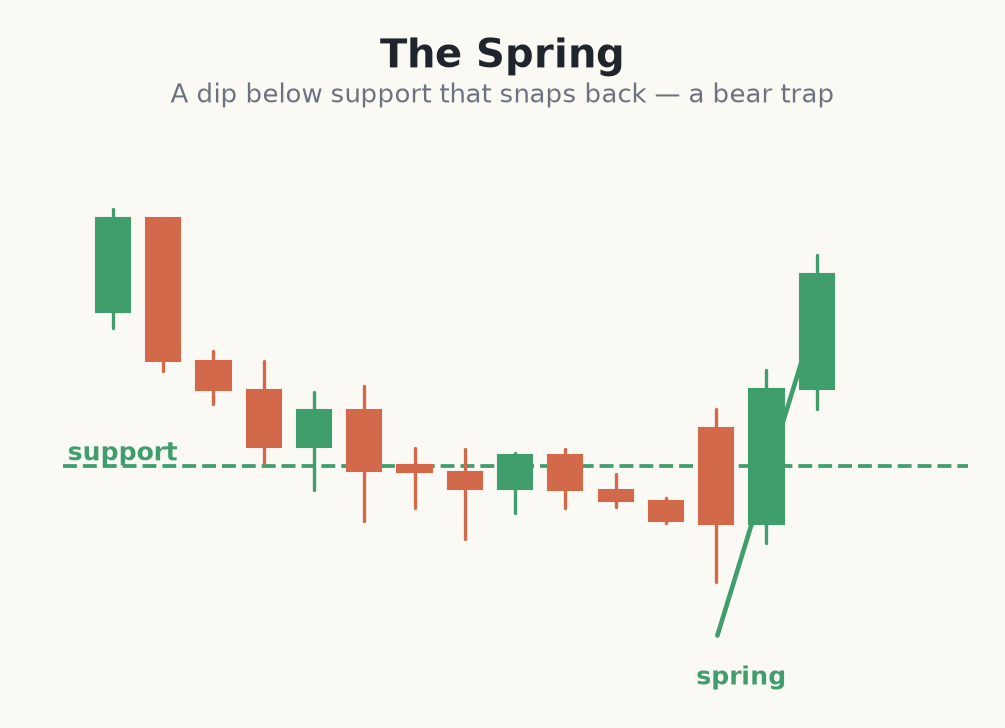
A spring is a false break below support at the end of an accumulation range. Price dips beneath the obvious low, triggers stops and tempts fresh shorts, then quickly recovers back into the range — trapping sellers as demand takes over.
Why the spring works
The dip below support flushes out the last weak holders and lets the composite operator absorb their supply cheaply. The fast recovery on strong demand shows sellers could not hold their advantage — a classic effort-versus-result tell that buyers are now in charge.
The best springs recover quickly and decisively, ideally on rising volume as price climbs back inside the range. A spring that is followed by a low-volume test which holds above the spring low is especially constructive.
Entry and stop logic
A common approach is to enter as price reclaims support, or on the successful test that follows, and to place the stop below the spring low. If price falls back beneath that low and stays there, the spring has failed and the setup is invalid — a clearly defined risk point.
How to spot a genuine spring
Not every dip below support is a spring. A genuine one has three features: it happens at the end of a mature accumulation range, not mid-chop; the recovery back inside is fast and decisive, ideally closing the bar back above support; and it is often followed by a low-volume test that holds above the spring low. Heavy volume on the stab down that gets absorbed, then thin volume on the test, is the classic effort-versus-result tell that supply is exhausted.
Trading a spring with a defined stop
- 1GBP/USD has accumulated for weeks between 1.2500 support and 1.2650 resistance. Price stabs down to 1.2465 — 35 pips below support — on a volume spike, then closes the bar back at 1.2510, inside the range.
- 2That is a candidate spring. You wait for the test: two bars later price dips to 1.2495 on thin volume and holds above the spring low. Supply is gone.
- 3You enter long at 1.2520 as price reclaims support with conviction.
- 4Stop below the spring low at 1.2450. Risk = 70 pips — a close there means the spring failed.
- 5Account €1,000, risk 1% = €10. A 70-pip stop sizes to about 0.014 lots so a full stop costs ~€10. Target the range top near 1.2650, ~130 pips, roughly 1.9:1; a run beyond it improves the ratio.
- 6Rule: a close back below 1.2450 invalidates the spring and you exit — no second-guessing.
A spring is a shakeout below support that recovers fast — enter on the reclaim or test, with a stop below the spring low.
Common beginner mistakes with springs
- Buying the stab down itself. Catching the dip below support before it recovers is guessing — that break might be a real breakdown. Wait for the reclaim or the test.
- Calling every break below support a spring. Plenty of supports just break and keep going. A spring needs a fast, decisive recovery back inside; without it, respect the breakdown.
- Placing the stop just under support. A spring is designed to poke below support — a stop there gets swept. The stop belongs below the spring low, giving the shakeout room.
- Ignoring the test. The low-volume test that holds is the highest-confidence entry. Skipping it for a faster fill often means worse odds.
- Over-sizing because it 'looks perfect'. The cleanest springs still fail. Risk the same fixed percentage; a failed spring must be a small, survivable loss.
Not every break below support is a spring; sometimes it is simply a genuine breakdown. That is precisely why the stop matters — the setup tells you exactly where it is wrong, and sizing keeps a failed spring small.