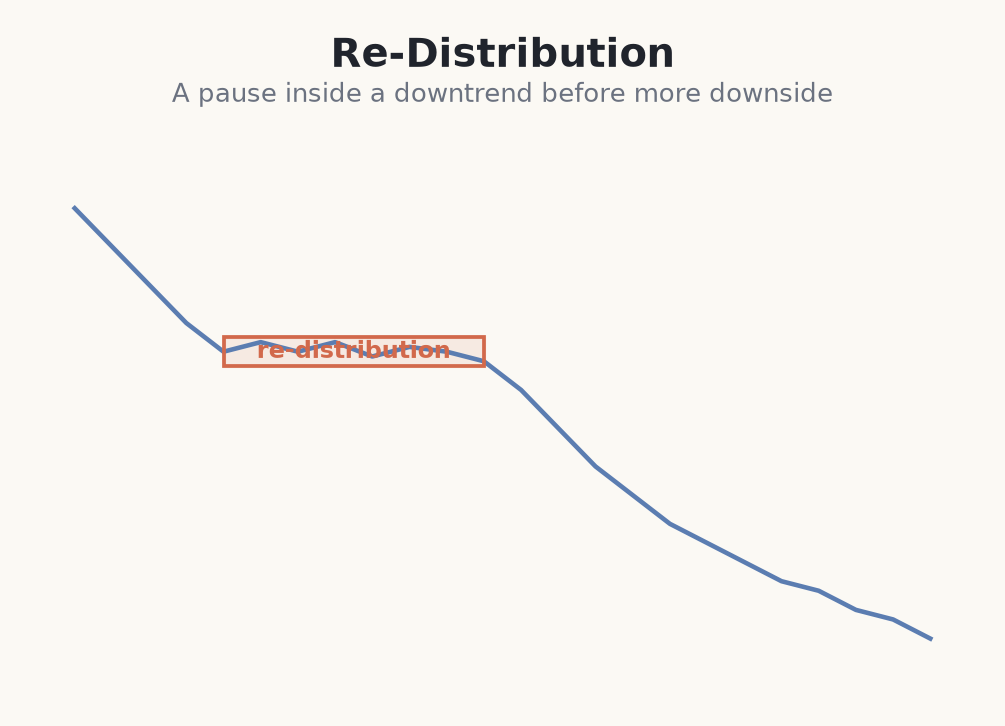
Re-distribution is the mirror of re-accumulation: a trading range that forms inside a downtrend. Price pauses and consolidates while supply is redistributed, then continues lower. It is a rest stop in a falling market, not a bottom.
Why it happens
After a sharp markdown, short-covering and bargain hunters create a pause. A re-distribution range lets sellers distribute into that demand and build the cause for another leg down. The surrounding downtrend is the clue that the pause is continuation rather than a genuine bottom.
Internally it behaves like distribution — rallies fade on weak volume, tests of the highs fail, and supply reasserts — but it forms below prior structure, with lower highs still intact on the larger view. That location tilts the odds toward more downside.
How to tell it from accumulation
A pause near lows could be re-distribution or a genuine bottom. Two clues help: context — an orderly downtrend with lower highs favours continuation, while a climactic, exhausted flush favours a bottom — and edge behaviour — rallies that fail on thin volume and stay below prior structure suggest re-distribution, while dips that get bought on shrinking volume and reclaim structure suggest accumulation. You never need certainty in advance; you let the range resolve and trade the confirmed direction.
How to trade the continuation
The cleanest re-distribution short is on the break and weak bounce out of the pause — a sign of weakness down out of the range, then a lower-high last point of supply that fails. Your stop goes above that bounce, and because the trade is with the larger downtrend the odds and reward-to-risk are often favourable. If the range instead reclaims its highs on strong demand, you stand aside — that is the accumulation outcome.
Trading a re-distribution continuation
- 1In a clear downtrend, a stock pauses and chops between €40.00 and €44.00 for two weeks. Rallies to €44.00 come on fading volume and fail — lower highs are intact.
- 2A wide down-bar breaks €40.00 to €39.20 on rising volume — a sign of weakness out of the pause. You wait for the bounce rather than chasing the break.
- 3Price bounces weakly to €39.90 on light volume and stalls below the old range floor — a last point of supply. You short at €39.80.
- 4Stop above the LPSY at €41.00. Risk = €1.20 per share — a close there means the continuation read failed.
- 5Account €1,000, risk 1% = €10. €1.20 risk per share sizes to 8 shares (short). The €4 cause projects toward ~€36, roughly 3.2:1.
- 6If price instead reclaims €44.00 on strong demand, the pause was a bottom — you never entered, and you stand aside.
Re-distribution is distribution inside a downtrend — a pause that stores fuel for the next leg down.
Common beginner mistakes with re-distribution
- Assuming more downside because 'the trend is down'. Downtrends end. A pause after a climactic flush can be the bottom, not a rest stop — read the edges first.
- Shorting before the break confirms. Selling deep inside the pause on faith is guessing. Wait for the sign of weakness and the last-point-of-supply bounce.
- Ignoring a reclaim of the range highs. If the pause pushes back above its ceiling on strong demand, that is the accumulation outcome. Drop the bearish read.
- Catching the falling knife instead. Buying a 'cheap' level inside a downtrend pause because it looks oversold fights the trend and the read. Trade with the direction that confirms.
- Over-sizing a short that 'can't bounce'. Bounces in downtrends can be violent. Risk the same fixed percentage and keep the stop above the structure.
As with its bullish twin, re-distribution can look just like accumulation in real time. If the range starts reclaiming prior swing highs on strong demand, be willing to abandon the bearish read. Wait for confirmation before committing to continuation.