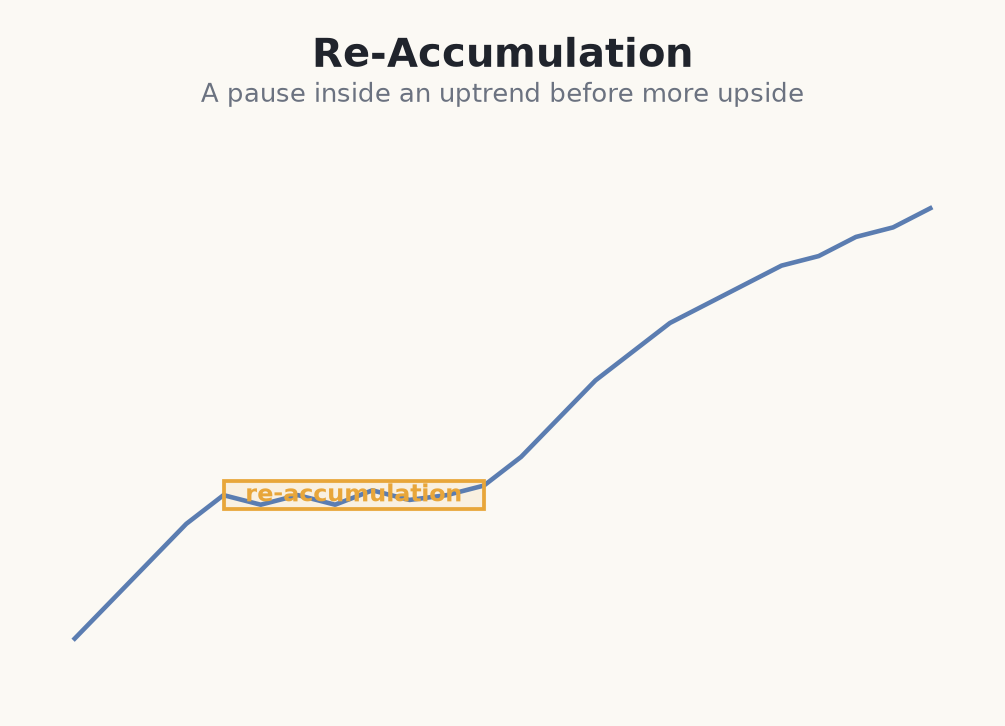
Re-accumulation is a trading range that forms inside an uptrend rather than at a bottom. Price pauses, consolidates, and absorbs profit-taking before resuming higher. It is a rest stop, not a reversal.
Why it happens
After a strong markup, some holders take profits and new buyers hesitate at higher prices. A re-accumulation range lets demand absorb that supply and build a fresh cause for the next leg up. The prior trend context is the key clue that a range is continuation rather than a top.
The internal behaviour looks like accumulation — drying volume on dips, tests that hold, and eventual signs of strength — but it occurs above prior structure, with higher lows still intact on the larger view. That location tilts the odds toward continuation.
How to tell it from distribution
The honest problem is that a pause near highs could be re-accumulation or a top. Two clues tilt the odds: first, context — a healthy uptrend with higher lows favours continuation, while a climactic, over-extended run favours a top. Second, behaviour at the range edges — dips that get bought on shrinking volume and hold above prior structure suggest re-accumulation, while rallies that fail on thinning volume and lower highs suggest distribution. You do not need to be certain in advance; you let the range resolve and trade the confirmation.
How to trade the continuation
The cleanest re-accumulation entry is on the break and pullback out of the pause — a sign of strength up out of the range, then a higher-low last point of support that holds. Your stop goes below that pullback, and because the trade is with the larger trend the odds and the reward-to-risk are often favourable. If instead the range breaks its lows on strong supply, you stand aside — that is the distribution outcome and the read was wrong.
Trading a re-accumulation continuation
- 1In a clear uptrend, EUR/USD pauses and chops between 1.0900 and 1.0980 for two weeks. Dips to 1.0900 come on lighter volume and hold — the prior higher lows are intact.
- 2A wide up-bar breaks 1.0980 to 1.1010 on rising volume — a sign of strength out of the pause. You wait for the pullback rather than chasing.
- 3Price eases back to 1.0990 and holds above the old range top — a last point of support. You enter long at 1.0995.
- 4Stop below the LPS at 1.0955. Risk = 40 pips — a close there means the continuation read failed.
- 5Account €1,000, risk 1% = €10. A 40-pip stop sizes to about 0.025 lots. Target the next leg near 1.1100, ~105 pips, roughly 2.6:1.
- 6If price instead breaks 1.0900 on strong supply, the pause was a top — you never entered, and you stand aside.
Re-accumulation is accumulation inside an uptrend — a pause that stores fuel for the next leg up.
Common beginner mistakes with re-accumulation
- Assuming continuation because 'the trend is up'. Trends end. A pause after a climactic run can be the top, not a rest stop — read the edges before you commit.
- Entering before the break confirms. Buying deep inside the pause on faith is guessing. Wait for the sign of strength and the last-point-of-support pullback.
- Ignoring a break of the range lows. If the pause cracks its floor on strong supply, that is the distribution outcome. Respect it instead of hoping it recovers.
- Placing the stop too tight inside the noise. A stop inside the range's chop gets clipped by normal wiggle. Put it below the structure the trade actually relies on.
- Over-sizing because the trend 'feels safe'. Continuation trades fail too. Risk the same fixed percentage regardless of how confident the trend makes you feel.
The honest difficulty is that re-accumulation and distribution can be indistinguishable early on. If the range starts breaking prior swing lows on strong supply, respect that it may be a top instead. Let the range resolve and confirm before assuming continuation.