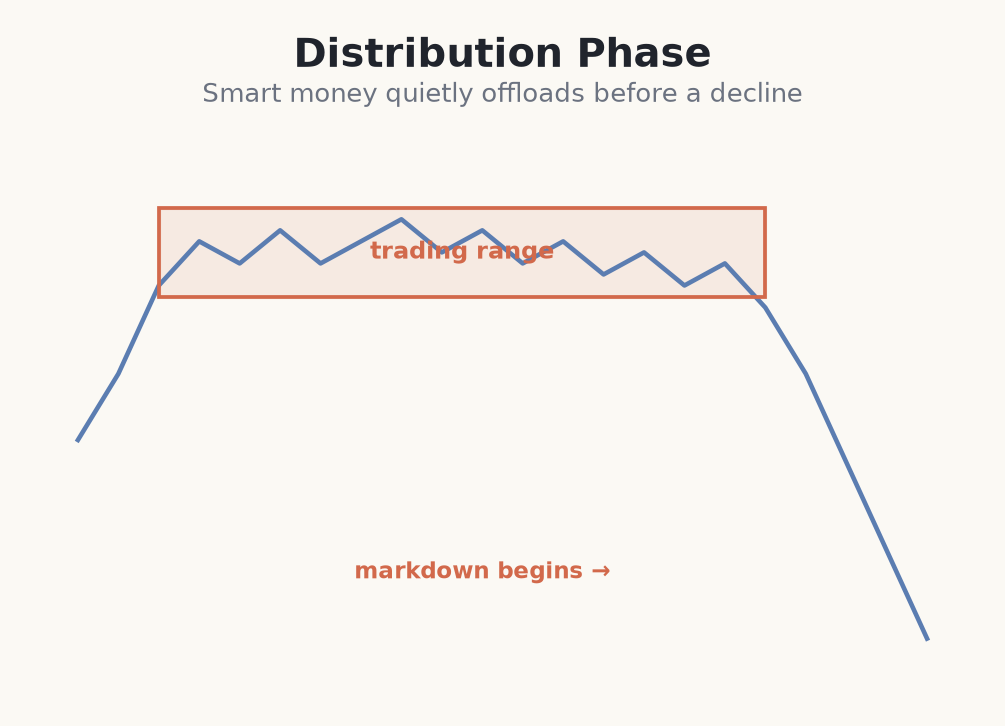
Distribution is the mirror of accumulation: a sideways range after an uptrend where large holdings are sold into strength near the highs. The composite operator unloads into eager buyers without collapsing price too soon.
What it looks like
Distribution often opens with a buying climax — a sharp, high-volume surge as the crowd chases the top — followed by a sell-off and repeated tests of the highs. As the range matures, upward pushes fail to extend, revealing that supply is meeting every attempt to rally.
Watch for rallies to the top of the range on weakening volume and reversals on strong volume. When declines within the range begin to look more forceful than the rallies, the balance is tipping toward sellers and a markdown may be approaching.
- Follows an uptrend, often after a climactic surge.
- Price chops sideways as selling meets incoming demand.
- Pushes to resistance lose momentum and volume.
- Late-stage declines widen while rallies narrow.
How to spot the phase progressing
Like accumulation in reverse, distribution unfolds as a sequence. A buying climax and automatic reaction define the range; secondary tests probe the highs on lighter volume; an upthrust may trap the last buyers; then a sign of weakness breaks the range low. Watch for each rally to achieve less than the last — narrower up-bars, thinner volume, lower highs creeping in — while declines start travelling further. When the range floor gives way on wide, high-volume down-bars, the phase is resolving down.
How to use distribution in a trade
You do not short just because a range 'looks toppy' — you wait for a confirming event. The lower-risk shorts are on a failed upthrust test or on the weak bounce after a sign of weakness (the last point of supply), with a stop above the level that would prove the read wrong. Shorting a market that has been rising carries real risk, so the stop and position size do the heavy lifting.
Shorting the last point of supply after distribution
- 1A stock chops for eight weeks between €88.00 and €94.00 after a long rally. Pushes to €94.00 come on fading volume — buyers are thinning.
- 2A wide down-bar breaks €88.00 to €86.80 on volume well above average — a sign of weakness flipping structure down. You do not chase it.
- 3Price bounces weakly to €87.60 on light volume and stalls below the old range floor — a lower high, the last point of supply. You short there.
- 4Stop above the LPSY at €89.10. Risk = €1.50 per share — a close there means supply did not win.
- 5Account €1,000, risk 1% = €10. €1.50 risk per share sizes to 6 shares (short). The €6 cause projects toward ~€82, roughly 3.7:1.
- 6Discipline: a daily close above €89.10 and you cover — no holding a short that has reclaimed the range.
Distribution is a range where buying is absorbed near the highs — the quiet groundwork for a later markdown.
Common beginner mistakes with distribution
- Calling every high a top. Ranges near highs resolve up as often as down. It is only distribution once weakness confirms it — until then it's a candidate.
- Shorting inside the range with no event. Picking a spot in the chop and shorting is guessing against a market that was recently rising. Wait for an upthrust or sign of weakness.
- Chasing the sign-of-weakness bar. Selling the wide breakdown bar puts your stop far away. The LPSY bounce offers a tighter, cheaper short.
- Confusing it with re-accumulation. A pause near highs can store fuel for another leg up. If it reclaims the highs on strong demand, drop the bearish read.
- Adding to a losing short as price rises. 'It has to top eventually' has blown up many accounts. Honour the stop; a range that keeps making highs is not distributing.
Distribution and re-accumulation can look almost identical in real time, and a suspected top may simply resolve upward. Never assume a range is distribution until a sign of weakness and a failed test confirm supply has won.