Accumulation is a sideways trading range that forms after a decline, where supply is being absorbed near the lows. The composite operator buys patiently from discouraged sellers, building a position without pushing price up prematurely.
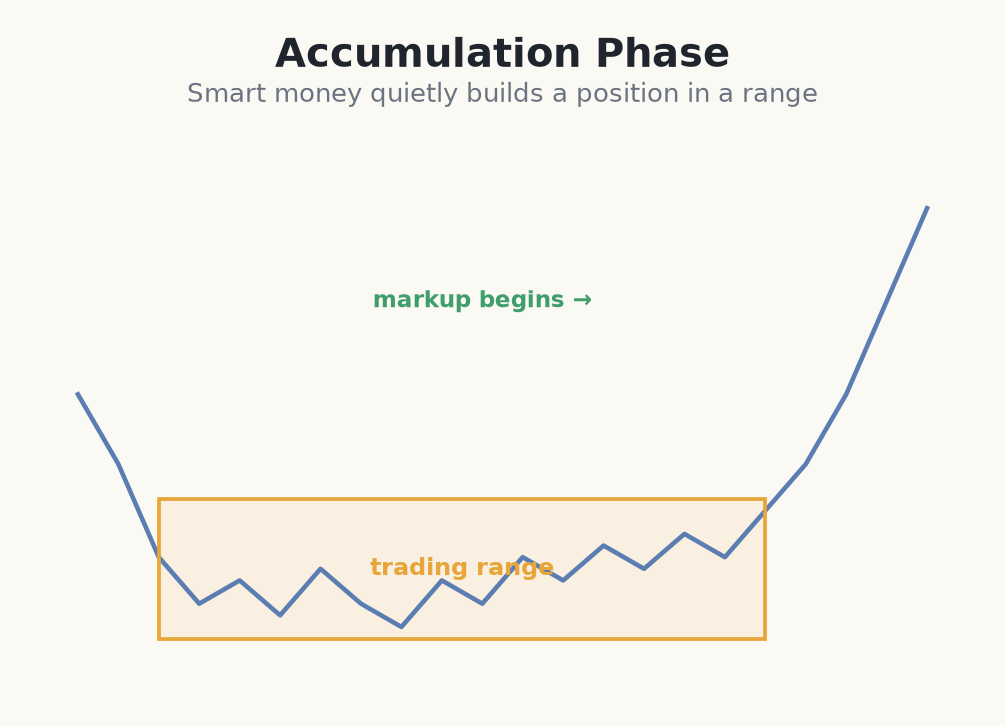
What it looks like
The range often begins with a selling climax — a sharp, high-volume drop as panicked holders capitulate — followed by a bounce and a period of testing the lows. Over time, downward pushes lose force and the lows stop making progress, hinting that demand is quietly overtaking supply.
A telltale sign is drying-up volume on dips into support: fewer sellers remain to be absorbed. Later in the range, rallies begin to show more strength than declines, another clue that the balance is shifting toward buyers.
- Follows a downtrend, often after a climactic sell-off.
- Price chops sideways as buying absorbs supply.
- Dips into support show diminishing volume and downside progress.
- Late-stage rallies widen while declines narrow.
How to spot the phase progressing
Accumulation reveals itself as a sequence, not a single moment. The selling climax and automatic rally define the range; secondary tests probe the lows on lighter volume; a spring may shake out the last sellers; then a sign of strength breaks the range top. You are looking for evidence that each dip matters less than the last — narrower down-bars, thinner volume, higher lows creeping in — while rallies begin to travel further. When the range top finally gives way on wide, high-volume bars, the phase is resolving up.
How to use accumulation in a trade
You do not buy just because a range 'looks like accumulation' — you wait for a confirming event. The lower-risk entries are on a successful spring test or on the pullback after a sign of strength (the last point of support), with a stop below the level that would prove the phase read wrong. The range gives you context and a natural stop location; the event gives you the trigger; sizing keeps a failed read small.
Buying the last point of support after accumulation
- 1A stock spends nine weeks basing between €24.00 and €27.00 after a long decline. Dips to €24.00 come on shrinking volume — supply is drying up.
- 2A wide bar breaks €27.00 to €27.80 on volume well above average — a sign of strength flipping structure up. You do not chase it.
- 3Price eases back to €27.20 and holds above the old range top on light volume — a higher low, the last point of support. You buy there.
- 4Stop below the LPS at €26.30. Risk = €0.90 per share — a close there means the markup read failed.
- 5Account €1,000, risk 1% = €10. €0.90 risk per share sizes to 11 shares (≈€299). The cause (a €3 base) projects toward ~€30, roughly 3:1.
- 6Discipline: a daily close under €26.30 and you are out — no adding to the position hoping the base holds.
Accumulation is a range where selling is absorbed near the lows — the quiet groundwork for a later markup.
Common beginner mistakes with accumulation
- Calling every low a bottom. Most sideways stretches after a decline just break lower. A range is only accumulation once strength confirms it — until then it's a candidate.
- Buying inside the range with no event. Picking a spot in the middle of the chop is guessing. Wait for a spring test or a sign of strength before committing.
- Chasing the sign-of-strength bar. Buying the wide breakout bar puts your stop miles away. The LPS pullback offers a tighter, cheaper entry.
- Ignoring that it might be redistribution. A range near a low can be distribution before more downside. If it breaks the lows on strong supply, respect that.
- Averaging down when the base breaks. Adding to a losing 'accumulation' trade as it fails is how a small planned loss becomes an account-threatening one. Honour the stop.
Not every range is accumulation. Many sideways stretches simply break lower, and a range that looks like a bottom can be redistribution before more downside. Wait for confirmation — a sign of strength and a successful test — before assuming the low is in.