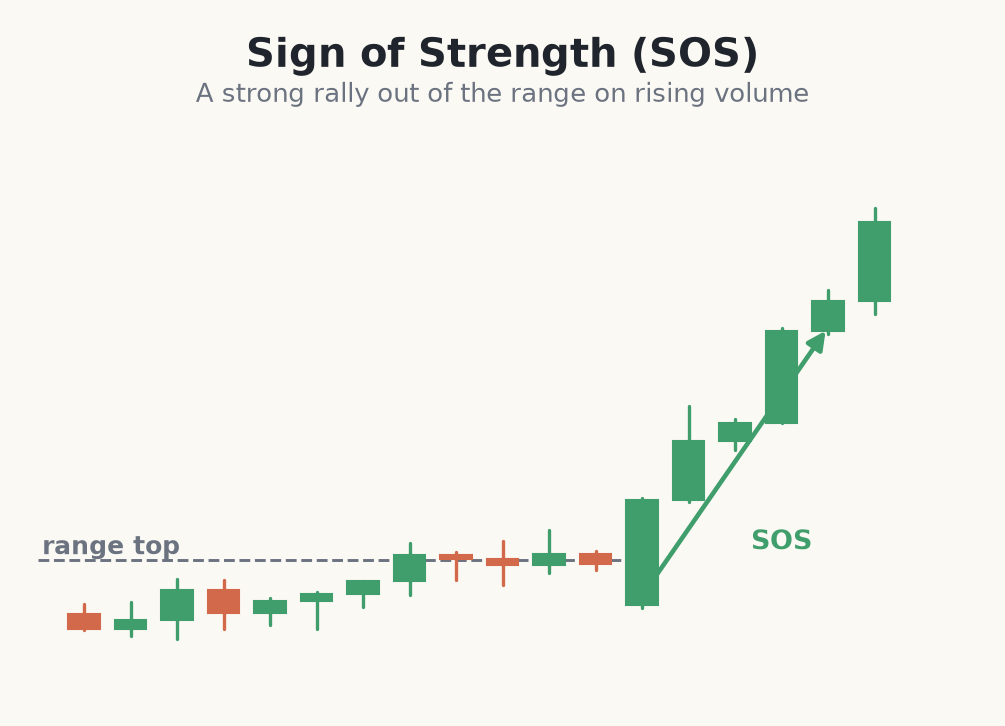
A sign of strength, or SOS, is a decisive rally out of an accumulation range on expanding volume and wide up-candles. It is the market confirming that demand has finally overpowered supply after the range did its absorbing work.
What makes it convincing
A genuine SOS shows effort matching result: strong volume and wide spread carrying price clearly above the range highs, with little overhead resistance able to stop it. The move usually breaks prior swing highs, flipping structure from sideways to up.
The pullback after an SOS is often called the last point of support (LPS) — a higher low that holds above the breakout on lighter volume. That pullback frequently offers a lower-risk entry than chasing the initial thrust.
How to trade the LPS instead of the breakout
Chasing the SOS bar means buying an extended candle with your stop far below — poor reward-to-risk. The disciplined play is to wait for the LPS: the first pullback that holds above the broken range top on thinning volume. You buy there with a stop just below the higher low, which sits much closer than a stop under the whole range. Same idea, tighter risk, and the market has already proven demand won by breaking out.
Buying the last point of support after an SOS
- 1A stock accumulates between €30 and €33. A wide bar breaks €33 to €34.20 on volume triple the average — a clear sign of strength. You do not chase it.
- 2Price pulls back over the next few days to €33.30 on light volume and holds above the old range top — the last point of support, a higher low.
- 3You enter long at €33.40 as the pullback stalls and turns up.
- 4Stop below the LPS at €32.60. Risk = €0.80 per share — a close there means the breakout is failing.
- 5Account €1,000, risk 1% = €10. €0.80 risk per share sizes to 12 shares (≈€401). The €3 cause projects toward ~€36, roughly 3.25:1.
- 6Rule: a daily close under €32.60 and you exit — an SOS confirms strength but never guarantees the trend continues.
A sign of strength is a wide, high-volume rally out of the range — demand confirming the start of a possible markup.
Common beginner mistakes with the sign of strength
- Chasing the breakout bar. Buying the wide SOS candle puts your stop far below and buys the high tick. The LPS pullback offers a tighter, cheaper entry.
- Accepting a low-volume 'SOS'. A break that lacks expanding volume and wide spread is weak and prone to failing back into the range. Demand the effort.
- Trusting the SOS to guarantee a trend. Breakouts still fail and turn into upthrusts. An SOS shifts odds; it does not remove the need for a stop.
- Missing that the LPS must hold. If the pullback slices back into the range on strong volume, the breakout is failing — that is not a dip to buy, it's a reason to stand aside.
- Ignoring the higher-timeframe context. An SOS against a strong higher-timeframe downtrend is lower-odds. Prefer breakouts that agree with the bigger picture.
An SOS confirms strength but does not guarantee a lasting trend; breakouts still fail and can turn into upthrusts. Prefer entries on the LPS with a stop below it, and let the market prove continuation rather than assuming it.