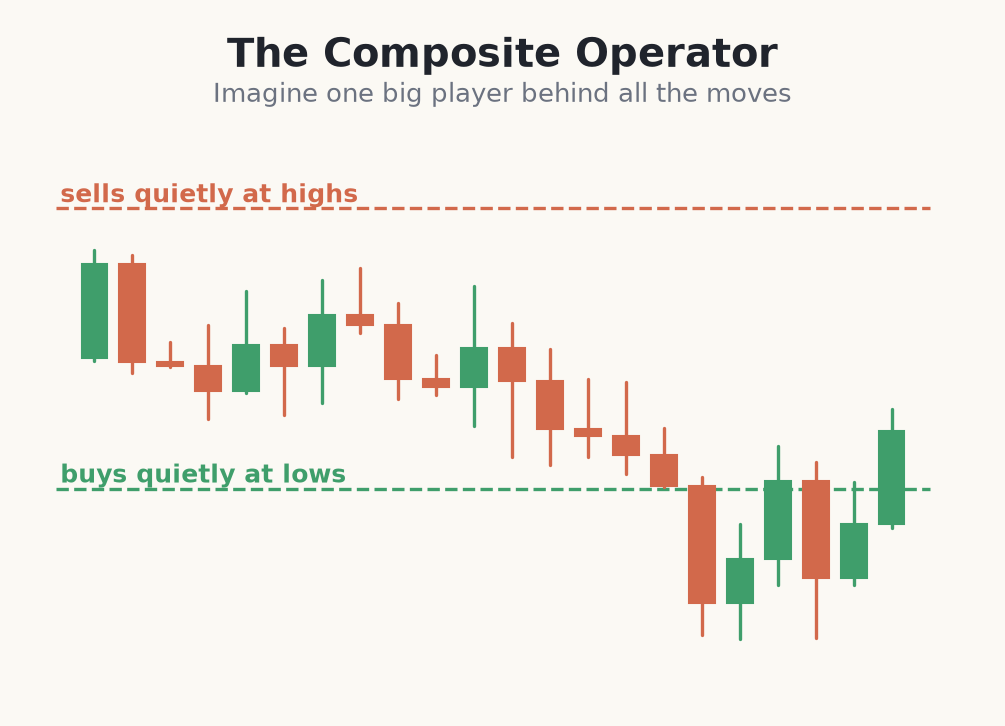
Wyckoff suggested imagining that all the large, informed money in a market acts as a single composite operator. This is a mental model, not a literal conspiracy — but thinking this way helps you interpret ranges as deliberate campaigns rather than noise.
How the operator behaves
The composite operator wants to buy low and sell high in size. Because large orders move price, they cannot simply buy everything at once — they must accumulate patiently in a range where the public is fearful, then distribute into a range where the public is greedy.
This is why ranges matter so much in Wyckoff. A sideways market is where a big position is quietly built or unloaded without alarming the crowd. Sharp shakeouts and false breaks are read as the operator absorbing supply or triggering stops before the real move.
- Accumulate cheaply while sentiment is negative.
- Mark price up once enough supply has been absorbed.
- Distribute into strength while sentiment is euphoric.
- Mark price down once holdings are gone.
How to spot the operator's footprints
You never see the operator directly, but the campaign leaves tells on the chart. Sharp shakeouts that immediately reverse, high-volume down-bars that fail to make new lows, and rallies that meet a wall of selling at the same price again and again are all footprints of large hands working. The key question to ask at every suspicious move is simple: who benefits? A stop-run below support that snaps back benefits a buyer absorbing panic; a spike to new highs that fails benefits a seller unloading into greed.
How to use the lens without abusing it
The operator model is useful when it makes you patient and structured — waiting for the campaign to reveal itself before you act. It is dangerous when it turns into a story you cannot falsify, where every move 'proves' the operator is doing something. Keep the lens honest by always pairing it with a defined invalidation: if price does X, the campaign read is wrong and you exit. The model should sharpen your reading, never replace your stop.
Using the operator lens to interpret a shakeout
- 1GBP/USD has chopped sideways for three weeks between 1.2600 support and 1.2750 resistance after a long decline. You suspect an operator is accumulating.
- 2Price suddenly stabs down to 1.2560 — 40 pips below support — on a spike of volume, then closes the day back at 1.2620, inside the range. You ask who benefits: a big buyer just absorbed every panic sell below support.
- 3You wait for a low-volume test. Two days later price dips to 1.2595 on thin volume and holds — supply is gone. You enter long at 1.2615.
- 4Stop goes below the shakeout low at 1.2545 — if price returns there the operator read was wrong. Risk = 70 pips.
- 5Account €1,000, risk 1% = €10. A 70-pip stop means about 0.014 lots so a full stop costs ~€10. Target the range top and beyond near 1.2800, roughly 2.6:1.
- 6Discipline: a close back under 1.2545 and you are out, no story about 'the operator shaking harder' allowed to keep you in.
The composite operator is a thinking tool — imagine one informed hand behind the range and ask what it is trying to achieve.
Common beginner mistakes with the composite operator
- Believing in a literal cartel. There is no single villain moving your chart. The operator is a simplifying lens for many large participants acting alike — treating it as a real conspiracy leads to paranoid, unfalsifiable reads.
- Explaining every candle away. If every move 'proves' the operator's plan, the model has stopped helping. A read you cannot be wrong about is worthless.
- Assuming smart money always wins. Large operators get trapped too. A shakeout can keep going; absorption can fail. The lens tilts odds, it does not remove them.
- Ignoring the invalidation. 'The operator is just shaking harder' is how traders talk themselves out of stops. Define where the campaign read is wrong and honour it.
- Front-running the campaign. Buying deep in a range because 'someone must be accumulating' is guessing. Wait for the footprints — shakeout, test, sign of strength — before committing.
Treat the operator as a working hypothesis, not a fact. It is valuable when it makes you ask who benefits from a move; it is dangerous if it makes you invent intentions that the chart does not actually support.