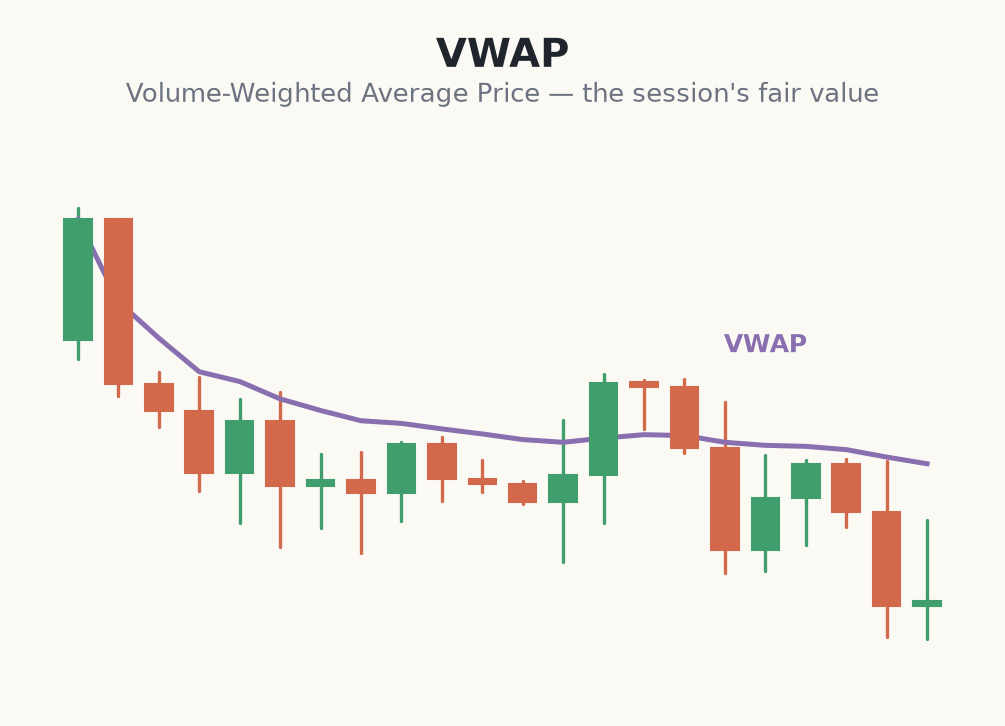
VWAP stands for volume-weighted average price. Unlike a simple moving average, which just averages closing prices, VWAP weights each price by the volume traded there — so a price that saw heavy trading counts far more than one that saw little. The result reflects the average price the market actually paid during the session, the level around which most business was done.
That makes VWAP a widely watched fair-value benchmark. Large institutions use it to judge whether their fills beat or missed the day's average, and many are literally measured against it. Because so much real money references the line, it attracts genuine attention and can influence how price behaves around it — a rare case where a tool matters partly because everyone watches it.
Reading VWAP
The simplest read is directional. Price trading above VWAP means buyers are paying more than the session average — a bullish lean; price below VWAP is the opposite. The slope of the line adds context: a rising VWAP supports longs, a flat VWAP suggests balance, and a falling one supports shorts. Combined, side and slope give you a quick bias in one glance.
Entry and stop logic
A common intraday approach is the VWAP pullback: in an uptrend that holds above VWAP, wait for price to dip back to the line, look for buyers returning, and enter with a stop just below VWAP. If price closes decisively on the other side of the line, the fair-value read has flipped and the trade is invalid — a clean, pre-defined point of failure.
- <strong>VWAP weights price</strong> by volume — the session's true average.
- <strong>Above VWAP leans</strong> bullish; below leans bearish.
- <strong>The slope adds</strong> context — rising supports longs, falling supports shorts.
- <strong>Pullbacks to VWAP</strong> in a trend can offer defined-risk entries.
- <strong>A decisive cross</strong> invalidates the idea — stop just beyond the line.
Trading a VWAP pullback long
- 1On the 5-minute S&P 500 futures chart, price has been trending up and holding above a rising VWAP all session — a clean bullish bias.
- 2Price pulls back down to the VWAP line, currently at 5,312. You wait for proof rather than buying the touch.
- 3A bullish rejection candle forms right on the line, closing back up at 5,316 — buyers stepping in at fair value. You enter long there.
- 4Your stop goes just below VWAP at 5,305; a decisive close below flips the fair-value read. Risk = 11 points.
- 5Account $15,000, risking 1% = $150. On the E-mini at $50 per point, 11 points = $550 per contract, so you trade the micro ($5/point): 11 points = $55, size ~2 micros ≈ $110 risk.
- 6You target the prior session high near 5,344, ~28 points away — about 2.5:1. Entry 5,316, stop 5,305, all fixed before the click.
Common mistakes trading VWAP
- Buying the touch with no confirmation. A dip to VWAP is a decision point, not a signal. Wait for buyers to actually show up before entering.
- Using VWAP across sessions. VWAP resets each day, so it is an intraday tool. Carrying yesterday's line into today reads a benchmark that no longer means anything.
- Trading VWAP in chop. In a rangey, directionless market price whipsaws across the line repeatedly. VWAP pullbacks work best in trending or orderly conditions.
- Placing the stop right on the line. Price commonly pokes across VWAP before resuming. Give the stop a little room beyond, not exactly on it.
- Treating a touch as a guaranteed turn. VWAP is a magnet and benchmark, not a wall. Pair it with structure and never bet the account on the line alone.
VWAP is the volume-weighted fair price of the session — a benchmark for bias and pullback entries, best used with structure and honest stops.
VWAP resets each session, so it is mainly an intraday tool. It works best in trending or orderly conditions and can whipsaw in choppy markets, so pair it with structure and never treat a touch of the line as a guaranteed turn. The next module shows how to keep VWAP running past a single session by anchoring it to an event.