A low volume node, or LVN, is a valley on the volume profile — a price level where very little trading took place. It marks an area the market rejected, passing through quickly because few participants wanted to transact there. Where an HVN is a thick, sticky band, an LVN is a thin gap in the profile.
LVNs are the mirror image of high volume nodes. Where an HVN slows price, an LVN accelerates it: because there is little resting interest, price can travel through a low volume gap fast, with few counterparties to absorb the move. That is why a market can look like it 'jumps' across certain prices — it is crossing an LVN with nothing to slow it down.
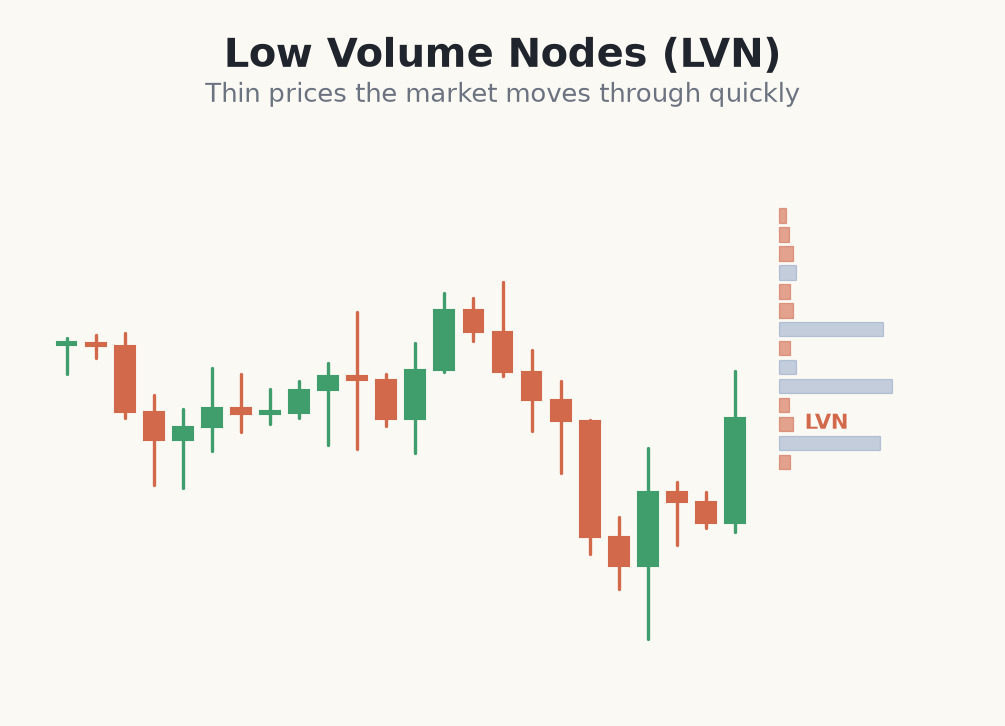
Two ways traders use LVNs
First, as rejection edges: the boundary between an HVN and an adjacent LVN often acts as support or resistance, because it separates a zone of agreement from a zone of disinterest. Price stalling at that edge can offer an entry with a stop just inside the low volume gap, since crossing into the void means the edge failed.
Second, as fast-travel zones: once price enters an LVN with momentum, it can move quickly to the next high volume node. Some traders target the far side of a low volume area rather than fading inside it, since fading a thin zone offers little support — there is simply nothing there to lean on if the trade goes wrong.
- <strong>LVN = a volume valley</strong>, a price the market rejected.
- <strong>Price tends to move</strong> through low volume areas quickly.
- <strong>The edge between</strong> an HVN and LVN often acts as support or resistance.
- <strong>Consider targeting</strong> the next HVN across a low volume gap.
- <strong>Do not fade</strong> inside a thin zone — there is nothing to support the trade.
Targeting the next HVN across an LVN
- 1On the 15-minute EUR/USD chart, the profile shows an HVN at 1.0850, a thin LVN from 1.0855 to 1.0885, then another HVN at 1.0890.
- 2Price breaks up out of the lower HVN on expanding volume and pushes into the LVN — the thin zone where little trading happened.
- 3You enter long at 1.0858 as price enters the gap, reasoning that with few counterparties inside it, price should travel quickly to the next node.
- 4Your stop goes back inside the lower HVN at 1.0844 — a return there means the breakout failed. Risk = 14 pips.
- 5Account €4,000, risking 1% = €40. On a 14-pip stop that sizes to about 0.28 lots (≈€2.80 per pip) so a full stop costs ~€40.
- 6You target the upper HVN at 1.0890, ~32 pips away — about 2.3:1. The LVN is the fast-travel zone; the HVN above is the natural target where price slows.
Common mistakes trading low volume nodes
- Fading inside the gap. An LVN offers no support to lean on. Taking a countertrend trade in the middle of a thin zone is a fast way to get run over.
- Setting targets inside the LVN. Price rushes through the void — it slows at the next HVN. Aim for the node beyond the gap, not the middle of it.
- Placing the stop in the void. A stop inside a thin zone gives price room to whip. Anchor it to the adjacent HVN edge instead.
- Ignoring momentum. LVNs accelerate price only when there is momentum behind the entry. A tired push into the gap can stall rather than fly.
- Forgetting the profile can change. As the market trades, today's LVN can fill in and become an HVN. Re-read the profile as it develops.
Low volume nodes are the market's no-man's-land — thin areas price rushes through, with the strongest reactions at their edges.
Together, HVNs and LVNs turn a static profile into a dynamic map: nodes where price sticks, gaps where it flies, and edges where reactions happen. Read them as a pair and you can anticipate the rhythm of a move before it unfolds.