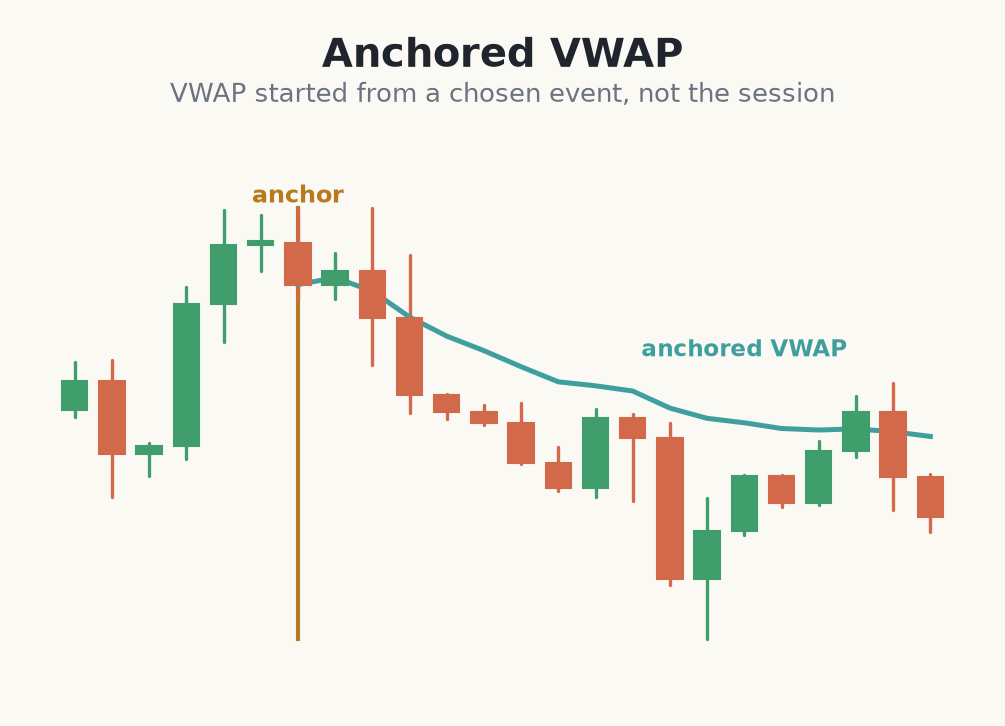
Anchored VWAP is the same volume-weighted average, but instead of resetting each session it starts from a point you choose. You anchor it to a meaningful event and it then measures the average price everyone has paid since that moment.
The power is in the anchor. Because it is tied to a specific event, an anchored VWAP tells you whether participants who acted since that event are, on average, in profit or in loss — which shapes how they may behave when price returns to the line.
Where to anchor
- A significant swing high or swing low.
- A major news release or earnings event.
- The start of a clear breakout or trend.
- The session or week's open for a cleaner reference.
Anchored from a swing low, the line often acts as dynamic support while an uptrend holds, because buyers since the low are collectively in profit and inclined to defend it. Anchored from a high, it can act as resistance in the same way for trapped buyers who are underwater and eager to exit at breakeven when price returns.
Use it as a reference, not a rule. A well-chosen anchor gives a meaningful line; a random one gives noise. As with any tool, wait for price to react at the line and confirm before acting, and place stops beyond it. The quality of an anchored VWAP is only ever as good as the quality of the event you anchored it to.
Anchoring a VWAP to a swing low for support
- 1On the daily Bitcoin chart, price made a clear swing low at 58,000 after a sell-off. You anchor a VWAP to that low candle.
- 2Over the next weeks price rallies, and the anchored VWAP climbs beneath it — everyone who bought since the low is on average in profit and inclined to defend the line.
- 3Price pulls back to the anchored VWAP, now at 63,500. You wait for proof and get a bullish rejection candle closing at 63,900.
- 4You enter long at 64,000. Your stop goes below the anchored line at 62,600 — a decisive break means buyers-since-the-low have given up. Risk = 1,400 points.
- 5Account $20,000, risking 1% = $200. On a spot position that sizes to about 0.14 BTC (1,400 × 0.14 ≈ $196) so a full stop costs ~$196.
- 6You target the prior high near 71,000, ~7,000 points away — roughly 5:1. The anchor gave the level; the rejection candle gave the trigger.
Common mistakes with anchored VWAP
- Anchoring to a random candle. The whole tool depends on the anchor being meaningful — a real swing, news event, or breakout. A random start point produces a meaningless line.
- Buying the touch with no reaction. Like session VWAP, a touch is a decision point. Wait for price to actually react at the line before committing.
- Anchoring too many at once. Ten anchored VWAPs turn the chart into spaghetti. Keep one or two anchored to the events that genuinely matter.
- Ignoring the trend context. An anchored VWAP acts as support only while the trend from the anchor holds. In a reversal, price slices through it.
- Placing the stop on the line. Price often pokes across the anchored line before resuming. Put the stop clearly beyond it, not exactly on it.
Anchored VWAP measures the average price paid since an event you choose — a powerful reference only when the anchor itself is meaningful.