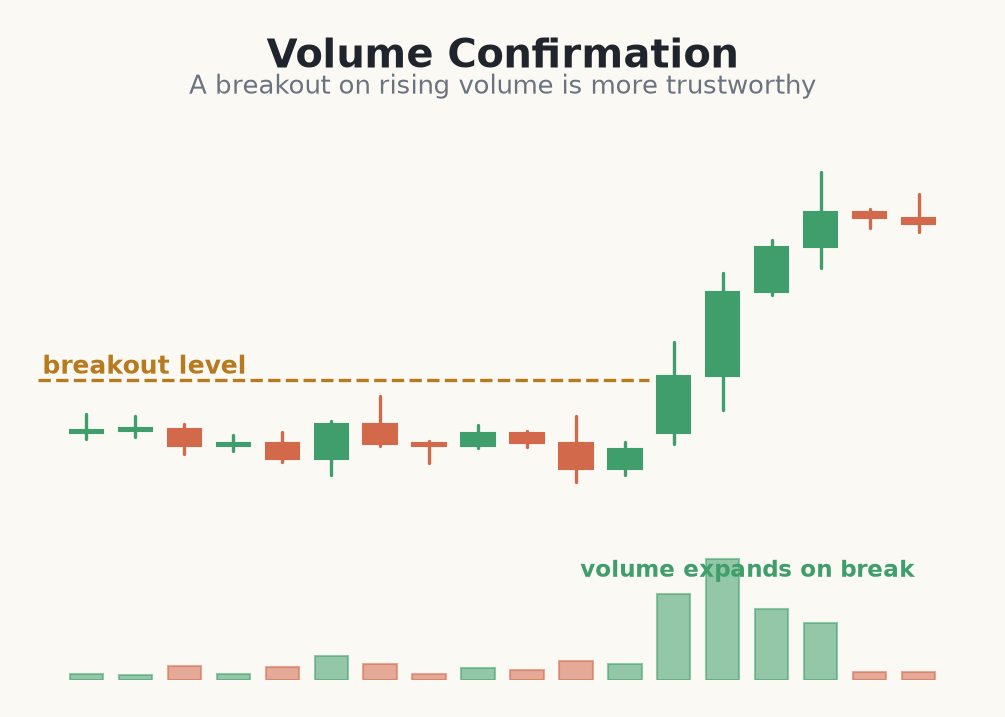
Volume confirmation is the practical heart of volume trading: using volume to judge whether a price move is real or hollow. A breakout backed by a surge in volume shows broad participation; the same breakout on thin volume is often a trap. It is the single filter that turns everything earlier in this course into a usable trading edge.
The logic is simple. For price to break a well-watched level and keep going, it needs fresh buyers or sellers stepping in. Expanding volume is the footprint of that fresh participation; flat or falling volume suggests only a few orders pushed price through, and the move may quickly reverse once they are done. Volume tells you whether the crowd came along.
Entry and stop logic
One honest approach: only take a breakout when the breakout candle shows clearly expanding volume versus recent bars. Enter on the close beyond the level or on a volume-backed retest, and place your stop back inside the range — a return there means the confirmed break has failed and you want out cheaply.
- <strong>Expanding volume on a break</strong> = genuine participation, higher confidence.
- <strong>Flat or thin volume</strong> on a break = weak move, higher chance of a fake.
- <strong>Rising volume on a retest</strong> adds further confirmation.
- <strong>Stop goes back inside</strong> the range the breakout left.
- <strong>No volume, no trade</strong> — treat the filter as a hard rule, not a suggestion.
Filtering a breakout with a volume rule
- 1On the 1-hour EUR/USD chart, price has capped at resistance 1.0900 three times. Volume bars in the range average about 90 ticks.
- 2A candle closes above 1.0900 and its volume bar prints 260 ticks — nearly three times the range average. Your filter is satisfied, so you take the break.
- 3You enter long at 1.0905 on the breakout close. Had the break come on thin, below-average volume, you would have skipped it entirely.
- 4Your stop goes back inside the range at 1.0882 — a return there means the confirmed break failed. Risk = 23 pips.
- 5Account €5,000, risking 1% = €50. On a 23-pip stop that sizes to about 0.22 lots (≈€2.20 per pip) so a full stop costs ~€50.
- 6You target the next resistance near 1.0965, ~60 pips away — about 2.6:1. The volume surge was the filter; the stop defines the risk.
Common mistakes with volume confirmation
- Taking every breakout regardless of volume. A break on thin volume is the classic fakeout. If volume doesn't expand, the filter says pass — so pass.
- Comparing to an absolute threshold. 'Expanding' means high versus the recent range bars, not against some fixed number. Read it relatively, every time.
- Chasing far past the level. Confirmation lets you enter near the break or on a retest, not 40 pips into the move. Late entries ruin the reward-to-risk.
- Ignoring the failed-break stop. Even a volume-backed break can reverse. Keep the stop back inside the range and honour it without debate.
- Over-trusting the filter on CFDs. Tick volume is a proxy, so a spike is suggestive, not certain. Keep size disciplined even when the volume looks convincing.
Let volume confirm the move — a breakout on expanding volume earns more trust, while a thin-volume break deserves suspicion.
Volume confirmation improves odds; it does not remove risk. Volume can spike and still fail, and on CFDs you are reading tick volume as a proxy. Use it as a filter, not a promise, and keep your stop and position size disciplined on every trade.