Raw volume is directionless — it counts every trade equally. Delta goes further by splitting volume into aggressive buyers versus aggressive sellers. It measures market orders that lifted the offer (buys) minus market orders that hit the bid (sells) for each bar.
A positive delta bar means aggressive buyers dominated that period; a negative delta bar means aggressive sellers did. Shown as a histogram beneath price, it turns neutral volume into a directional order-flow reading of who was pressing hardest.
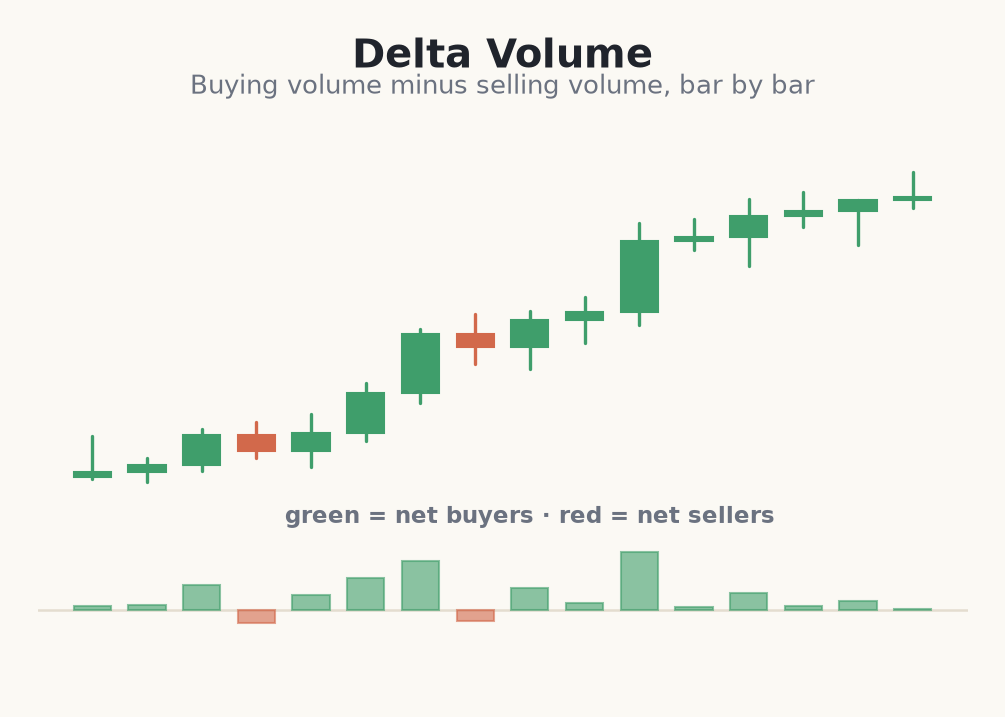
Reading delta with price
The most useful reads come from comparing delta with price. When price rises and delta is strongly positive, buyers are genuinely driving the move. When price rises but delta is weak or negative, the rally is being quietly sold into — a divergence worth noting.
- Delta = aggressive buy volume minus aggressive sell volume per bar.
- Positive delta = aggressive buyers dominated; negative = sellers dominated.
- Delta agreeing with price supports the move.
- Delta diverging from price warns the move may lack real backing.
An important honest limit: true delta needs tick-level bid/ask data from a real exchange feed, so it is reliable on futures and stocks but often unavailable or estimated on CFDs and forex. Know what your platform is actually calculating before you trust it.
HOW to trade it in practice: wait for price to reach a level you already respect, then let delta confirm or veto. A green push-up bar into resistance that prints a large negative delta is telling you buyers hit the wall and sellers absorbed them — that is your permission to fade, not chase.
Fading a delta divergence at resistance (€1000 account)
- 1Instrument: EUR/USD futures proxy, price grinds up to a resistance shelf at 1.0920.
- 2The final push prints a new high candle at 1.0922 but delta on that bar is -1,800 (aggressive sellers dominated the up-move).
- 3Read: price up, delta negative = bearish divergence, buyers were absorbed.
- 4Entry: short at 1.0918 once the next bar closes back below the shelf.
- 5Stop: 1.0930, just above the delta-negative high — a 12-pip risk.
- 6Risk 1% of €1000 = €10. At €1 per pip that is a size of ~0.8 mini-lots (€10 / 12 pips).
- 7Target: prior value-area low at 1.0882 = 36 pips, roughly 3R.
- 8Outcome logged either way — the setup is defined before entry, not after.
Delta mistakes that cost money
- Trusting delta on a CFD or forex feed that only estimates it from ticks — you are trading a guess dressed as data.
- Treating one positive delta bar as a buy signal with no level or structure behind it.
- Chasing a big green delta bar at the top of an extended move — that is often the last aggressive buyer, not the first.
- Ignoring divergence because 'price is still going up' — divergence is a warning, and warnings arrive early.
- Sizing off gut feel instead of stop distance, so one wide-stop delta trade wipes three winners.
Delta reveals who was aggressive — buyers or sellers — and its divergence from price is one of order flow's most telling clues.