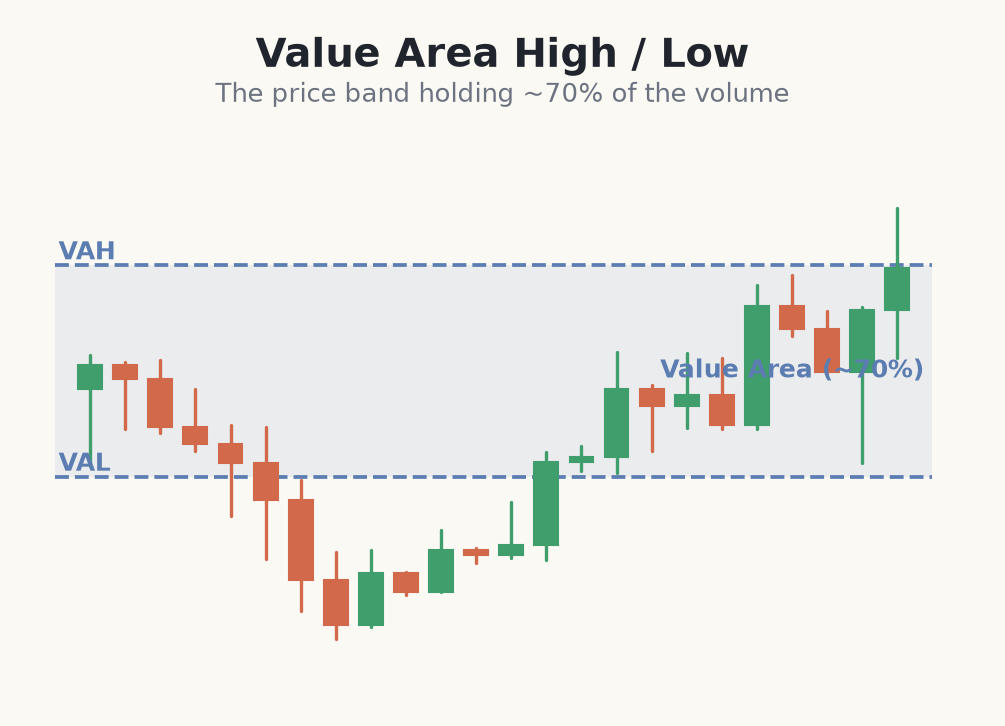
The value area is the band of prices where the bulk of trading happened — by convention, about 70 percent of the volume in the profile, centred on the POC. Its upper edge is the value area high (VAH) and its lower edge the value area low (VAL). Where the POC is a single price, the value area is a whole zone, and that zone is where the market genuinely agreed price was fair.
Inside the value area, price was accepted as fair — the market spent most of its time and traded most of its volume there. Outside it, price was comparatively rejected, visited briefly before returning. That makes VAH and VAL natural boundaries between value and extreme, and much of intraday trading is really about whether price stays inside value or breaks out to seek new value.
Trading the edges
In a balanced market, price often rotates within the value area: a push to the VAH that fails can rotate back toward the POC or VAL, and vice versa. Fading the edges back toward the middle is a classic range approach, with a stop just outside the value area — because if price accepts beyond the edge, the range read is wrong and you want out cheaply.
The edges also matter for breakouts. Price that leaves the value area and accepts beyond it — trading and holding there rather than snapping back — signals the market is seeking new value, and traders may follow that direction instead of fading it. The single most useful judgement at an edge is acceptance versus rejection: does price hold outside, or does it come straight back in?
- <strong>Value area = roughly</strong> 70% of volume around the POC.
- <strong>VAH and VAL mark</strong> the transition from fair value to extreme.
- <strong>In balance, price</strong> tends to rotate between the edges and the POC.
- <strong>Acceptance beyond an edge</strong> hints the market is moving to new value.
- <strong>Read the edge</strong> as accept-or-reject, not a fixed line.
Fading the value area high back to the POC
- 1On the 15-minute Nasdaq futures chart, today's developing profile gives VAL 18,200, POC 18,260, VAH 18,320.
- 2Price rotates up to the VAH at 18,320 in a balanced, rangey session. You wait rather than short the touch.
- 3A bearish rejection candle prints right at the VAH — buyers can't accept above value. You enter short at 18,312.
- 4Your stop goes just outside the value area at 18,340; acceptance above VAH would mean the range is breaking. Risk = 28 points.
- 5Account $10,000, risking 1% = $100. On micro-Nasdaq at $2 per point, 28 points ≈ $56 per contract, so 1 contract keeps risk under budget.
- 6You target the POC at 18,260, ~52 points away — about 1.9:1 — the natural rotation objective inside value. Entry 18,312, stop 18,340.
Common mistakes with the value area
- Fading every edge blindly. Value-area edges only reliably reject in balanced conditions. In a trend, price blows through the VAH or VAL and keeps going.
- Ignoring acceptance. The whole edge trade hinges on whether price holds outside. If it accepts beyond VAH, stop fading and respect the breakout.
- Using a still-developing profile as if it were final. An intraday value area shifts as the session builds. Levels early in the day are provisional.
- Placing the stop inside the value area. A rotation trade needs its stop outside the edge, or normal noise takes you out before the idea plays.
- Forgetting the 70% is a convention. The exact percentage is a rule of thumb, not a law. Treat VAH and VAL as zones, not precise prices.
The value area frames where price was fair; its high and low are the lines between rotation inside value and a move to find new value.
Combined with the POC, the value area gives you a complete map of a session: a middle magnet and two edges. Read whether price is rotating or breaking, and let acceptance — not a single touch — decide which game you are playing.