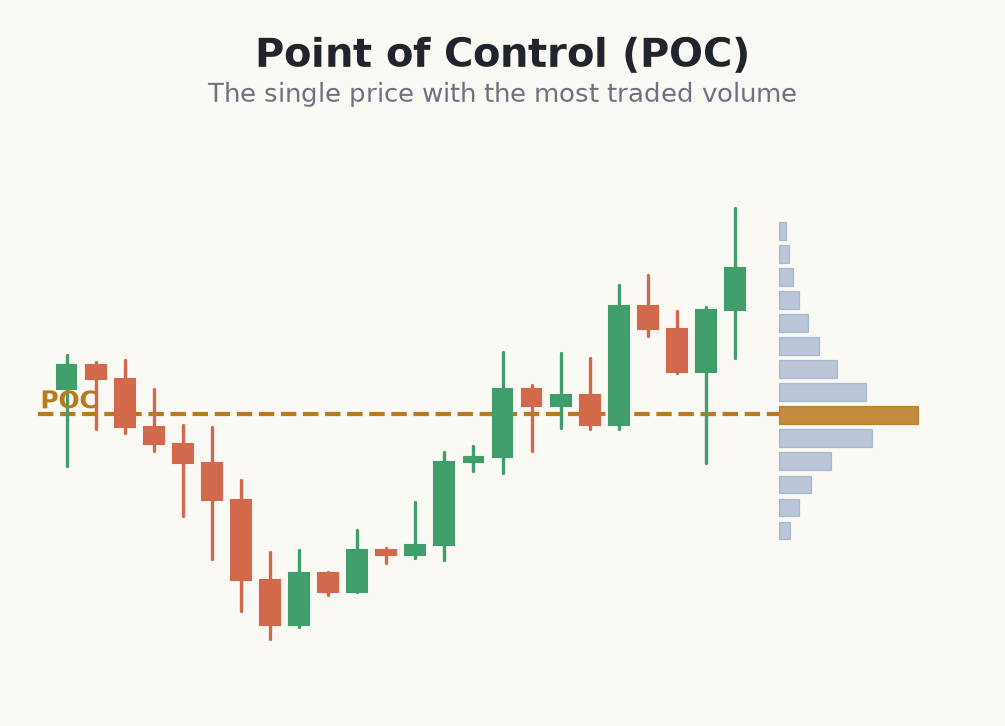
The point of control, or POC, is the single price level with the highest traded volume in a profile — the longest bar on the histogram. It marks the price at which buyers and sellers were most in agreement, the fairest price over the range you selected. Of every level a profile produces, the POC is the one to find first, because more business was transacted there than anywhere else.
Because so much business was done at that price, the POC often behaves like a magnet: price that drifts away can be drawn back to it, and price that reaches it can pause, because it is a level nearly everyone recognises as fair value. This pulling behaviour is why intraday traders watch the prior day's POC so closely — it is a shared reference the whole market can see.
How to use the POC
Traders use the POC as a reference level, much like a support or resistance line, but with the added meaning that it is where the most trading occurred. In a range, price rejecting the POC from below can offer a short back toward the value edges; accepting above it can favour longs. The key question is always which side of that level price is trading, because that tells you whether the crowd currently sees fair value above or below.
For entries, a common approach is to act as price tests the POC and place a stop just beyond it, since a decisive move through the fairest price means your read on control was wrong. The prior day's POC (often written as pd-POC) that price revisits the next session is a particularly watched level, because it combines volume significance with a fresh, un-traded reaction.
- <strong>POC = the price</strong> with the most volume in the profile.
- <strong>It acts as a magnet</strong> and a fair-value reference, not a guaranteed turn.
- <strong>Watch acceptance</strong> above versus rejection below to read the current bias.
- <strong>Place stops beyond</strong> the POC when you trade a reaction at it.
- <strong>The prior day's POC</strong> is one of the most-watched revisit levels.
Fading a POC rejection back toward the value edge
- 1On the 30-minute crude oil chart, yesterday's profile placed the POC at 78.40. Today price rallies back up into it from below.
- 2You do not short the touch. You wait: price stalls at 78.40 and prints a bearish rejection candle with a long upper wick — sellers defending the fair-value level.
- 3You enter short at 78.30 on the close of that rejection candle, reading the POC as resistance because price failed to accept above it.
- 4Your stop goes just beyond the POC at 78.62 — a decisive move above the fairest price means your read was wrong. Risk = 32 cents.
- 5Account $8,000, risking 1% = $80. On crude at $10 per 0.01 per contract... you size 1 micro-contract ($1 per 0.01), so 32 ticks ≈ $32 — comfortably within budget.
- 6You target the value-area low near 77.60, ~80 cents away — about 2.5:1. Entry 78.30, stop 78.62, defined before the click.
Common mistakes trading the point of control
- Treating the POC as a guaranteed turn. It is a magnet and reference, not a wall. Price accepts through it regularly — wait for a reaction before fading.
- Entering on the touch with no confirmation. A test of the POC is a decision point, not a signal. Let price show rejection or acceptance first.
- Placing the stop at the POC itself. Normal noise will clip a stop sitting on the level. Put it clearly beyond the fair-value price.
- Using a stale profile. A POC from an irrelevant range is just a line. Anchor it to the session or swing that actually matters now.
- Ignoring which side price is on. The same POC is support when price is above and resistance when below. Read acceptance versus rejection, not the line alone.
The point of control is the market's fairest price over your range — a magnet and reference level, but never a certainty on its own.
The POC is most powerful when it lines up with other evidence — structure, a VWAP, or a value-area edge. Alone it is a magnet, not a signal; in confluence with a price-action reaction it becomes a level worth risking a defined stop on.