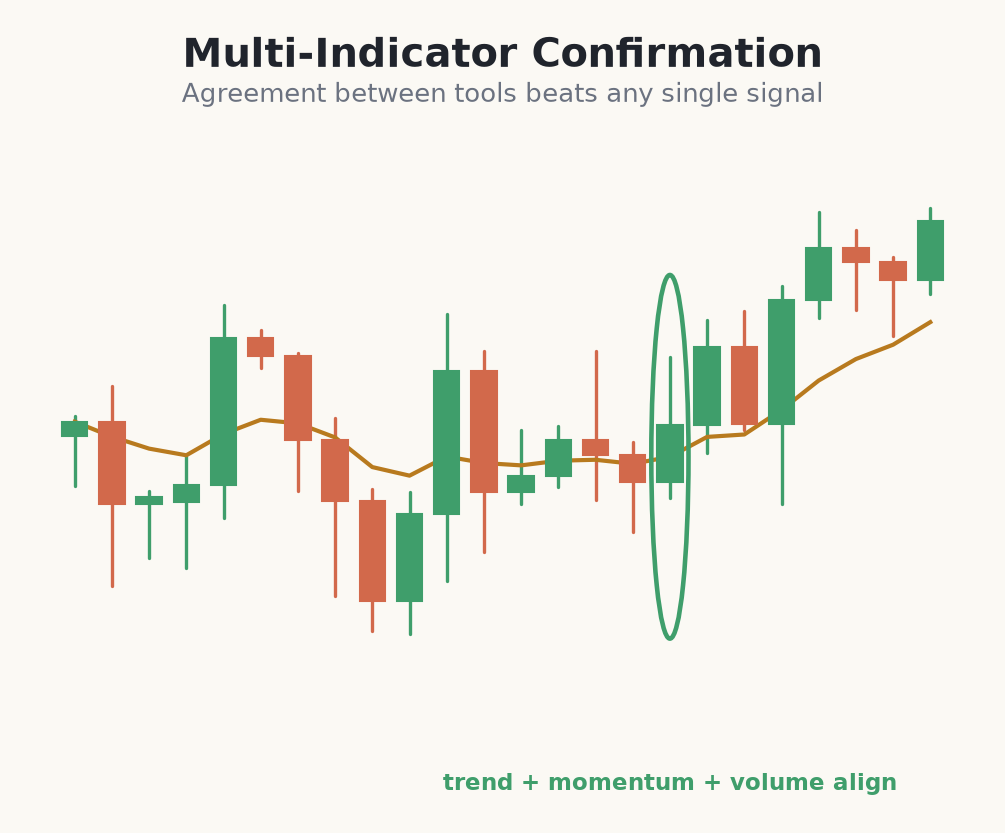
Confirmation means letting independent tools agree before you act. When a moving average, a momentum reading and a strength filter all point the same way, the case for a trade is stronger than any single tool alone. This alignment is called confluence.
More is not better
The critical warning: more indicators is not better. Adding five momentum oscillators does not give five opinions — they are all reading the same price and will mostly agree, giving you false confidence. Piling on tools also leads to analysis paralysis, where conflicting readings freeze you.
Choose complementary tools
The fix is to pick tools that measure different things: one for trend direction (a moving average), one for momentum (RSI or MACD), and one for strength or volatility (ADX or Bollinger Bands). Two or three complementary indicators plus price structure beat a screen buried under redundant lines.
- Trend tool: direction and bias (e.g. 200 EMA).
- Momentum tool: is the move accelerating (e.g. RSI or MACD)?
- Strength/volatility tool: is a trend even present (e.g. ADX)?
- Two or three that disagree in nature beat ten that echo each other.
A three-tool confluence long
- 1Trend tool: on the 1-hour Nasdaq, price is above a rising 200 EMA — bias long.
- 2Strength tool: ADX reads 27 and rising — a real trend, so trend signals are worth taking.
- 3Momentum tool: after a pullback, RSI turns up from 42 as a green candle closes at 18,240 — the trigger.
- 4All three agree, so you enter long at 18,240 with a stop below the pullback low at 18,140 — risk = 100 points, sized to 1%.
- 5You target 18,540, ~300 points — a 3:1 trade. Three different tools agreeing, not three momentum oscillators echoing each other.
Common beginner mistakes with confirmation
- Stacking redundant tools. Five momentum oscillators all read the same price and mostly agree — that's false confidence, not five edges.
- Analysis paralysis. Pile on enough indicators and they'll always conflict, freezing you. Fewer, complementary tools keep decisions clean.
- Waiting for perfection. Demanding ten green lights means never trading. Two or three complementary confirmations plus price is enough.
- Treating confluence as certainty. Even perfect agreement can be wrong. Every confluence trade still needs a stop and sensible size.
- Curve-fitting on history. Tweaking settings until a combo looks perfect on old charts rarely survives live markets. Keep it simple and robust.
Seek confluence from complementary tools that measure different things — stacking redundant indicators adds noise and false confidence, not edge.
Even perfect confluence is not a guarantee. Indicators lag, agreement can still be wrong, and the market owes you nothing — which is why risk management remains the deciding factor in every trade.