A strategy is a small set of written rules you follow the same way every time. Without rules you drift into impulsive trades and cannot tell whether an approach works. The goal now is to fold the course into one simple, testable plan.
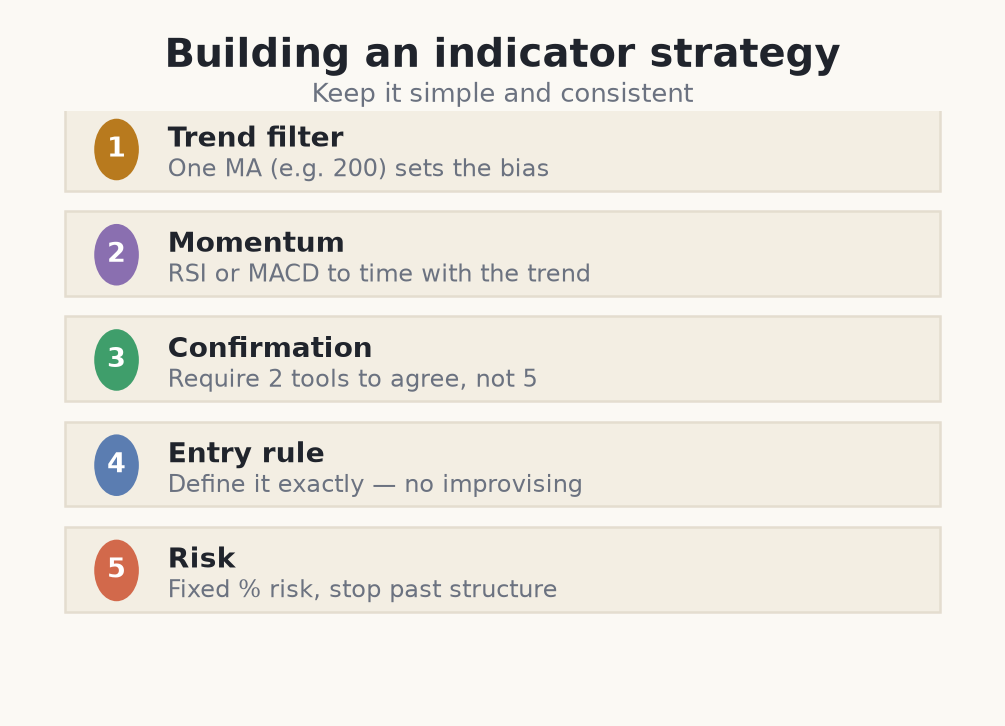
A five-step trend template
- 1. Bias: is price above or below the 200 EMA? Trade with it only.
- 2. Strength: is ADX confirming a real trend (rising, above ~25)?
- 3. Trigger: wait for a pullback and a momentum turn (RSI or MACD).
- 4. Entry: act on the candle close that confirms the trend resuming.
- 5. Risk: place a stop beyond the invalidation swing before you enter.
Notice each step uses a different type of tool — trend, strength, momentum — rather than three that repeat each other. The stop is defined by where the idea is wrong, not by how much you hope to make, and position size is set so that a single loss is small.
Test and expect losses
Before risking money, review the rules over past charts and, ideally, on a demo account to see how they behave. Every strategy has losing streaks; trend-following in particular takes many small losses to catch a few big winners. A plan you cannot follow through a drawdown is worthless.
Finally, keep expectations honest. No indicator setup guarantees profit, no combination removes losing trades, and anyone promising signals or riches is selling something. Your durable edge is discipline and risk control applied consistently to a plan you actually understand.
Running the five-step template on a live setup
- 1Bias: on the 1-hour gold chart, price is above a rising 200 EMA — long only.
- 2Strength: ADX reads 26 and rising — a real trend, so the signal is worth trading.
- 3Trigger: price pulls back and RSI turns up from 40 as a green candle closes at 2046.
- 4Entry & risk: you buy 2046, stop below the pullback low at 2032 (14 points). On €3,000 at 1% (€30), size ≈ 0.2 lots.
- 5Target: the prior high near 2088, ~42 points — a 3:1 trade planned in full before you clicked. Same five steps, every single time.
Common beginner mistakes building a strategy
- Having no written rules. Without them you drift into impulsive trades and can't tell if the approach works. Write the plan down.
- Stacking redundant tools. Three momentum oscillators is not a strategy. Use one of each type: trend, strength, momentum.
- Sizing before the stop. Pick the invalidation level first, then size so a loss is small. Never pick a size then hunt for a stop that fits.
- Abandoning the plan in a drawdown. Every strategy has losing streaks; trend following in particular. A plan you can't follow through a bad run is worthless.
- Chasing guaranteed profits. No setup wins every time and anyone selling certainty is selling nonsense. Discipline and risk control are the real edge.
A strategy is a written, tested set of rules — bias, strength, trigger, entry, stop — where consistent risk management, not any indicator, is the real edge.