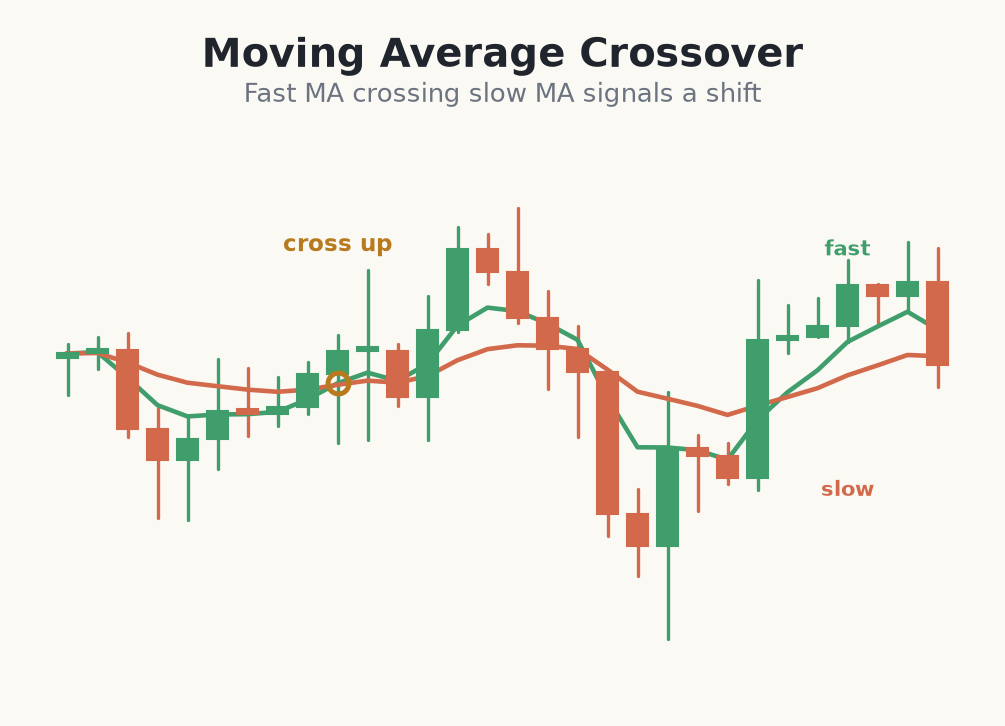
A moving average crossover uses two averages of different lengths — a fast MA and a slow MA. When the fast average crosses above the slow one, momentum has turned up; when it crosses below, momentum has turned down. It is one of the oldest mechanical trend signals.
How the signal works
The crossover captures a shift in relative momentum. Because the fast average reacts quicker to new prices, it pulls above the slow one when buying accelerates. Traders often use pairs like 9/21 for short-term trading or 20/50 for swing trading — shorter pairs signal earlier but noisier.
Entry, stop and the whipsaw problem
A straightforward plan enters on the candle close after the cross and places a stop beyond the recent swing against the trade. The honest weakness is the whipsaw: in a range the averages cross back and forth, generating a string of losing signals. This is why many traders only take crossovers that agree with the higher-timeframe trend.
- Bullish: fast MA crosses above slow MA — momentum turning up.
- Bearish: fast MA crosses below slow MA — momentum turning down.
- Entry on the close after the cross; stop beyond the opposing swing.
- Filter with a trend rule (like the 200 EMA) to cut whipsaw losses.
A 9/21 crossover long with a trend filter
- 1On the 1-hour EUR/USD chart, price is above the 200 EMA — you only accept bullish crossovers.
- 2After a pullback, the 9 EMA crosses above the 21 EMA and a candle closes at 1.0910 confirming the cross.
- 3You enter long at 1.0910 and place the stop below the recent swing low at 1.0880 — risk = 30 pips.
- 4Account is €2,000, risking 1% = €20; a 30-pip stop sizes you to about 0.06 lots.
- 5You target the next resistance near 1.1000, ~90 pips away — a 3:1 trade. A cross back down or a close below 1.0880 ends it.
Common beginner mistakes with crossovers
- Taking every cross. In a range the averages cross back and forth, handing you a string of small losses. Only take crosses that agree with the higher-timeframe trend.
- Entering before the candle closes. An intrabar cross that reverses by the close is a fake. Wait for the close to commit.
- Using too-fast a pair. A 3/8 crossover fires constantly and mostly noise. Slower pairs signal later but cleaner.
- Trading crossovers with no stop. The lag means a bad signal can run far before the reverse cross. Define the invalidation swing first.
- Expecting them to lead. A crossover always arrives after the move has begun. Treat it as confirmation, not a head start.
A crossover flags a momentum shift, but it lags the turn and whipsaws in ranges — pair it with a trend filter and a defined stop.
Crossovers always arrive after the move has begun, because they depend on averaged history. Used alone they underperform; used as one confirmation among several in a trending market, they can help keep you on the right side.