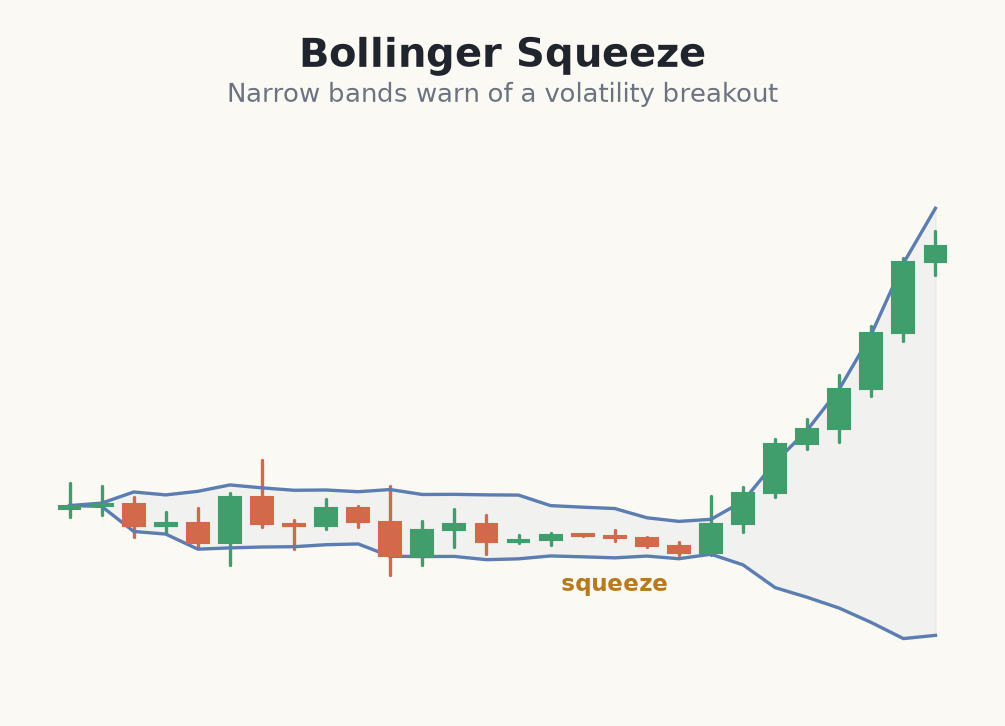
A Bollinger squeeze is when the bands narrow sharply, showing that volatility has collapsed and price is coiling in a tight range. Markets alternate between quiet and active phases, and an unusually tight squeeze often precedes an expansion in volatility — a breakout move.
Why the squeeze works
During a squeeze, buyers and sellers reach a temporary balance and orders build up on both sides of a tight range. When one side finally wins, the pent-up energy releases into a directional move and the bands snap open. The squeeze tells you a move is likely — it does not tell you the direction.
Entry and stop logic
A disciplined plan waits for a candle to close outside the range that formed during the squeeze, then enters in the breakout direction with a stop on the opposite side of the range. Because the squeeze is directionless, aligning the breakout with the higher-timeframe trend improves the odds and reduces false starts.
- Squeeze = bands pinch tight = volatility compressed.
- Signals that a move is likely, but not which way.
- Enter on a close outside the range; stop on the opposite side.
- Favour breakouts that agree with the larger trend.
Trading a confirmed squeeze breakout
- 1On the 1-hour Nasdaq chart, the bands have pinched tight for several hours and price coils in a narrow 18,300–18,360 range.
- 2The higher-timeframe trend is up, so you favour an upside break and ignore a downside one.
- 3A candle closes above 18,360 as the bands snap open — you enter long at 18,370.
- 4Stop goes on the opposite side of the range at 18,290 — risk = 80 points. On €5,000 at 1% (€50), that's about 0.6 lots.
- 5You target a measured move of the range height projected up, near 18,530 — roughly 2:1. A close back inside the range would mean a false break and an exit.
Common beginner mistakes with the squeeze
- Guessing the direction. A squeeze tells you a move is coming, not which way. Wait for the break rather than pre-positioning.
- Entering before the close. Price often pokes outside the range and snaps back. Require a candle close beyond the range to filter fakes.
- Chasing a break against the trend. Breakouts that agree with the higher timeframe are far more reliable. Fade the temptation to counter-trend.
- Skipping the stop on the far side. A false break needs a clean exit. The opposite side of the range is your logical invalidation.
- Trading tiny squeezes for tiny moves. Not every contraction leads to a big expansion. Favour meaningful, prolonged squeezes.
A squeeze warns that a volatility expansion is coming — trade the confirmed break out of the range, with a stop on the other side, not a guess at direction.
Squeezes produce false breakouts too, where price pokes out and snaps back. That is exactly why waiting for a close and defining your invalidation before you enter matters — no squeeze guarantees the move sticks.