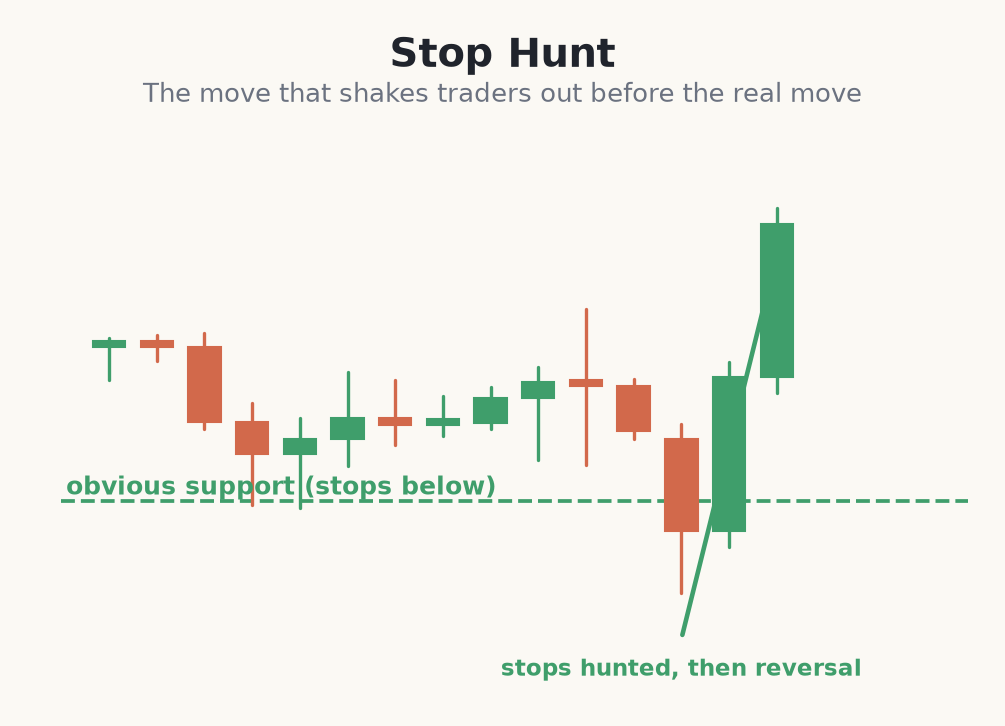
A stop hunt is a specific kind of liquidity sweep aimed at protective stop orders. Because so many traders place stops at the same obvious spot — just below support or above resistance — that price becomes a target. A quick spike triggers the stops, and price then often reverses. It is the reason your stop feels 'personally hunted' so often: it was sitting exactly where everyone else's was.
Why stops get hunted
When your stop is hit, your order becomes a market order in the opposite direction — a long's stop is a sell. Those forced sells are exactly the fills a large buyer wants. This is the mechanism SMC points to: obvious stop clusters are convenient liquidity, whether by deliberate design or simply by crowd behaviour. Either way, the practical result for you is the same, so the defence is the same.
How to protect yourself
The practical lesson is to avoid placing stops at the most obvious price. Give the stop room beyond the sweep zone, then size the position down so your risk stays constant despite the wider stop. Remember that not every spike is a hunt — sometimes a level breaks for real — and never move a stop further away just to avoid being hit. A wider stop is a planning decision, not a panic reaction.
- A stop hunt is a sweep aimed specifically at the <strong>obvious stop cluster</strong> beyond a level.
- Your triggered stop becomes forced flow that <strong>feeds the reversal</strong>.
- Place stops <strong>beyond the likely sweep</strong>, not at the crowd's price, and size down to keep risk fixed.
- Not every spike is a hunt — respect a level that breaks and holds with conviction.
Surviving and trading a stop hunt
- 1EUR/USD 15-min has obvious support at 1.0850. The crowd's stops sit just under it at ~1.0846. You are looking for a long.
- 2Instead of buying at support with a stop at 1.0846, you wait for the hunt. Price spikes down, wicks to 1.0838, sweeping the stops, then closes back at 1.0856.
- 3A CHoCH up confirms at 1.0868. You enter long on the pullback at 1.0860.
- 4Stop goes below the hunt wick at 1.0835, not at the obvious 1.0846. Risk = 25 pips — wider, but beyond the sweep.
- 5Account €2,000, risk 1% = €20, so ~0.08 lots. Target buy-side liquidity at 1.0915, ~55 pips, about 2.2:1.
Common mistakes around stop hunts
- Putting your stop at the obvious price. Just below support is exactly where the hunt reaches. Give it room beyond the likely sweep zone.
- Moving your stop further away mid-trade. Widening a stop to avoid being hit turns a small planned loss into a large unplanned one. Never do it.
- Assuming every dip below support is a hunt. Sometimes the level genuinely breaks. Demand a reversal and structure shift before buying the dip.
- Revenge-entering right after being stopped. Being hunted stings, but chasing back in without a fresh setup usually compounds the loss.
Stop hunts target obvious stop clusters — place your stop beyond the likely sweep, size down to keep risk fixed, and only trade the reversal once structure confirms it.