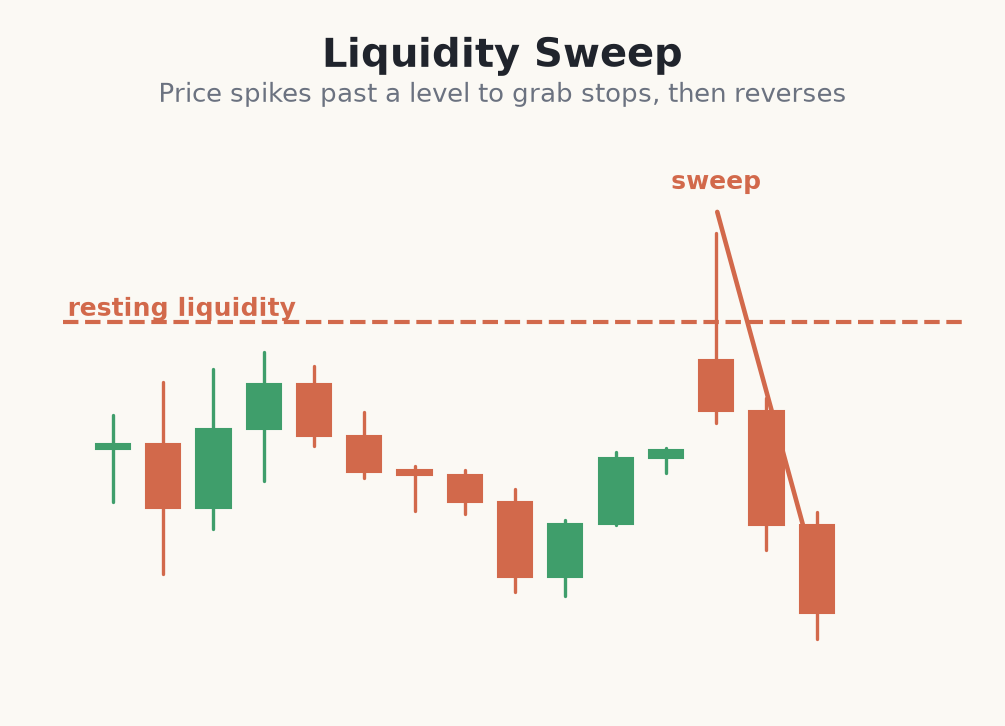
A liquidity sweep is when price pushes beyond a key level, triggers the resting orders there, and then quickly reverses. Instead of a clean breakout, the level is taken and rejected — a sign that the move beyond it was about grabbing liquidity rather than genuine continuation. The sweep is arguably the single most important pattern in SMC: almost every high-quality reversal starts with one.
How to spot a sweep
The classic footprint is a long wick that pierces a high or low and closes back inside the range. It often happens fast, on a spike of activity, and looks violent. A genuine sweep is usually followed by a shift in structure in the opposite direction — that structure shift, not the wick itself, is your confirmation. No shift, no trade.
Sweep versus real breakout
The hard part is telling a sweep from a real break. The tell is how price behaves after: a sweep is rejected within a candle or two and closes back inside; a real breakout closes beyond the level with conviction and holds. If price pierces a high and keeps closing above it, that was continuation, not a sweep — do not fade it. Waiting for the close is what keeps you from being on the wrong side.
Entry and stop logic
A common approach is to wait for the sweep, then for a CHoCH or MSS confirming the reversal, and enter on the pullback. The stop sits just beyond the sweep's extreme — the wick high or low — because a return there means the reversal read was wrong. Target the opposite liquidity pool for a strong reward-to-risk.
- Sweep = price takes orders beyond a level then reverses, usually with a <strong>long wick</strong>.
- Wait for a <strong>structure shift</strong> back the other way before entering — the wick alone is not enough.
- Stop goes just past the <strong>sweep extreme</strong>; target the opposite liquidity.
- Not every wick is a sweep — some are genuine breakouts, so the closing behaviour decides.
Trading a liquidity sweep with defined risk
- 1EUR/USD 15-min sits below an old swing high at 1.0900 in a bearish higher-timeframe context. Buy-side liquidity rests above 1.0900.
- 2Price spikes up, wicks to 1.0912 taking the stops, then closes back at 1.0894 — a clean sweep, not a hold above.
- 3A CHoCH down prints at 1.0880, confirming rejection. You wait for a small pullback to the order block at 1.0890.
- 4Enter short at 1.0888, stop above the sweep wick at 1.0915. Risk = 27 pips.
- 5Account €2,000, risk 1% = €20, so ~0.074 lots. Target the sell-side liquidity at 1.0830, ~58 pips, about 2.1:1.
Common mistakes with liquidity sweeps
- Fading the wick before it closes back inside. If you short mid-spike and it keeps going, you are caught in a real breakout. Wait for the close.
- Entering with no structure shift. A sweep without a CHoCH/MSS behind it is just a wick. The reversal needs confirmation to be tradeable.
- Placing the stop inside the wick. The whole point is a violent poke — a stop inside the sweep range gets clipped by the next probe. Put it beyond the extreme.
- Calling every wick a sweep. Most wicks are noise. Reserve the read for wicks that pierce an obvious liquidity pool and reject cleanly.
A liquidity sweep grabs orders beyond a level then reverses — trade the reversal only after a structure shift, with your stop just past the wick.