Sell-side liquidity, or SSL, is the mirror image of BSL: the pool of sell orders resting below the market. These are mostly stop losses from long traders and breakout sell stops. When price falls into them they trigger, become forced selling, and provide exactly the fills a large buyer wants right before a rally begins.
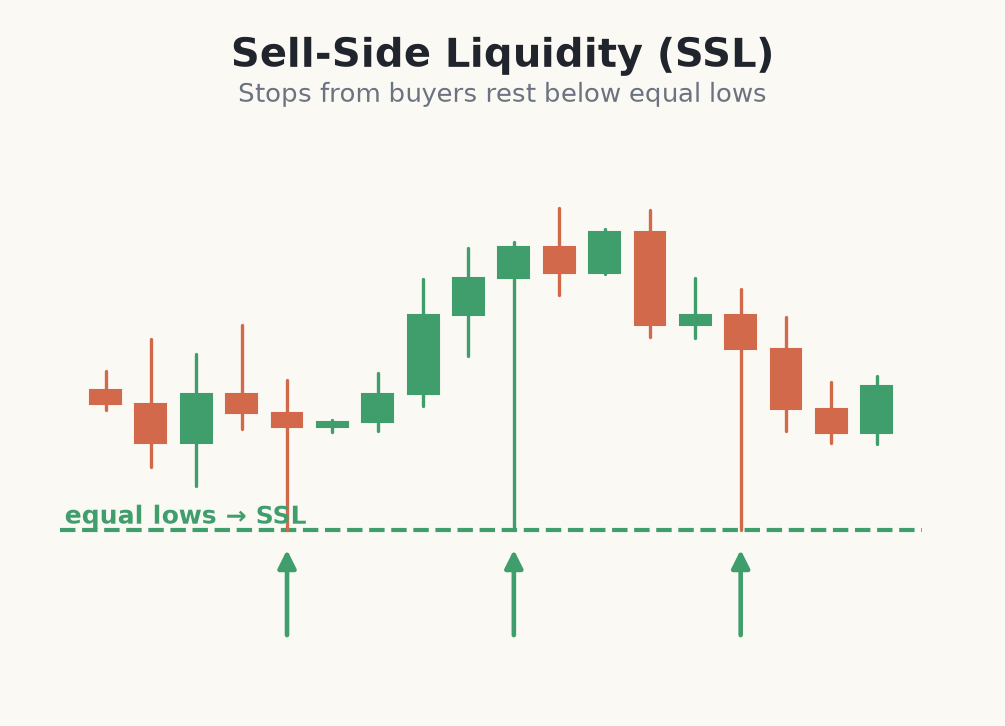
How to spot it
Mark swing lows and equal lows. Two or more lows at a similar price form a stronger pool, because everyone places protective stops just under obvious support. A clean, flat double bottom is one of the most reliable liquidity magnets on the chart — precisely because it looks so safe to buy, everyone's stop ends up in the same place below it.
Why it matters for direction
In a bullish scenario, price may dip into sell-side liquidity to trigger long stops and provide fills for large buyers before rallying. So a sweep of SSL followed by a strong reversal is a classic long context. But it only works when structure and confirmation agree — a break of the low can also mean genuine continuation down, so you never buy the sweep blindly.
- <strong>Equal lows</strong> and clean double bottoms are the strongest SSL pools.
- The orders below a low are mostly <strong>long stops and breakout sells</strong>, not genuine supply.
- A sweep of SSL in a bullish context is often the <strong>launch pad</strong> for a rally.
- No sweep + structure shift = no trade; the break alone can just be continuation down.
Buying a sweep of sell-side liquidity
- 1EUR/USD 1-hour has equal lows at 1.0810 and the higher-timeframe bias is bullish. You mark SSL just below 1.0810.
- 2Price drops and wicks to 1.0802, sweeping the equal lows and the stops under them, then closes back above 1.0810.
- 3You wait for a CHoCH up on the 5-min confirming the sweep is rejected. It prints at 1.0828.
- 4Enter long on the pullback at 1.0820, stop below the sweep wick at 1.0799. Risk = 21 pips.
- 5Account €2,500, risk 1% = €25, so ~0.11 lots. Target buy-side liquidity at 1.0885, ~65 pips, about 3:1.
Common mistakes with sell-side liquidity
- Placing your long stop right below the equal lows. That is the pool everyone targets. A tiny sweep clips you before the move you predicted.
- Buying the sweep with no reversal proof. A dip below the low is only bullish if structure shifts back up. Otherwise it is real continuation down.
- Shorting the breakdown of a clean double bottom. Your breakout sell is the liquidity a buyer wants. In a bullish context that is a classic trap.
- Marking messy lows as SSL. Only clean equal lows and obvious swing lows hold stacked orders worth trading around.
Sell-side liquidity sits below lows — mostly long stops and breakout sells — that price may sweep before reversing up, but only buy it with a structure shift confirming the turn.