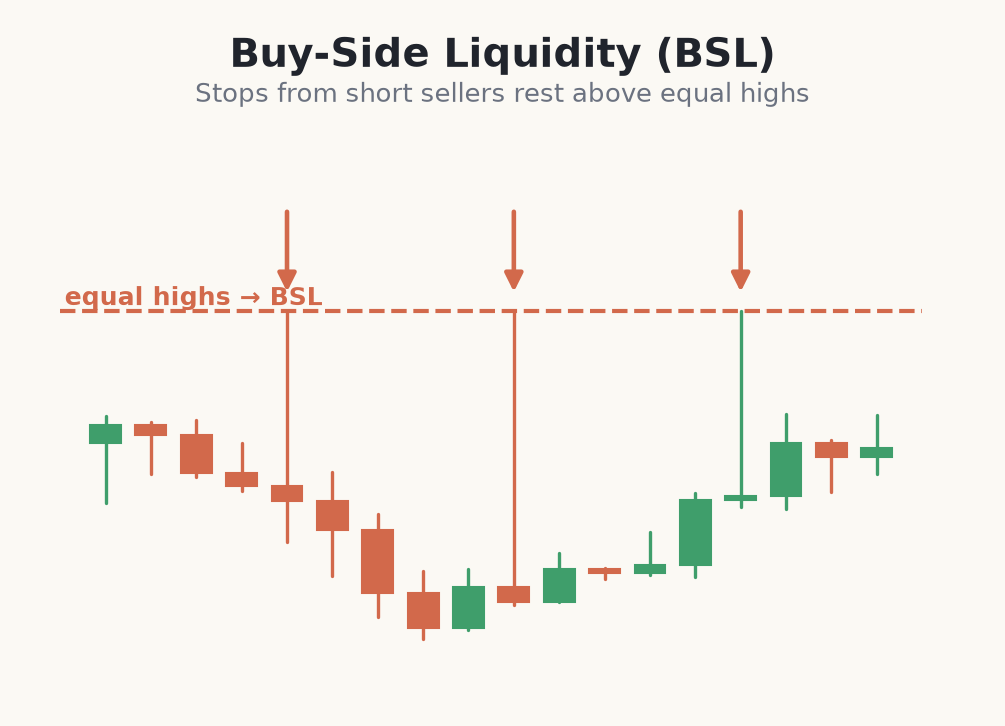
Buy-side liquidity, or BSL, is the pool of buy orders resting above the market. It sounds counter-intuitive, but the buy orders here are mostly stop losses from short sellers and breakout buy stops. When price rises into them they trigger, become forced buying, and provide exactly the fills a large seller wants before pushing price back down.
How to spot it
Look for swing highs and equal highs. A single old high holds some liquidity; two or more highs at roughly the same price form a stronger pool, because traders keep placing stops and breakout orders just above the obvious resistance. The flatter and cleaner the highs, the more orders likely sit above them — a textbook double top is a textbook BSL pool.
Why it matters for direction
BSL is often a target, not an entry. In a bearish scenario, price may rally into buy-side liquidity to fill large sell orders before turning down — the rally is the setup for the drop, not a reason to chase longs. Marking BSL tells you where an up-move might be running out of fuel. But a run into liquidity is not automatically a reversal, so you wait for confirmation before fading it.
- <strong>Equal highs</strong> are the strongest BSL — the more touches, the more stacked orders above them.
- The orders above a high are mostly <strong>short stops and breakout buys</strong>, not genuine demand.
- A rally into BSL in a bearish context is often <strong>fuel for a drop</strong>, not a breakout to trust.
- Higher-timeframe highs hold more meaningful BSL than intraday wiggles.
Fading a run into buy-side liquidity
- 1EUR/USD 1-hour prints equal highs at 1.0920 and the higher-timeframe bias is bearish. You mark BSL just above 1.0920.
- 2Price rallies and wicks to 1.0928, sweeping the equal highs and the stops above them, then closes back below 1.0920.
- 3You wait for a CHoCH down on the 5-min to confirm the sweep is being rejected. It comes at 1.0905.
- 4Enter short on the pullback at 1.0912, stop above the sweep wick at 1.0931. Risk = 19 pips.
- 5Account €2,000, risk 1% = €20, so ~0.10 lots. Target sell-side liquidity at 1.0850, ~62 pips, about 3:1.
Common mistakes with buy-side liquidity
- Buying the breakout above equal highs. That is exactly the trap — your breakout buy is the liquidity a seller is using. Wait to see if it holds first.
- Fading BSL with no confirmation. A run into BSL is only half the story. Without a structure shift back down, price can keep going higher.
- Marking every minor high as BSL. Only clean, obvious highs stack real orders. Messy, unclear highs are weak pools.
- Ignoring bias. Fading BSL only makes sense when the higher-timeframe context is bearish. Against a strong uptrend it is a losing game.
Buy-side liquidity sits above highs — mostly short stops and breakout buys — that price may run for fuel before reversing down, but only fade it with confirmation.