Liquidity is simply the resting orders available for someone to trade against — stop losses, pending orders and breakout entries sitting on the book. SMC treats these clusters as targets, because large players need them to fill size. Understanding where liquidity sits is the key that unlocks most other concepts in this course: sweeps, stop hunts, inducement and order blocks all revolve around it.
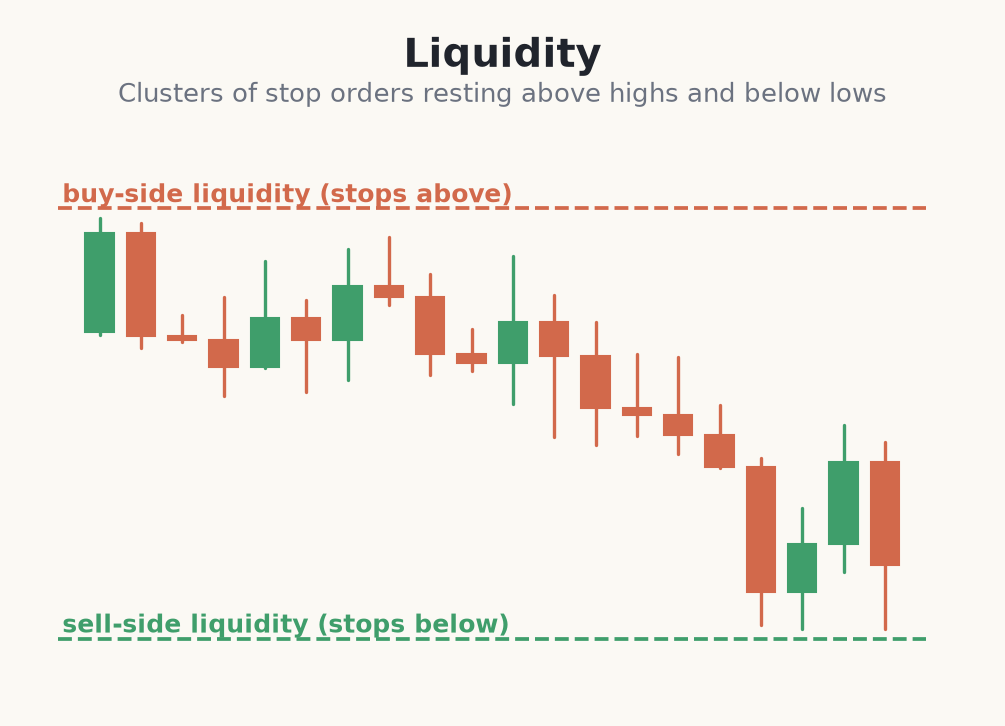
Where liquidity rests
The most predictable pools sit at obvious price points. Stops from short sellers and breakout buy orders gather above swing highs (buy-side liquidity), while stops from longs and breakout sell orders gather below swing lows (sell-side liquidity). Equal highs and equal lows are especially strong magnets, because so many orders line up at the exact same price that price is almost drawn to sweep them.
The counter-intuitive part: the buy orders above the market are mostly stop losses of shorts, and the sell orders below are mostly stop losses of longs. When your stop is hit it becomes a market order in the opposite direction — exactly the fuel a large player on the other side wants. That is the whole mechanism in one sentence.
Why price seeks it
The mechanism is a matching problem: a large buyer needs many sellers, and the easiest place to find them is where stop-sell orders cluster below a low. This is why price so often runs a level, grabs the orders, and then reverses. A liquidity pool is not a place price must respect — it is a place price is attracted to and often passes through violently.
How to grade a pool
- <strong>More equal touches</strong> = stronger pool. A clean double or triple top holds far more orders than a single old high.
- <strong>Obviousness matters.</strong> The more textbook the level looks, the more retail stops sit just beyond it — and the better a target it makes.
- <strong>Higher-timeframe pools</strong> (daily/4-hour highs and lows) attract bigger reactions than 5-minute wiggles.
- <strong>Untapped pools</strong> that price has not yet run are more interesting than levels already swept.
Using a liquidity pool as a target
- 1On EUR/USD 1-hour you spot equal lows at 1.0800 touched three times — an obvious sell-side pool with long stops sitting just under it.
- 2Bias is bearish (recent CHoCH down), so you expect price to reach for 1.0800 and likely sweep it.
- 3You short a pullback into an order block at 1.0855, stop above it at 1.0878. Risk = 23 pips.
- 4Your first target is the liquidity pool itself: 1.0795 (just beyond the equal lows), ~60 pips, about 2.6:1.
- 5Account €1,500, risk 1% = €15, so ~0.065 lots. If price sweeps 1.0795 and reverses hard, that is your cue the pool has been taken — manage or exit.
Common mistakes with liquidity
- Treating a pool as a wall that stops price. Liquidity is a magnet, not support. Price usually runs through it, not bounces off it.
- Marking liquidity everywhere. Only the obvious equal highs/lows and clean swing points hold meaningful orders. Skip the messy, unclear levels.
- Putting your own stop right at the obvious pool. That is exactly where everyone else's stop sits and exactly what gets swept. Give it room.
- Assuming a sweep is an instant reversal. Sometimes the pool is taken and price keeps going — the sweep is only tradeable with a structure shift behind it.
Liquidity is where orders rest — above highs and below lows — and SMC treats those pools as magnets and targets, not walls that stop price.