Market structure is the sequence of swing highs and swing lows that defines whether a market is trending or turning. In SMC, three labels describe how that structure develops: BOS, CHoCH and MSS. Reading them correctly is the backbone of the whole methodology — almost every setup in this course is timed off a structure event. Get this right and the rest of SMC becomes far more intuitive.
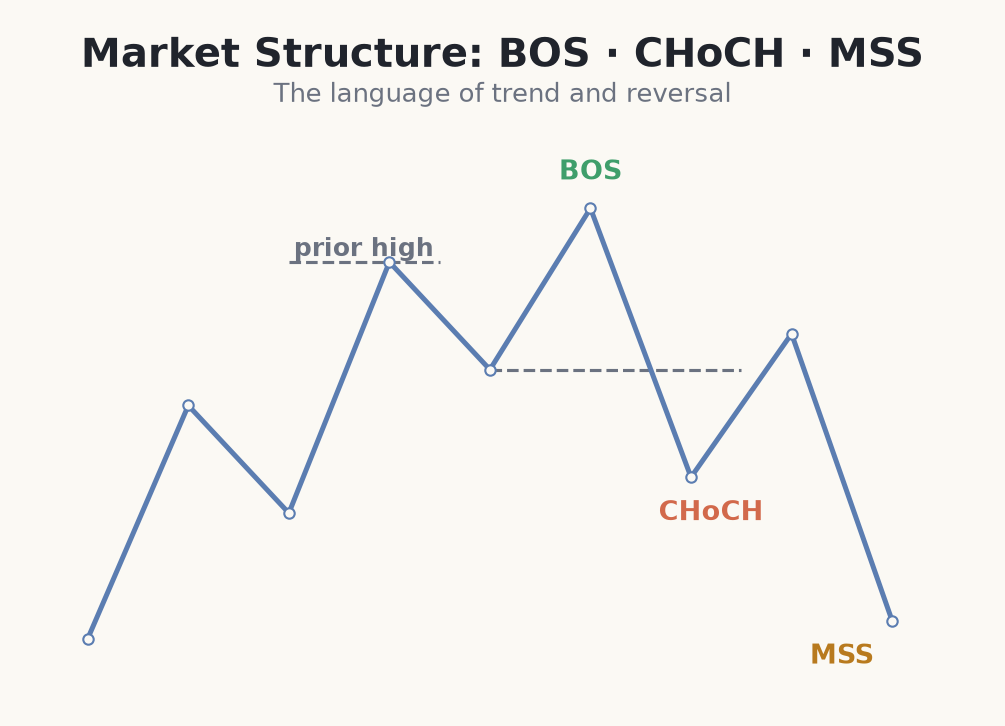
The three labels
- <strong>BOS (Break of Structure):</strong> price breaks a swing point in the trend's direction — continuation. In an uptrend, a close above the last higher high.
- <strong>CHoCH (Change of Character):</strong> the first break against the trend — an early reversal warning. In an uptrend, the first close below a higher low.
- <strong>MSS (Market Structure Shift):</strong> a decisive break, usually on displacement, that many treat as confirmation order flow has flipped.
A BOS confirms continuation: in an uptrend it is a break above the prior swing high, telling you the aggressor is still in charge. A CHoCH is the first crack against the trend and only warns of change — it is not yet a reversal. An MSS is stronger: a momentum-backed break, often leaving an FVG and a fresh order block, which is why traders treat it as the moment flow actually turned.
How to spot each one cleanly
First, mark only meaningful swings — the highs and lows a stranger would circle, not every tiny wiggle. Then require a candle body close beyond the swing point, never just a wick poke, or you will label noise as structure. A BOS in the trend direction is routine; a CHoCH is the first counter-trend close and deserves attention; an MSS is a CHoCH backed by a big, decisive candle.
How to use it in practice
After a CHoCH or MSS, stop hunting continuation trades and start looking for setups in the new direction — but wait for a fresh structure to build before committing, because structure is often misread in real time. A single break does not guarantee a full reversal; it just tips the odds. Treat the label as a bias filter, then let a specific entry (order block, FVG, OTE) time the trade.
Trading a CHoCH-confirmed reversal
- 1EUR/USD 15-min is in an uptrend: higher highs and higher lows, last higher low at 1.0870. Price makes a high at 1.0905 then turns down.
- 2A candle closes below 1.0870 — that is the first counter-trend close, a CHoCH. Bias shifts from bullish to cautious/bearish.
- 3You do not short blindly. You wait for a small pullback into the order block left by the CHoCH candle near 1.0888 and a lower-timeframe rejection.
- 4Enter short at 1.0885, stop above the recent high at 1.0908 — a close there invalidates the reversal. Risk = 23 pips.
- 5Account €2,000, risk 1% = €20, so ~0.086 lots. Target the sell-side liquidity below at 1.0830, ~55 pips, about 2.4:1.
Common mistakes with market structure
- Counting wicks as breaks. A wick through a swing is not a BOS. Demand a body close beyond the level or you will label every fake-out as structure.
- Marking every micro-swing. Too many swing points create contradictory structure. Zoom out and keep only the swings that clearly matter.
- Treating a CHoCH as a guaranteed reversal. It is the first warning, not confirmation. Many CHoCHs fail and the trend resumes — wait for follow-through.
- Ignoring the higher timeframe. A CHoCH on the 5-min inside a strong daily uptrend is usually just a pullback. Let the higher timeframe set your dominant bias.
BOS means continuation, CHoCH is the first warning of a turn, and MSS confirms order flow has shifted — always require a candle close, never a wick.