Institutional order flow is the idea that large participants push price in a consistent direction over time as they build and unwind positions. Because their orders are too big to fill at once, the resulting pressure shows up as a series of impulsive moves in one direction interrupted by smaller, weaker pullbacks. You cannot see the orders themselves, but you can read their footprint in the rhythm of the candles.
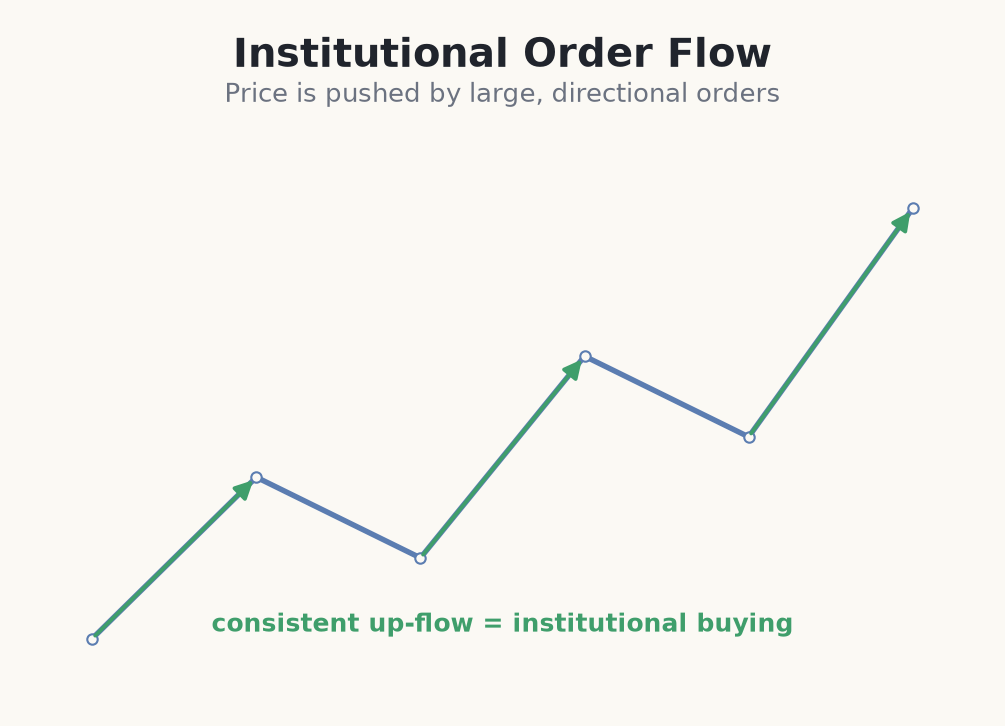
What order flow actually looks like
The simplest tell is impulse versus correction. Strong, wide-range candles in one direction, followed by weak, small, overlapping candles against it, mean that direction is in control. When buyers are the aggressor, dips are shallow and rallies are sharp; the pullbacks look like tired, choppy hesitation while the moves in the trend direction look decisive and fast. Flip it for sellers: sharp drops, weak bounces.
A second tell is how pullbacks resolve. In healthy bullish flow, each correction stops above the previous higher low and gets bought before it can do damage. The moment a pullback becomes deep, fast and takes out a prior low, order flow is being challenged — that is your early warning that the aggressor may be changing.
Why aligning with flow matters
Aligning with order flow means trading with the aggressor instead of guessing tops and bottoms. Most SMC setups are simply attempts to enter in the direction of the prevailing flow at a favourable price, after liquidity has been taken. Fading strong flow is possible but statistically harder — you are betting against the side that is currently winning, so it demands more confirmation and tighter risk.
Reading and trading with order flow
- 1On the EUR/USD 1-hour you see three big green candles into 1.0880, then a small, choppy three-candle pullback that holds at 1.0855 above the prior higher low at 1.0840. Verdict: bullish order flow.
- 2You wait for the pullback to stall. A green candle closes back up at 1.0865 — buyers reasserting. You enter long at 1.0865.
- 3Stop goes below the higher low at 1.0838 — a break there says the flow is broken. Risk = 27 pips.
- 4Account €3,000, risk 1% = €30. With a 27-pip stop you size ~0.11 lots so 27 pips against you costs about €30.
- 5Target the next liquidity above the recent high near 1.0930, ~65 pips — roughly 2.4:1. Plan set before entry: 1.0865 / 1.0838 / 1.0930.
Common mistakes reading order flow
- Calling one big candle a trend. Order flow is a sequence of impulses, not a single bar. Wait for the pattern of shallow pullbacks to repeat before trusting it.
- Fading strong flow because it 'looks overextended'. Overextended trends stay overextended for a long time. Trade with the aggressor until structure actually breaks.
- Ignoring the deep pullback warning. When a correction suddenly goes fast and deep, flow may be flipping. Do not keep loading the old direction on autopilot.
- Confusing a choppy range with a trend. If impulses appear in both directions and pullbacks are as big as the moves, there is no clean flow — stand aside.
Order flow is the direction of the aggressor, read from impulse versus correction — align with it and treat a deep, fast pullback as your first warning it is changing.