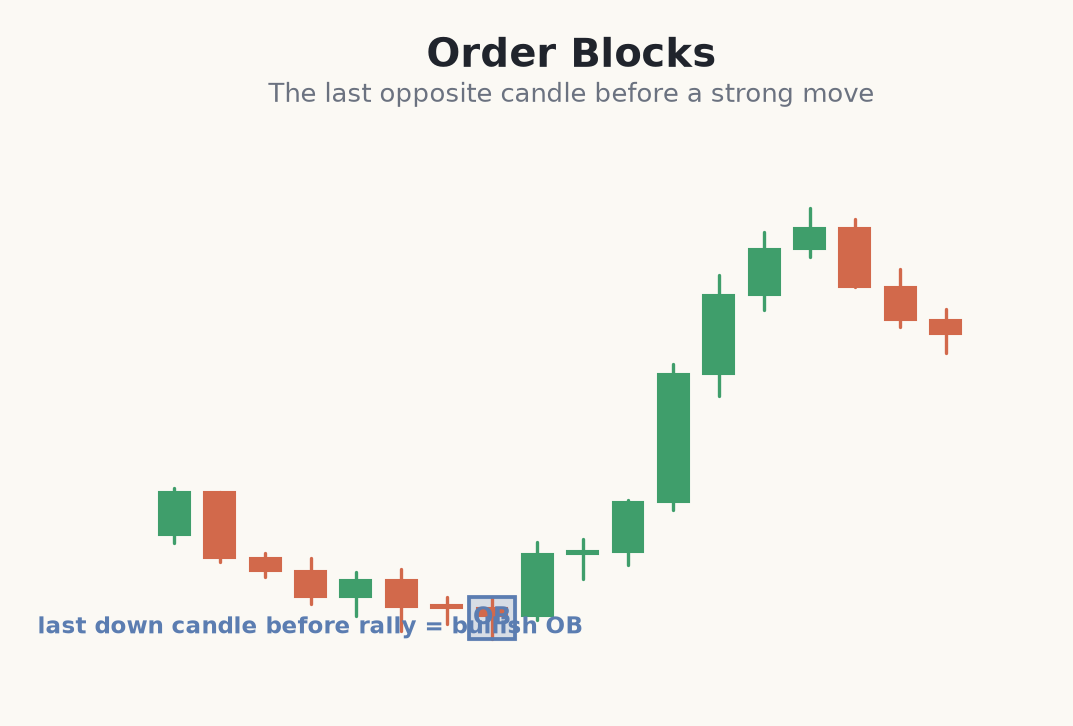
An order block is the last opposing candle before a strong, impulsive move. A bullish order block is the last down candle before a rally; a bearish order block is the last up candle before a sell-off. SMC treats it as the area where large orders were placed to launch the move — a footprint of where the aggressor stepped in. It is the single most-used entry zone in the entire methodology.
Why order blocks work
The logic is that not all of the institutional orders were filled at the origin, so unfilled orders remain inside the block. When price returns, those orders can be completed and the move can resume. A stronger case exists when the departure from the block broke structure and left an imbalance (an FVG) behind — that combination is what separates a high-quality block from a random candle.
How to qualify a block
- It should be the <strong>last opposing candle</strong> before an impulsive, structure-breaking move.
- The move away should be <strong>sharp</strong> and ideally leave a fair value gap.
- A <strong>fresh, untested</strong> block reacts more cleanly than one price has already revisited.
- Higher-timeframe blocks <strong>aligned with the trend</strong> are generally higher quality.
How to mark the zone precisely
Draw the block from the open to the close of the last opposing candle, or use its full high-to-low if you want a wider zone. Many traders watch the 50% of the block as the decision point — a reaction there is often enough. The far edge of the block is your invalidation: a candle closing through it means the block failed.
Trading a bullish order block retest
- 1EUR/USD 1-hour rallies hard from a base. The last down candle before the impulse spans 1.0840–1.0855 — that is your bullish order block.
- 2The rally broke structure above the prior high and left an FVG, so the block is high quality. You wait for price to return.
- 3Price pulls back into the block and taps 1.0850 (near its 50%) with a bullish rejection candle on the 5-min. You enter long at 1.0850.
- 4Stop goes just below the far edge at 1.0836 — a close there invalidates the block. Risk = 14 pips.
- 5Account €2,000, risk 1% = €20, so ~0.14 lots. Target the buy-side liquidity at 1.0905, ~55 pips, about 3.9:1.
Common mistakes with order blocks
- Marking any down candle as a block. A valid block must precede an impulsive, structure-breaking move. A down candle before a slow drift is nothing.
- Trading blocks against the trend. A counter-trend block in a strong trend fails often. Favour blocks aligned with higher-timeframe order flow.
- Re-using an already-tapped block. The first retest is the cleanest. Once price has reacted and moved on, the leftover orders are largely gone.
- Skipping the stop because 'the block is strong'. Order blocks fail regularly. Fixed, small risk beyond the far edge is non-negotiable.
An order block is the last opposing candle before an impulse — enter on a fresh retest, aligned with the trend, with your stop just beyond its far edge.