A breaker block is an order block that failed and flipped. When price violates an order block and then breaks structure the other way, the old block changes role — a broken bullish block can become resistance, and a broken bearish block can become support. It is the SMC version of the classic support-becomes-resistance idea, but tied to a specific failed block and a confirmed structure break.
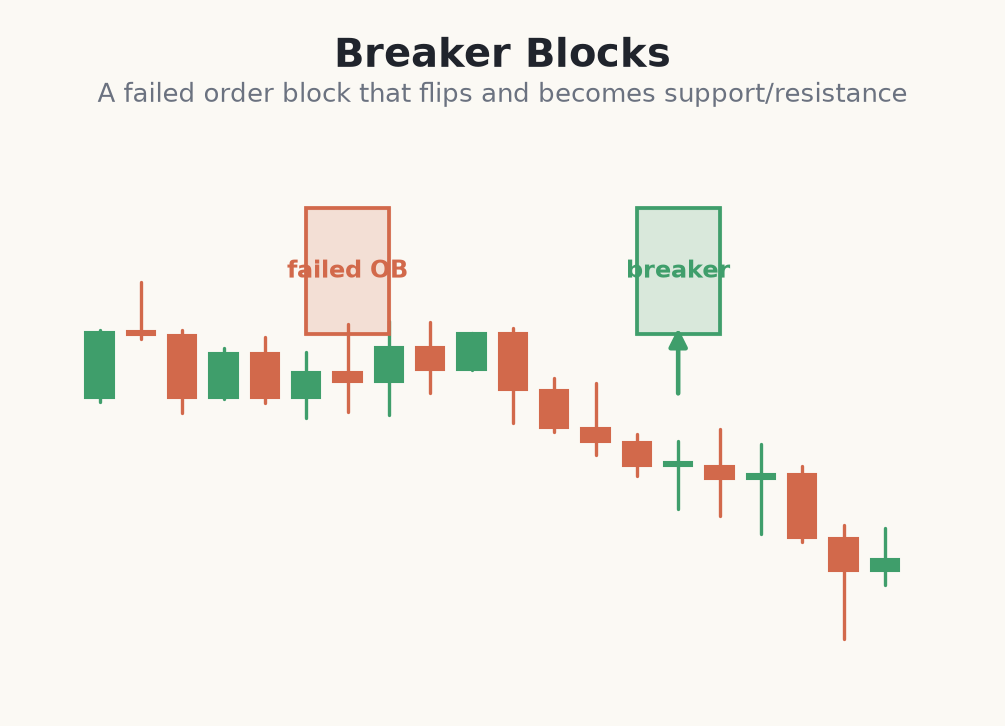
How a breaker forms
First an order block is established. Then price trades through it and, crucially, breaks structure in the opposite direction, signalling that the original story has changed. The traders trapped by the failed block provide fuel: their stops and reversals push price the new way when it retests the zone. Without that structure break it is just a failed block, not a breaker.
Why the trapped traders matter
The edge in a breaker comes from trapped positions. Everyone who bought the original bullish block is now underwater once it fails and structure breaks down. As price retests the zone, those trapped longs bail out (selling) and new shorts pile in — both feed the move. That concentration of forced flow is why a confirmed breaker can react so cleanly.
Entry and stop logic
Wait for the structure break to confirm the flip, then look to enter on the retest of the breaker in the new direction. The stop belongs just beyond the breaker, since price closing back through it means the flip has failed. As always, target the next liquidity or structural level for a defined reward-to-risk.
- A breaker is a <strong>failed order block</strong> confirmed by an opposite structure break.
- It <strong>flips role</strong>: old support becomes resistance and vice versa.
- The edge comes from <strong>trapped traders</strong> bailing out as price retests.
- Enter on the retest in the new direction, stop beyond the breaker.
Trading a bearish breaker retest
- 1EUR/USD 1-hour was bullish with an order block at 1.0870–1.0885. Price fails, trades through it, and breaks structure down below the last higher low at 1.0850.
- 2The failed bullish block is now a bearish breaker — expected to act as resistance on a retest.
- 3Price bounces back up into the breaker at 1.0878 and prints a bearish rejection on the 5-min. You enter short at 1.0876.
- 4Stop goes above the breaker at 1.0890 — a close there means the flip failed. Risk = 14 pips.
- 5Account €2,500, risk 1% = €25, so ~0.18 lots. Target sell-side liquidity at 1.0825, ~51 pips, about 3.6:1.
Common mistakes with breaker blocks
- Calling a failed block a breaker with no structure break. The flip is only valid once structure breaks the other way. Otherwise it is just a losing block.
- Front-running the retest. Entering before price actually returns to the breaker leaves you guessing. Wait for the retest and a reaction.
- Placing the stop inside the breaker zone. The zone is a range; a stop inside it gets clipped. Put it beyond the far edge of the breaker.
- Ignoring the higher-timeframe trend. A breaker fighting a strong higher-timeframe trend is lower probability. Prefer breakers that align with the new dominant flow.
A breaker block is a failed order block that flips direction after a structure break — trade its retest with the new flow, stop just beyond the zone.