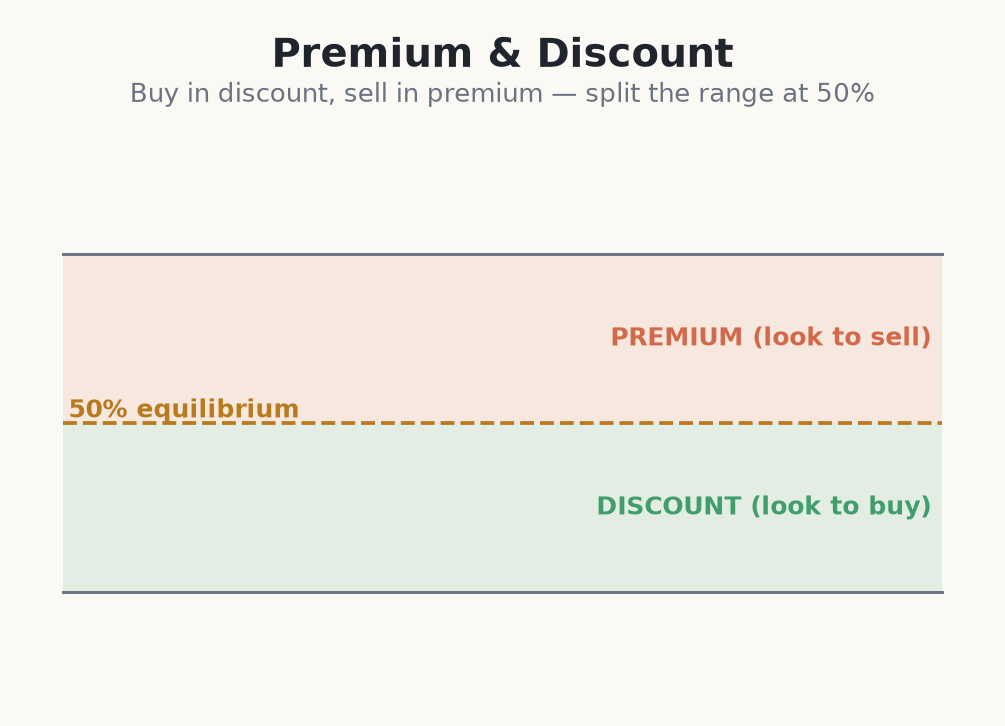
Premium and discount describe where price sits within a range relative to its midpoint. Split a swing from low to high with a Fibonacci tool: the upper half is premium (expensive) and the lower half is discount (cheap). The 50% line between them is equilibrium. It is the simplest idea in SMC and one of the most useful — it stops you buying at the top and selling at the bottom.
Why it matters
The idea is to buy at a discount and sell at a premium — the same logic as any market. In a bullish scenario you want longs from the discount zone, and in a bearish scenario you want shorts from the premium zone. It stops you chasing price at expensive levels and pushes your entries toward the side of the range with better reward-to-risk, because the stop can sit closer to the extreme.
How to apply it
- Draw the Fibonacci from the <strong>range low to the range high</strong> (or high to low) on the swing you care about.
- For longs, favour setups in the <strong>discount half</strong>; for shorts, the <strong>premium half</strong>.
- Combine with order blocks or FVGs that sit in the <strong>favourable zone</strong> for confluence.
- <strong>Redraw the range</strong> as structure updates — premium and discount are always relative to the current swing.
Combining it with a zone
Premium/discount is a filter, not a trigger. Its real power comes from confluence: an order block or FVG that also sits in the discount half of a bullish range is far more attractive than the same block sitting in premium. When your entry zone and the favourable half of the range line up, you have a much cleaner reason to trade.
Buying from the discount half of a range
- 1EUR/USD 1-hour rallies from a low at 1.0800 to a high at 1.0900, bias bullish. Equilibrium (50%) is 1.0850.
- 2You only want longs below 1.0850 (discount). Price pulls back and there is a bullish order block at 1.0825 — deep in discount. Confluence.
- 3Price taps the block at 1.0827 with a bullish 5-min rejection. You enter long at 1.0827.
- 4Stop goes below the block at 1.0812. Risk = 15 pips.
- 5Account €2,000, risk 1% = €20, so ~0.13 lots. Target the range high / buy-side liquidity at 1.0900, ~73 pips, about 4.9:1.
Common mistakes with premium & discount
- Buying in premium in a bull setup. Longing the expensive upper half means a worse price and a wider stop. Wait for discount.
- Forgetting to redraw the range. Once structure breaks, the old range is stale. Premium and discount must be recalculated on the new swing.
- Using it as a trigger by itself. 'Price is in discount' is not an entry. It is a filter — you still need a zone and confirmation.
- Picking a meaningless range. Splitting a random, choppy swing gives a useless midpoint. Anchor on a clean, obvious high and low.
Premium is the expensive upper half of a range, discount the cheap lower half — buy discount, sell premium, and use it as a filter that stacks with your entry zone.