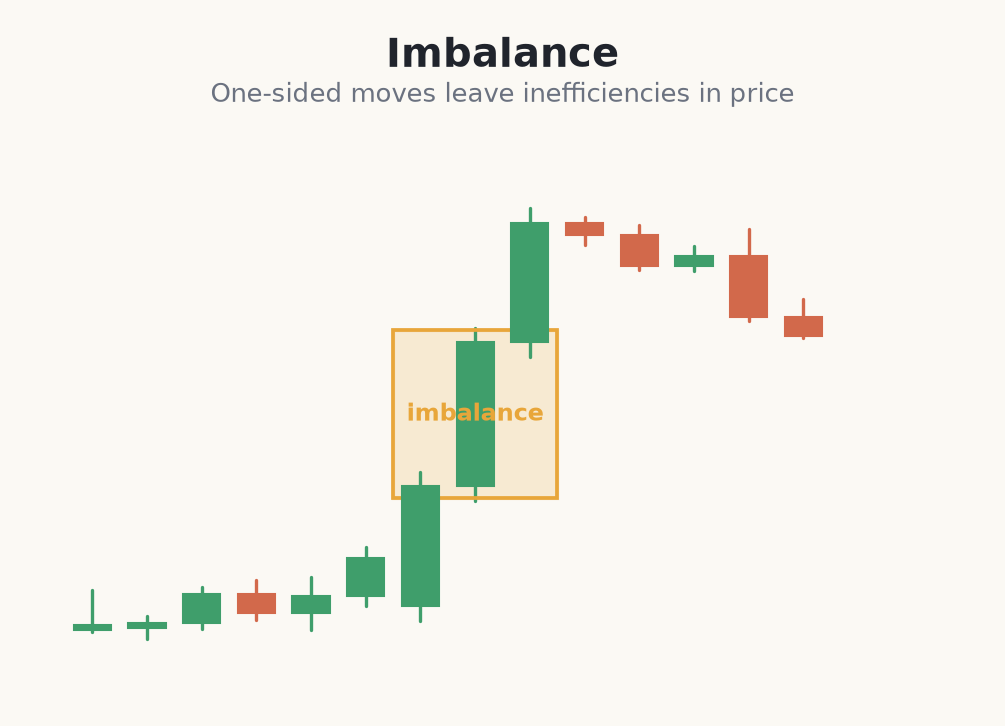
An imbalance is any area where price moved so quickly in one direction that buying and selling were lopsided. The fair value gap is the most common example, but the broader idea is simply a stretch of chart where one side overwhelmed the other and left an inefficiency behind. Think of the FVG as the precise, measurable version and imbalance as the general concept.
The efficiency principle
Markets prefer two-sided trading, where both buyers and sellers transact across a price range. A rapid, one-sided move skips that, so price often returns later to rebalance the area. This is the same mechanism behind FVGs, generalised to any lopsided run in price — a run of big same-colour candles with little overlap is the visual signature.
How to use it
Mark obvious imbalances as areas of interest where price may react on a return. Pair them with structure and liquidity for context; an imbalance on its own does not tell you direction, only that an inefficiency exists. And remember, not all imbalances get filled — some stay open for a long time or never rebalance at all.
- An imbalance is a <strong>one-sided run</strong> that left inefficiency in price.
- The <strong>FVG</strong> is the precise three-candle version of the same idea.
- Treat it as an <strong>area of interest</strong>, not a directional signal on its own.
- Pair with structure and liquidity; not every imbalance rebalances.
Using an imbalance as an entry area
- 1EUR/USD 1-hour drops in a run of four big black candles from 1.0900 to 1.0840 with almost no overlap — a clear bearish imbalance, and the higher-timeframe bias is bearish.
- 2You mark the imbalance zone roughly 1.0868–1.0885 (the least-traded middle of the run) as an area of interest for a short.
- 3Price rebounds up into the zone at 1.0876 and stalls with a bearish 5-min rejection. You enter short at 1.0874.
- 4Stop goes above the imbalance at 1.0891. Risk = 17 pips.
- 5Account €2,000, risk 1% = €20, so ~0.11 lots. Target the sell-side liquidity at 1.0835, ~39 pips, about 2.3:1.
Common mistakes with imbalances
- Treating an imbalance as a direction signal. It only marks inefficiency. Direction comes from structure and trend, not the gap itself.
- Expecting every imbalance to fill. Many stay open indefinitely. Do not marry a losing trade to the idea that price 'must' return.
- Marking micro-imbalances. Small, choppy gaps are noise. Only obvious, impulsive one-sided runs are worth watching.
- Entering with no confirmation at the zone. A tap of the imbalance is an area of interest, not a trigger. Wait for a reaction and define risk.
An imbalance is a one-sided move that left inefficiency — price often revisits it to rebalance, but treat it as an area of interest paired with structure, not a signal.