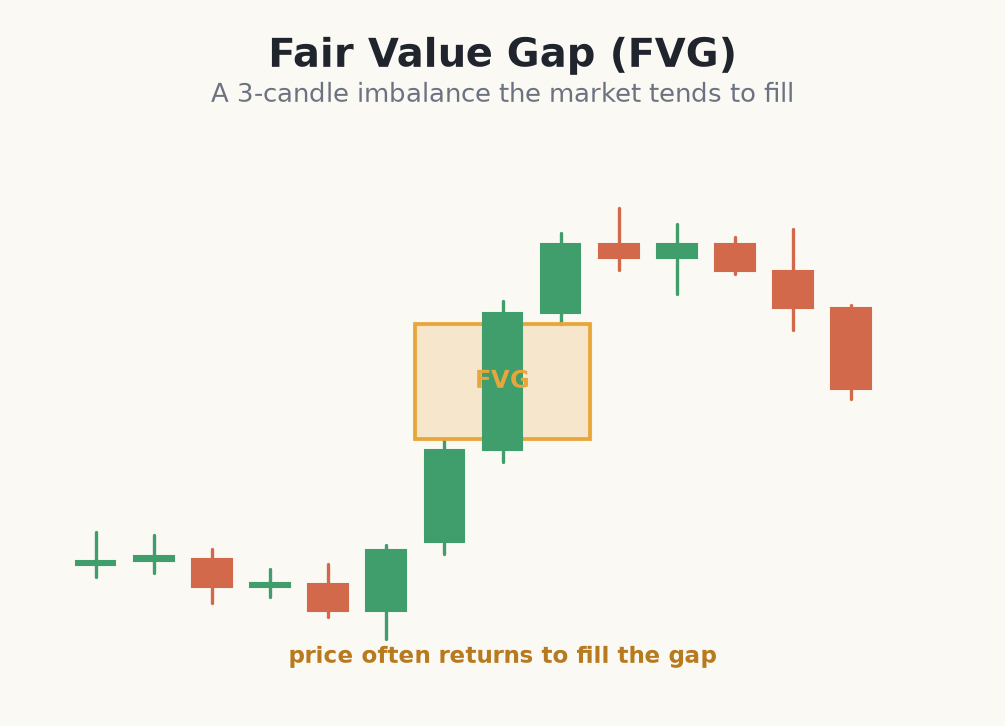
A fair value gap, or FVG, is a price imbalance left by a fast, one-sided move. It appears as a three-candle pattern where the first and third candles do not overlap, leaving a gap between them. SMC treats this gap as an inefficiency the market tends to revisit and fill. It is one of the most popular SMC entries because it is objective — you can measure it exactly.
Why FVGs matter
The move that creates an FVG was so aggressive that price skipped past a range without two-sided trading — an inefficiency where one side never got to transact. Markets tend to seek efficiency, so price often returns to rebalance the gap before continuing. That return is what SMC traders use for an entry, ideally in the direction of the move that created it.
How to find a valid FVG
- Look for three candles where <strong>candle 1's wick</strong> and candle 3's wick leave a gap around candle 2.
- The <strong>stronger and more impulsive</strong> the middle candle, the more meaningful the gap.
- FVGs <strong>aligned with the trend</strong> and order flow are higher quality than counter-trend gaps.
- Not every gap fills, and some fill only partially — it is a probability, not a rule.
Entry and stop logic
A common approach is a limit at the gap or entering as price taps it with confirmation. Many traders watch the 50% of the gap as the decision point — a reaction there is often enough, and it improves the entry price. The stop sits beyond the gap or the origin of the move, and the target is the next liquidity pool. Combine the FVG with structure — a gap alone is a weak signal.
Entering a bullish fair value gap
- 1EUR/USD 15-min prints a strong impulse up that breaks structure. The three-candle FVG spans 1.0846–1.0862 (candle 1 high 1.0846, candle 3 low 1.0862).
- 2The impulse is aligned with a bullish higher-timeframe bias, so the gap is high quality. You wait for a pullback.
- 3Price retraces into the gap and reacts at its 50%, 1.0854, with a bullish 5-min candle. You enter long at 1.0854.
- 4Stop goes below the gap and impulse origin at 1.0840. Risk = 14 pips.
- 5Account €3,000, risk 1% = €30, so ~0.21 lots. Target buy-side liquidity at 1.0910, ~56 pips, about 4:1.
Common mistakes with fair value gaps
- Trading every gap you see. Tiny gaps from weak candles fill randomly. Only meaningful, impulsive FVGs aligned with the trend are worth an entry.
- Assuming a gap must fill. Many never fill, or fill much later. It is a tendency, not a guarantee — never hold a losing trade 'because the gap will fill'.
- Ignoring structure and trend. A counter-trend FVG against strong flow is low probability. Pair the gap with a structure shift for context.
- No confirmation at the tap. Buying the instant price touches a gap, with no reaction, often means catching it mid-flight. Wait for a candle to react.
A fair value gap is a three-candle imbalance price often rebalances — use it as an entry zone aligned with the trend, never as a stand-alone signal.