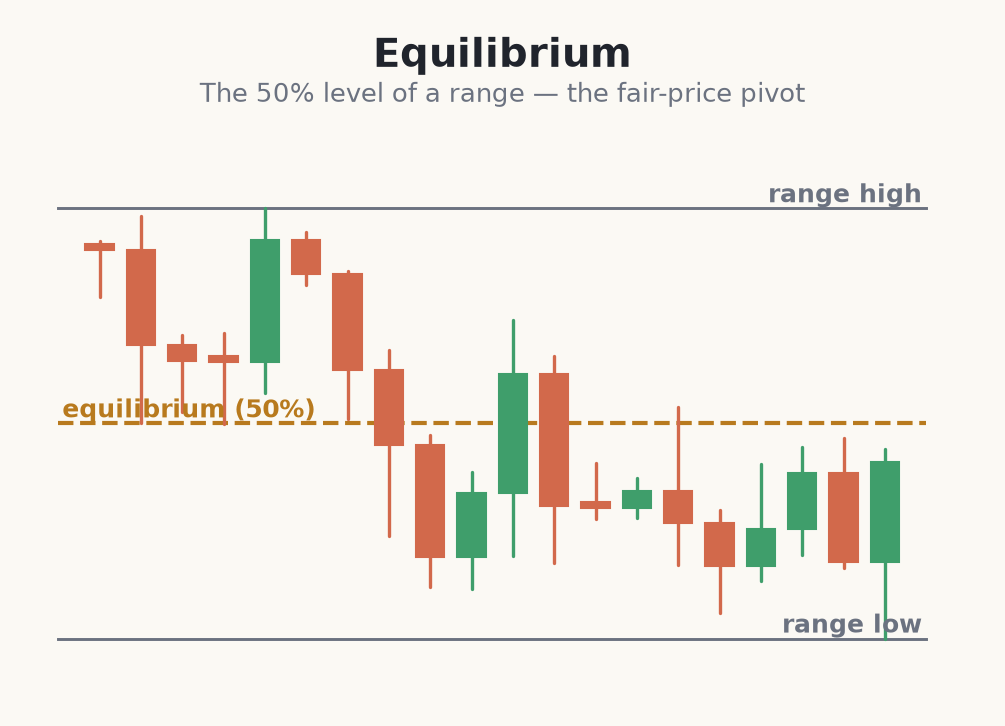
Equilibrium is the 50% level of a defined range — the exact midpoint between a swing high and swing low. It is the dividing line between premium and discount, and SMC treats it as the point of fair value where price is neither cheap nor expensive.
Why the midpoint matters
Because it marks fair value, equilibrium often acts as a pivot or magnet. Price frequently retraces to around 50% of a strong move before deciding its next direction, which is why the midpoint shows up in so many SMC and Fibonacci-based setups.
How to use it
Use equilibrium as a reference, not a rule: a bullish trade is more attractive when price is below equilibrium (discount), and a bearish trade when it is above (premium). It is a filter that stops you from entering at poor prices, best confirmed by structure and a level of interest.
Sizing a discount entry from equilibrium
- 1On GBP/USD the range runs from a swing low at 1.2500 to a swing high at 1.2700. Equilibrium sits at the 50% midpoint = 1.2600.
- 2Bias is bullish from higher-timeframe structure, so you only want to buy in the discount half below 1.2600 — never chase longs above it.
- 3Price pulls back to 1.2540 (deep discount) and taps a demand order block. You enter long at 1.2545.
- 4Stop goes below the range low at 1.2490 — a break there means the range and the bullish read are done. Risk = 55 pips.
- 5Account €1,000, risk 1% = €10. With a 55-pip stop, size ≈ €10 ÷ 55 pips ≈ 0.018 lots on GBP/USD.
- 6Target is the range high at 1.2700, ~155 pips away — roughly 2.8:1 reward-to-risk. Entering below equilibrium is what made that ratio possible.
Common mistakes with equilibrium
- Buying above equilibrium in a range. Longing in the premium half means paying up and shrinking your reward-to-risk — the level exists to stop exactly this.
- Measuring the wrong range. Equilibrium is only meaningful on a valid, clearly-defined swing high to swing low. Draw it on random noise and the 50% is meaningless.
- Treating the midpoint as a signal. Price touching equilibrium is not an entry — it is a filter. You still need structure and a level of interest to act.
- Ignoring the higher-timeframe bias. Discount only favours longs when the bigger trend is up. In a downtrend, the discount half can just be a stop on the way lower.
- Skipping the stop because the price looked cheap. A discount entry can still fail. Always place the stop beyond the range invalidation and size from it.
Equilibrium is the 50% fair-value midpoint of a range — the pivot separating discount below from premium above.