Inducement is a piece of obvious liquidity placed to lure traders in before the intended move. It is the tempting swing point or minor level that gets everyone positioned the wrong way, providing the orders needed to fill the real move. In SMC it explains why the cleanest-looking entry so often fails.
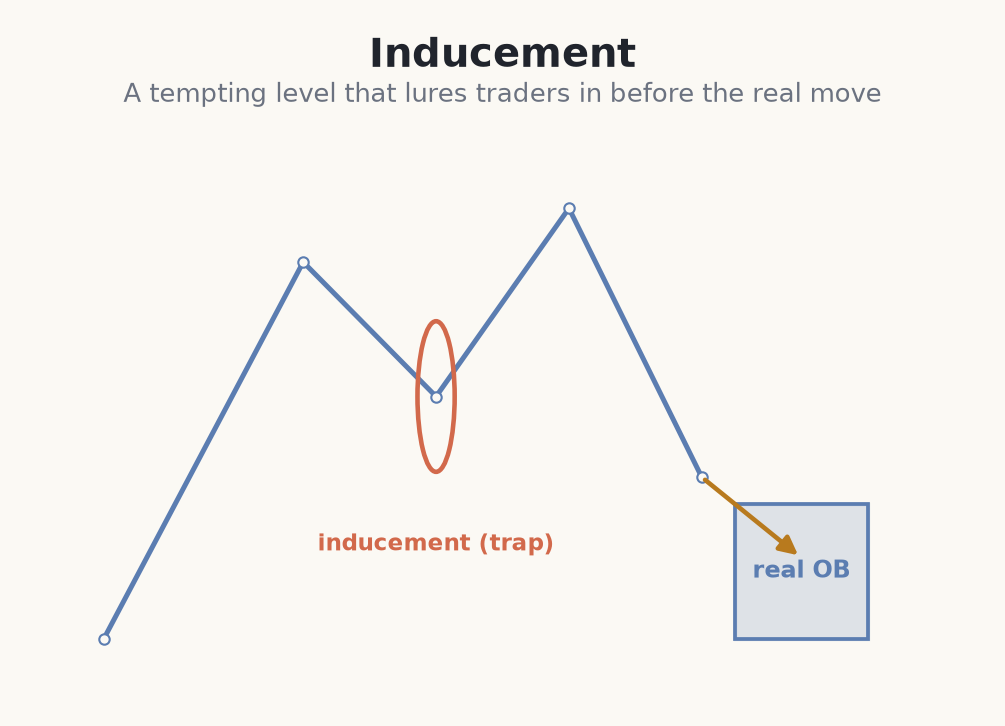
How inducement works
The obvious high or low that everyone would trade becomes the bait. Retail piles in, their stops become liquidity, and price sweeps that inducement before reaching the genuine order block or FVG deeper in the move. The real setup usually sits beyond the inducement, not at the first tempting level.
How to avoid the trap
Ask whether the level you like is too obvious — if so, treat it as potential inducement rather than an entry. Look for the deeper zone that price is likely reaching for, and wait for a sweep of the inducement plus a structure shift. This is a probabilistic idea, not a certainty, so still define risk clearly.
- Inducement is obvious liquidity designed to lure early entries.
- The real order block or FVG usually sits beyond the inducement.
- If a level looks too clean, treat it as possible bait.
- Wait for the inducement to be swept before trusting the deeper zone.
Waiting past inducement into the real order block
- 1On the 15-minute EUR/USD you are bullish and mark an obvious minor swing low at 1.0880 — the level everyone would buy. Treat it as inducement, not entry.
- 2Deeper below sits a fresh demand order block at 1.0850–1.0855, created before the last displacement up. That is the real zone.
- 3Price dips, taps 1.0880, tempts early longs, then sweeps straight through it — those longs are now trapped and their stops feed the move.
- 4Price runs into the order block at 1.0852 and prints a lower-timeframe CHoCH. You enter long at 1.0856.
- 5Stop goes below the order block at 1.0842. Risk = 14 pips. Account €1,000, risk 1% = €10 → size ≈ €10 ÷ 14 pips ≈ 0.071 lots.
- 6Target the prior high near 1.0910, ~54 pips away — about 3.8:1. Patience past the inducement is exactly what bought that reward-to-risk.
Common mistakes with inducement
- Buying the first obvious level. The cleanest swing is usually the bait. If everyone can see it, its liquidity is likely being harvested, not defended.
- Entering before the inducement is swept. The whole point is that price takes that liquidity first — jumping in early puts you in exactly the trapped crowd.
- Confusing inducement with the real zone. The genuine order block or FVG sits beyond the inducement. Mislabel them and you enter at the worst possible price.
- Treating it as a guarantee. Inducement is a probabilistic read, not a law. Sometimes the obvious level simply holds. Always define risk regardless.
- No confirmation after the sweep. A sweep alone is not entry — wait for a structure shift or CHoCH in the deeper zone before committing.
Inducement is the obvious liquidity that baits traders early — the real entry usually waits beyond it.