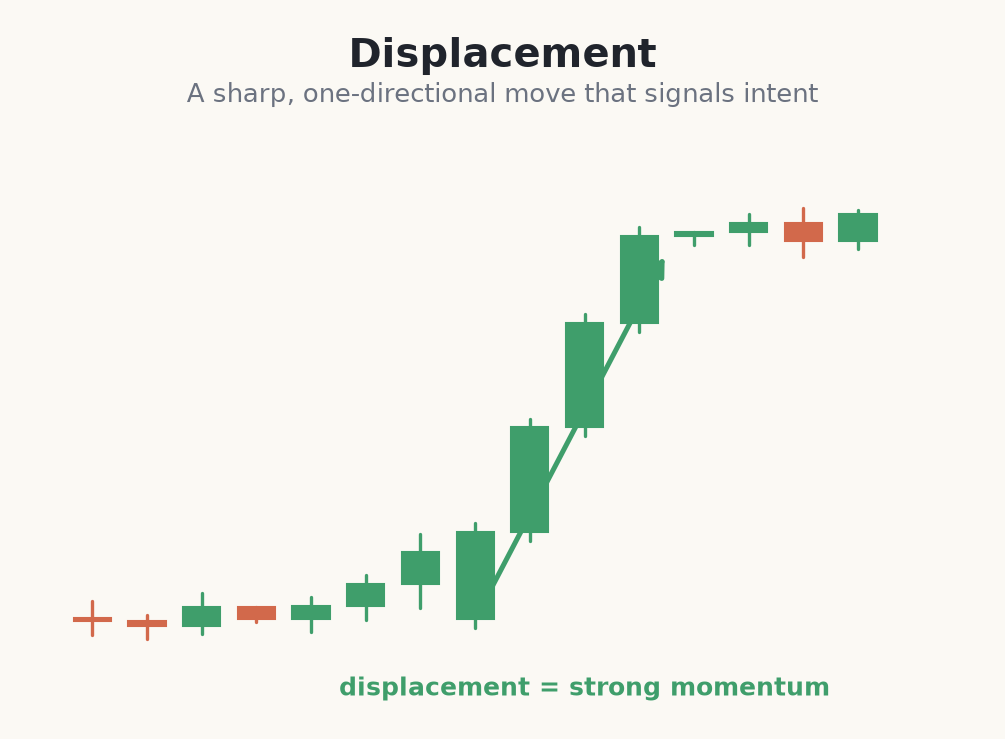
Displacement is a sharp, forceful move in one direction — a run of strong, wide-range candles that leaves imbalance behind. SMC treats it as a footprint of institutional intent, because ordinary noise does not usually move price this decisively.
Why it matters
Displacement is what turns a plain break into a meaningful one. A structure break backed by displacement is far more convincing than a slow, overlapping drift through a level, because it usually leaves an FVG and a fresh order block you can trade from. It is the energy that validates a market structure shift.
How to use it
Use displacement as a confirmation filter. After a sweep, a displacement move away from the level tells you the reversal has conviction. The order block and FVG created by that displacement then become your entry zones. Weak, indecisive breaks without displacement deserve more caution.
Trading the FVG left by displacement
- 1On the 5-minute US30 (Dow) index, price sweeps a session low at 38,600, then fires up with three wide-range bullish candles — clear bullish displacement.
- 2That run leaves a fair value gap between 38,660 and 38,690 and prints a CHoCH — the displacement validated the shift.
- 3You wait for the retrace into the FVG and enter long at 38,675 as price fills the gap and holds.
- 4Stop goes below the displacement origin at 38,590 — if that fails, the intent read was wrong. Risk = 85 points.
- 5Account €1,000, risk 1% = €10. At €1 per point, size ≈ €10 ÷ 85 ≈ 0.12 contracts (or the nearest micro/CFD size your broker allows).
- 6Target the next liquidity at 38,940, ~265 points away — about 3.1:1. No displacement, no trade: the sharp move is the whole edge here.
Common mistakes with displacement
- Trading breaks with no displacement. A slow, overlapping drift through a level is not intent. Without wide-range candles and imbalance, the break is far weaker.
- Confusing a news spike with displacement. A single erratic candle on a headline can reverse instantly. Look for a sustained run that leaves structure, not one violent wick.
- Chasing the displacement candle itself. Entering mid-move at the extreme gives a terrible stop. Wait for the retrace into the FVG or order block it created.
- Ignoring the origin as your invalidation. If price closes back beyond where the displacement began, the intent read is dead — that is where the stop belongs.
- Assuming displacement guarantees continuation. It raises the odds, it does not remove risk. Size from the stop and accept that some validated shifts still fail.
Displacement is a sharp, imbalanced move that signals intent — it validates structure shifts and creates tradeable zones.