The Power of Three is an ICT model that breaks a move into three phases: accumulation, manipulation and distribution. It is a way of framing how a large position might be built, protected and then unwound within a session or a swing.
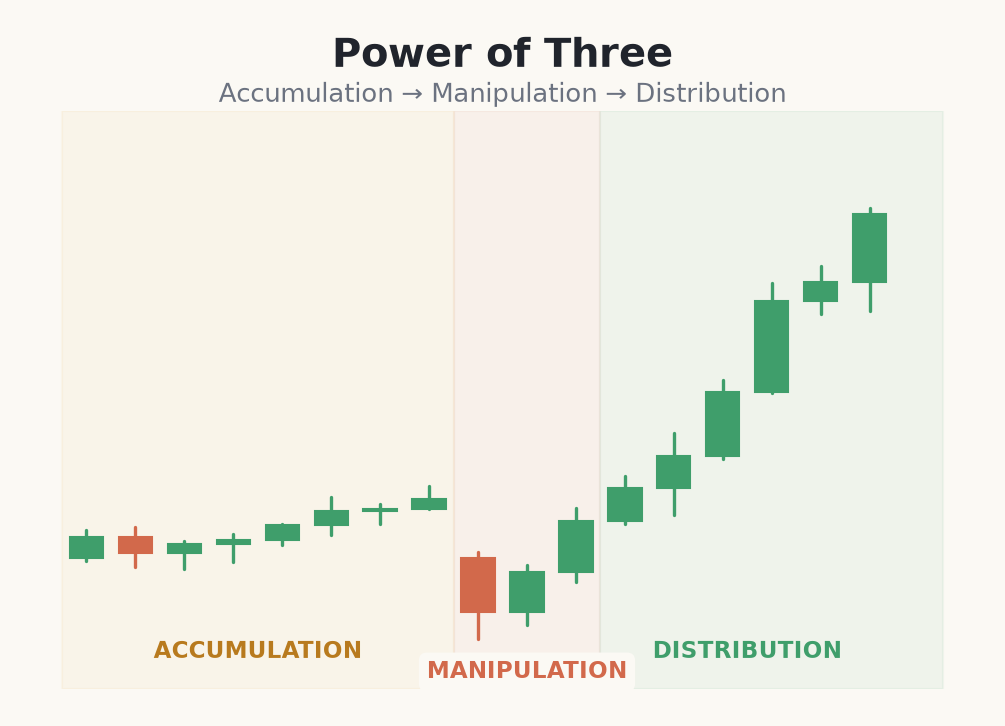
The three phases
- Accumulation: price consolidates in a range while a position is quietly built.
- Manipulation: a false move sweeps liquidity in the wrong direction to trap traders.
- Distribution: the real, sustained move plays out in the intended direction.
The insight is that the first obvious move is often the fake. During manipulation, price runs the opposite way to gather liquidity and trap breakout traders, and only then does the genuine distribution leg begin. Recognising this can stop you from chasing the manipulation move.
How to use it honestly
Treat Power of Three as a narrative framework, not a precise timing tool. Phases are only clear in hindsight and do not appear on every chart. Use it to stay patient through the manipulation and to align entries with the distribution leg once structure confirms it.
Trading the distribution leg after the manipulation sweep
- 1On the daily open, EUR/USD builds an accumulation range between 1.0900 and 1.0930 during the quiet session — you mark both edges.
- 2At the London open, price drives below the range low to 1.0885 — a manipulation sweep that traps breakout sellers. You do NOT short this.
- 3Price snaps back above 1.0900 with displacement and prints a CHoCH — the distribution leg up is beginning. You enter long at 1.0912.
- 4Stop goes below the manipulation low at 1.0878 — if that breaks, the read failed. Risk = 34 pips.
- 5Account €1,000, risk 1% = €10 → size ≈ €10 ÷ 34 pips ≈ 0.029 lots on EUR/USD.
- 6Target the buy-side liquidity above at 1.0985, ~73 pips away — about 2.1:1. The edge came from waiting out the fake move, not chasing it.
Common mistakes with Power of Three
- Trading the manipulation as a breakout. The first obvious push is usually the trap. Chasing it puts you on the wrong side right before distribution begins.
- Forcing the model onto every chart. Not every session accumulates, manipulates and distributes cleanly. Many days are just noise — don't invent phases that aren't there.
- Using it for precise timing. Phases are only obvious in hindsight. Treat it as a narrative to stay patient, not a clock that tells you the exact turn.
- Entering distribution with no confirmation. Wait for the snap-back plus a structure shift. A sweep alone is not proof the distribution leg has started.
- No stop beyond the manipulation extreme. Sometimes the 'fake' is real continuation. Your invalidation must sit past the sweep, and size comes from it.
Power of Three frames a move as accumulate, manipulate, distribute — the first obvious push is often the trap.