ICT kill zones are specific time windows during the trading day when volatility and volume are often higher, typically around major session opens. The idea is that liquidity events cluster during these windows, so setups may resolve more cleanly than in quiet periods.
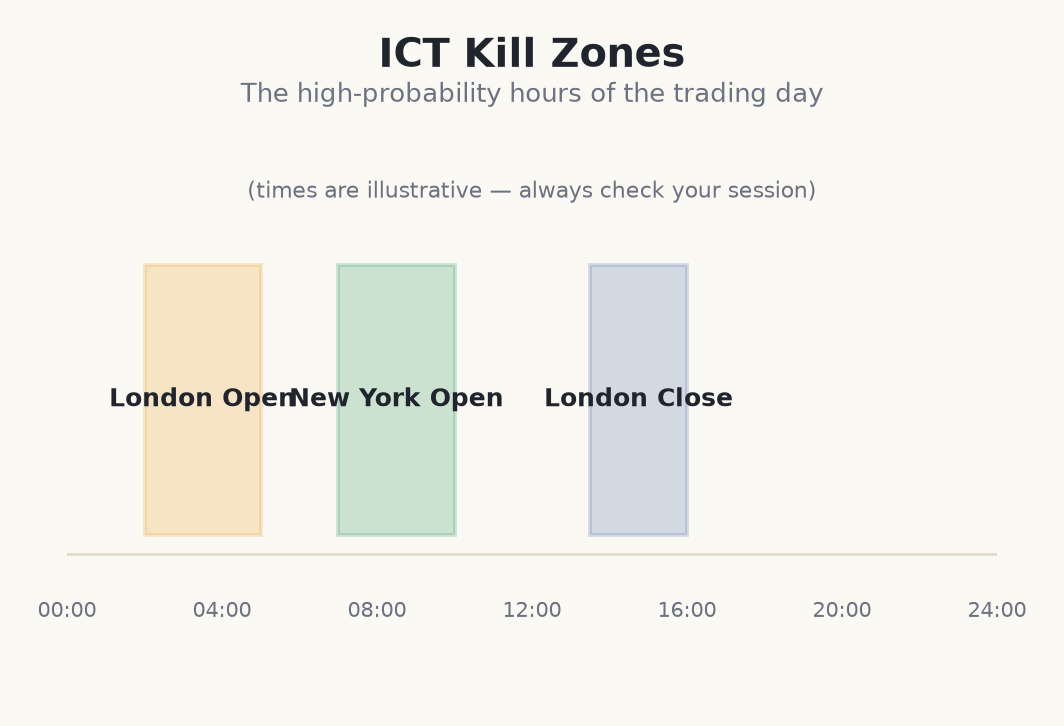
The commonly cited windows
- London open — often around the start of the European session.
- New York open — around the start of the US session, frequently overlapping London.
- London close — a later window as the European session winds down.
- An Asian range that later provides liquidity for the London and New York moves.
These labels come from the FX world and are usually quoted in a specific time zone. The exact clock times are illustrative only and shift with daylight saving, your broker's server time, and the market you trade — crypto and index futures do not follow FX sessions. Always convert the concept to your own instrument and time zone.
How to use it honestly
Kill zones are a filter, not a signal. Trading during active hours can improve fills and follow-through, but the window alone is not a reason to trade — you still need structure, liquidity and a valid setup. Backtest whether these windows actually help on your market before relying on them.
Taking a London-open setup inside the kill zone
- 1During the Asian session, GBP/USD builds a tight range between 1.2650 and 1.2680 — you mark the range as the liquidity pool for later.
- 2You wait for the London-open window (illustrative — convert to your own broker time). Outside this window you take no trade.
- 3At the open, price sweeps the Asian high to 1.2688, then reverses with displacement and a CHoCH — a valid sell setup inside the active window.
- 4You enter short at 1.2670 on the retrace into the FVG. Stop goes above the sweep at 1.2694. Risk = 24 pips.
- 5Account €1,000, risk 1% = €10 → size ≈ €10 ÷ 24 pips ≈ 0.041 lots on GBP/USD.
- 6Target the Asian range low at 1.2650 then the next pool at 1.2620, ~50 pips away — about 2:1. The window improved timing; the setup still did the work.
Common mistakes with kill zones
- Trading the window with no setup. A kill zone is a filter, not a signal. Being in the right hour means nothing without structure, liquidity and confirmation.
- Using fixed clock times blindly. The quoted times shift with daylight saving and your broker's server time. Convert the concept to your own instrument and zone.
- Applying FX sessions to the wrong market. Crypto trades 24/7 and index futures follow their own rhythm. FX kill zones may not map to them at all — test first.
- Forcing trades to 'not miss' the window. Overtrading during active hours burns capital fast. If no clean setup appears, the correct action is no trade.
- Assuming the window guarantees follow-through. Volatility can also mean whipsaws and wider spreads. Higher activity is not the same as higher probability.
Kill zones flag active session windows, but the exact times are illustrative and depend on your session, broker and market.