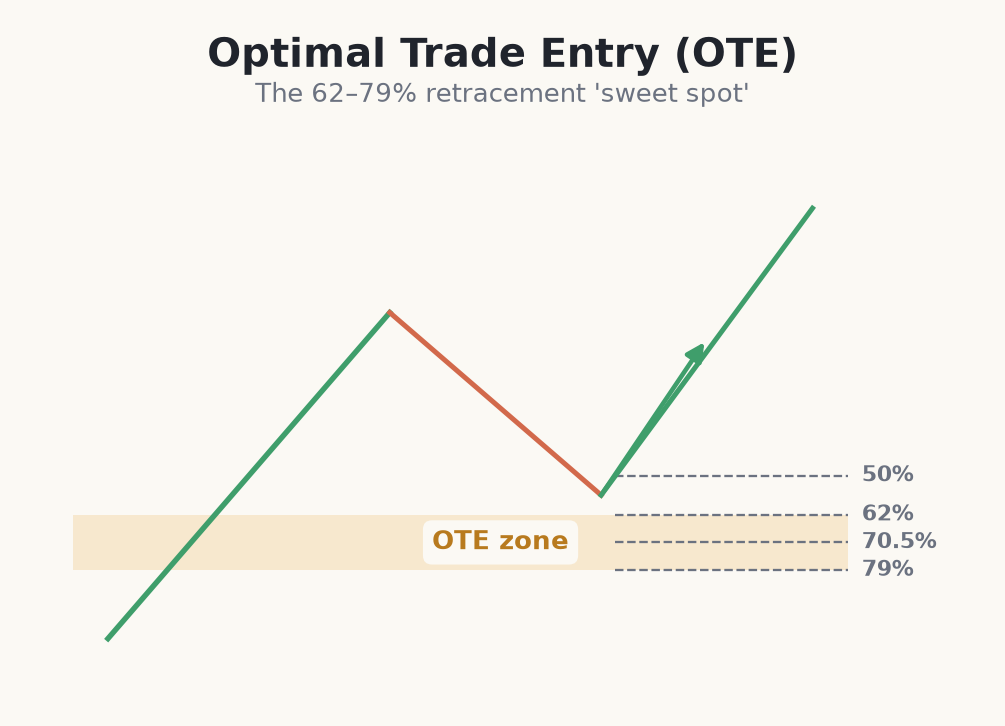
Optimal Trade Entry, or OTE, is an ICT retracement zone used to time entries within a confirmed move. It is drawn with a Fibonacci from the start to the end of an impulse and focuses on the 62% to 79% retracement band, a deep pullback that still sits within the trend.
Why the deep retracement
A deep pullback lets you enter at a discount within the trend, improving your reward-to-risk because the stop can sit just beyond the origin. The 70.5% level between 62% and 79% is often watched as the sweet spot. The logic works only when the impulse and structure genuinely favour continuation.
Entry, stop and target
- Draw the Fibonacci across a confirmed, structure-breaking impulse.
- Look for entries as price trades into the 62%–79% zone, ideally at an order block or FVG there.
- Stop goes just beyond the origin of the move (below the swing low for longs).
- Targets are typically the prior high/low or the next liquidity pool for strong reward-to-risk.
OTE is not a stand-alone signal. Combine it with market structure, a liquidity sweep and a confirmation like a CHoCH on a lower timeframe. Deep retracements sometimes turn into full reversals, so the stop beyond the origin is what keeps a wrong read small.
Plotting the OTE zone and sizing the entry
- 1On EUR/USD a confirmed bullish impulse runs from a swing low at 1.0800 (origin) to a swing high at 1.0900 (a 100-pip leg). You draw the Fibonacci low-to-high.
- 2The OTE zone (62%–79%) sits between 1.0838 and 1.0821, with the 70.5% sweet spot near 1.0830.
- 3Price retraces into the zone and taps an order block at 1.0829 with a lower-timeframe CHoCH confirming. You enter long at 1.0830.
- 4Stop goes just below the origin at 1.0794 — beyond the swing low that must hold. Risk = 36 pips.
- 5Account €1,000, risk 1% = €10 → size ≈ €10 ÷ 36 pips ≈ 0.027 lots on EUR/USD.
- 6Target the prior high / buy-side liquidity at 1.0900, ~70 pips away — about 1.9:1, and the next pool at 1.0940 stretches it past 3:1. The deep entry is what funds that ratio.
Common mistakes with OTE
- Drawing the Fib on an unconfirmed move. OTE only works on a genuine structure-breaking impulse. Plot it on random noise and the 62%–79% zone means nothing.
- Treating the zone as an automatic buy. Price reaching 70.5% is not a signal. Without a sweep, order block or CHoCH inside it, you are just catching a falling knife.
- Putting the stop inside the zone. A deep pullback can wick further. The stop belongs beyond the origin, not at the 79% level where noise easily takes you out.
- Forgetting deep retraces can fully reverse. Sometimes the 'pullback' is the start of a new trend. The origin stop is exactly what keeps that wrong read cheap.
- Ignoring reward-to-risk. If the target barely clears the stop distance, the discount entry gained you nothing. Confirm the ratio before clicking.
OTE is the 62%–79% retracement of a confirmed impulse — a discount entry with the stop just beyond the origin.