Risk management is what separates scalpers who last from those who blow up. Because scalping produces so many trades, any flaw in your risk is repeated relentlessly. The single most important rule is to risk a small, fixed percentage of your account on every single trade — commonly well under one percent.
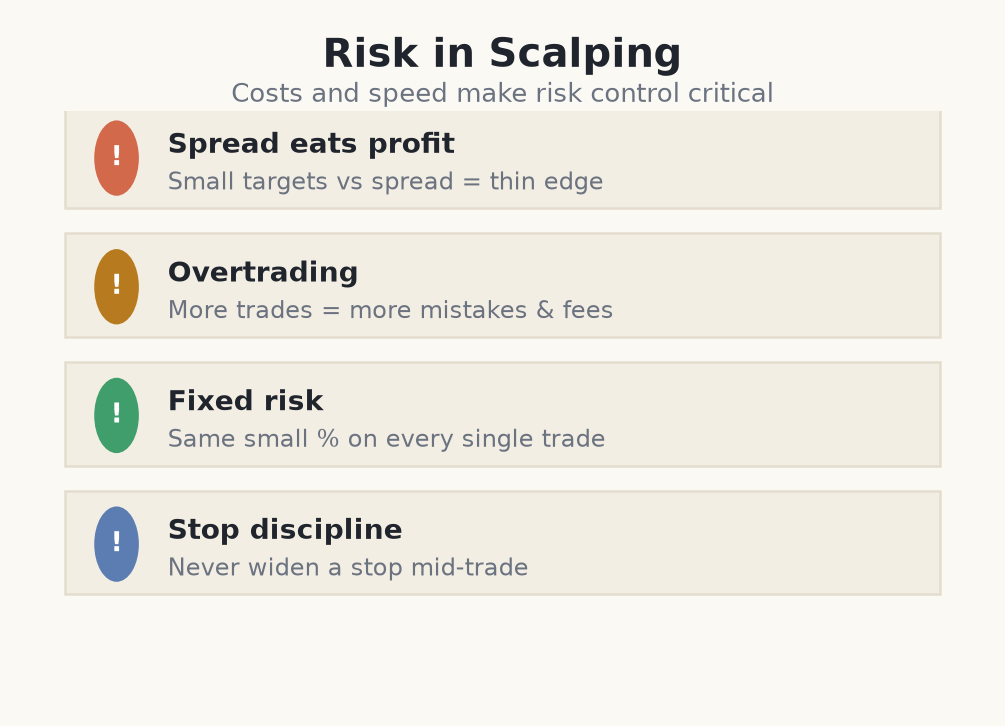
Fixed risk decides your size
The workflow runs one way: choose the stop at a logical level first, then size the position so that if that stop is hit you lose only your fixed small percentage. The stop distance is dictated by the chart; the position size adjusts to fit it. You never do this backwards by picking a size and then hunting for a stop that fits.
Never widen a stop
The most destructive habit in trading is moving a stop further away to avoid taking a loss. It converts a small, planned loss into a large, unplanned one and it is how accounts are destroyed in a single trade. A stop is a promise: once placed, it only ever moves in your favour to lock in profit, never against you.
Costs and overtrading
Scalping carries a hidden tax: the spread and commission on every trade. Because you trade so often, these costs accumulate into a serious drag, so your edge must be large enough to clear them repeatedly. This is also why overtrading is so dangerous — each extra low-quality trade adds cost and risk while adding no edge.
- Risk a fixed small percentage on every trade — no exceptions.
- Set the stop at a logical level first, then size to fit it.
- Never widen a stop; a stop only moves to protect profit.
- Count costs and set a daily loss limit to curb overtrading.
Sizing three scalps to fixed risk on a €1,000 account
- 1Your rule: risk 1% = €10 per trade, hard daily loss limit of 3% (€30 / three losers), then you stop for the day. This is decided before the session, not in the heat of it.
- 2Trade A — EUR/USD, stop 4 pips. To lose €10 on 4 pips you size ~0.25 lots (€2.50/pip). Chart sets the stop; size adjusts to it.
- 3Trade B — gold XAUUSD, stop 3.5 points. Same €10 risk means ~0.03 lots. The instrument is bigger, so the position is smaller — risk in money is identical.
- 4Trade C — NAS100, stop 20 points. Same €10 risk means ~0.05 lots. Three different instruments, three different sizes, one fixed €10.
- 5Say A and B both lose: −€20, plus ~€5 of spread and commission across the trades. You are down ~€25. One more loser hits your €30 limit and you are done — the limit caps the damage.
- 6Never widen: if trade A ticks to −3 pips you do not move the stop to −8 'to give it room'. That single habit is what turns a €10 loss into a €30+ disaster.
Common risk-management mistakes in scalping
- Widening a stop to avoid a loss. The single most destructive habit in trading. It converts a small planned loss into a large unplanned one — this is how accounts blow up in one trade.
- Sizing first, then hunting a stop to fit. Backwards. The chart dictates the stop; the position size adjusts to keep risk at your fixed €10.
- Risking a bigger percentage 'because the setup looks perfect'. The cleanest setups still fail regularly. Fixed risk means fixed — no exceptions for confidence.
- No daily loss limit. Without a hard stop for the day, three losses become ten as you chase them back. Decide the limit in advance and honour it.
- Forgetting costs compound. Twenty scalps a day at a few euros of spread each is real drag. Overtrading adds cost and risk while adding no edge.
Fixed small risk and a stop you never widen are non-negotiable — everything else in scalping is secondary to protecting the account.