Knowledge only helps if it becomes a repeatable routine. An intraday plan is a short written document that tells you what to trade, when, how, and — crucially — when to stop. Fast trading gives you no time to improvise, so the decisions must be made in advance, calmly.
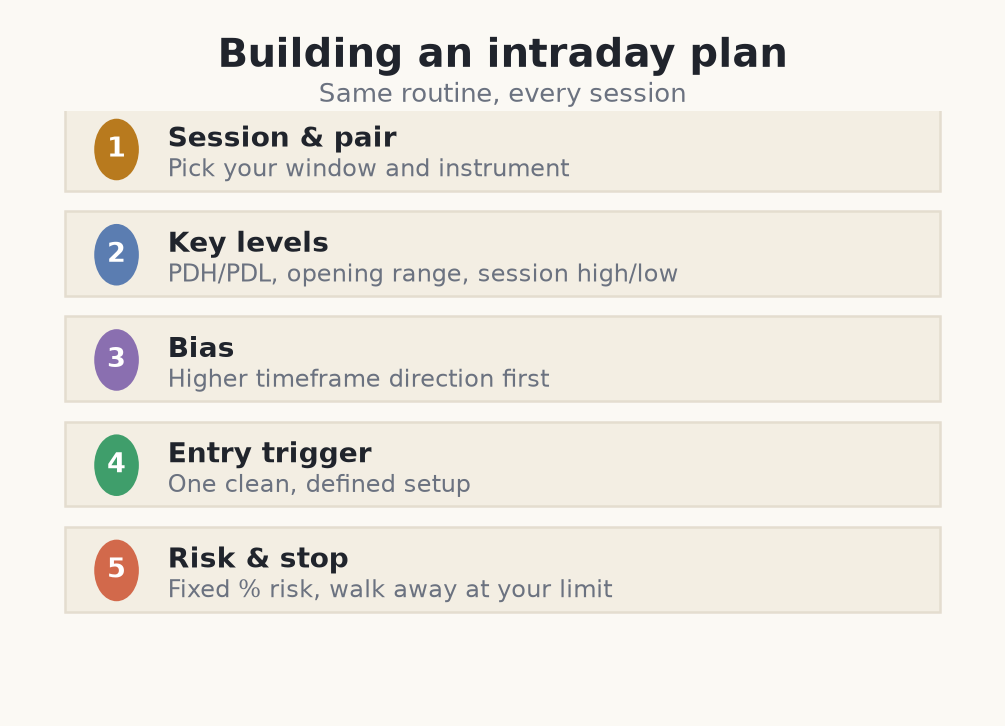
A five-step plan
- 1. Instrument & session: which markets, and which hours you will trade.
- 2. Levels: mark PDH, PDL, the Asian range and key round numbers.
- 3. Setups: the specific ORB, pullback or range plays you will take.
- 4. Risk: fixed small percentage, stop rules, and a hard daily loss limit.
- 5. Review: log every trade and study the results afterwards.
Notice that risk and a daily loss limit are built into the plan, not bolted on. Deciding in advance that you stop after a set loss for the day protects you from the emotional spiral that fuels overtrading — the single fastest way a scalper wrecks an account.
Finally, keep a trading journal. Recording each trade, the reason for it and the outcome turns random screen time into feedback you can actually learn from. A plan you follow and review beats a clever idea you trade on impulse, every time.
A worked one-page intraday plan for a €1,000 account
- 1Instrument & session. EUR/USD and NAS100 only, traded in the London–New York overlap. No other pairs, no other hours — the plan closes the rest of the market off.
- 2Levels. Before the open you mark PDH 1.09200, PDL 1.08600, the Asian range 1.08650–1.08750, and the round number 1.09000.
- 3Setups. Two only: the opening range breakout and a PDH/PDL rejection fade. Anything that is not one of these two is not a trade.
- 4Risk. 1% = €10 per trade, stop always at a logical level with size fitted to it, and a hard daily loss limit of €30 — three losers and you are flat for the day.
- 5Example trade. Price fades PDH 1.09200 with a bearish rejection; you short 1.09180, stop 1.09230 (5 pips, ~0.20 lots, €10 risk), target 1.09080 for a 2:1.
- 6Review. Every trade goes in the journal with its reason and result. At session end you check: did I follow the plan, or improvise? The answer, not the P&L, is the scorecard.
Common mistakes with an intraday plan
- Having no written plan at all. Fast trading gives you no time to improvise. If the decisions are not made in advance, they get made on emotion mid-trade.
- Trading setups not in the plan. The moment you take a 'nice-looking' trade outside your two setups, the plan is meaningless. Discipline is following it on a boring day.
- Leaving out the daily loss limit. A plan without a hard stop for the day does not protect you from the revenge-trading spiral that wrecks accounts fastest.
- Never reviewing. A journal you do not read is just a diary. The edge comes from studying the results and cutting what does not work.
- Rewriting the plan after every loss. A plan changed on tilt is no plan. Adjust it calmly on a schedule from journal evidence, not in reaction to one bad trade.
A written five-step plan — instrument, levels, setups, risk, review — is what turns scattered scalping ideas into a disciplined routine.