Not every day trends. On many quiet sessions price oscillates inside a daily range, drifting between a high and a low without going anywhere. When conditions are clearly range-bound, a mean-reversion approach — fading the edges — can suit the environment.
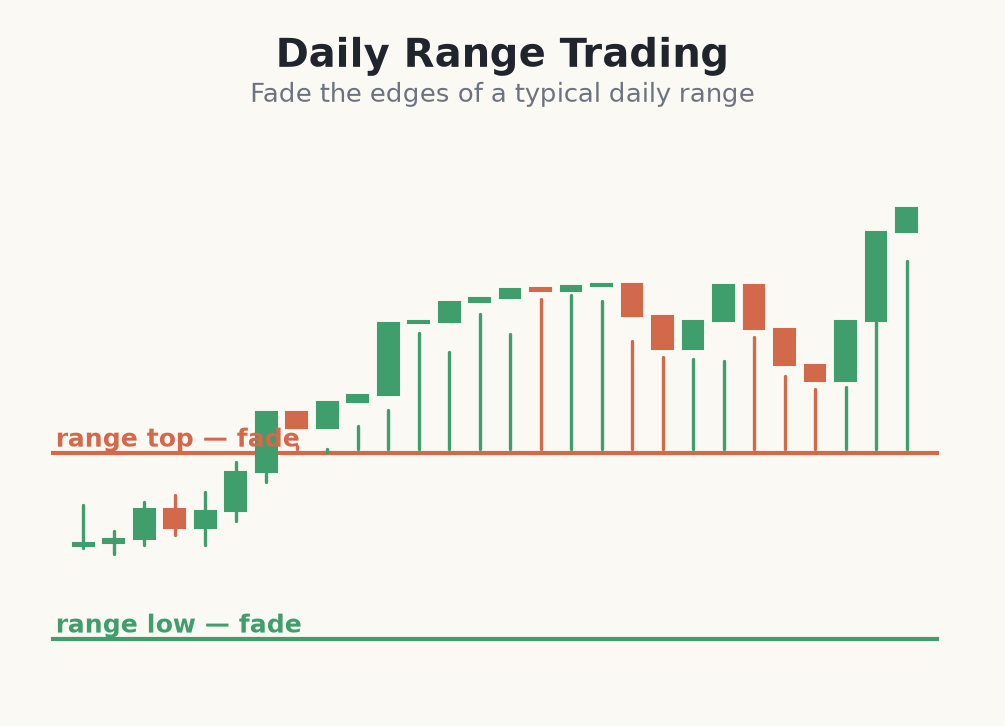
Fading the edges
The idea is to sell near the top of the range and buy near the bottom, expecting price to rotate back toward the middle. Entries come on signs of rejection at the edge, stops sit just beyond it, and targets aim for the range midpoint or the opposite edge.
When ranges are a trap
The danger is obvious and serious: ranges eventually break. Fading the edge of a range that is about to become a breakout puts you on exactly the wrong side of a fast move. This is why range trades need a tight stop beyond the edge and why you must stand aside the moment structure or a session open threatens to trend.
- Only fade edges when the day is clearly range-bound.
- Sell rejections at the top, buy rejections at the bottom.
- Stop just beyond the edge — a break there ends the trade.
- Every range eventually breaks; do not marry the mean-reversion view.
Fading a range edge on a €1,000 account
- 1On a quiet session EUR/USD is clearly range-bound between 1.08400 (bottom) and 1.08520 (top) — a 12-pip box price keeps rotating inside.
- 2Price rallies to the top and prints a bearish rejection at 1.08520. You sell high at 1.08505, expecting a rotation back toward the middle.
- 3Your stop sits just beyond the edge at 1.08545 — a 4-pip risk. A break above the range ends the mean-reversion idea immediately.
- 4Risk 1% = €10 on 4 pips means ~0.25 lots (€2.50 per pip). Target the range midpoint at 1.08460, ~4.5 pips away — about 1:1 to the middle, or the far edge for more.
- 5The tight stop is essential: because ranges break, you keep the loss small so the day a fade fails does not cost more than a few winners.
- 6The moment structure or a session open threatens to trend, you stand aside — fading the edge of a range about to break is exactly the wrong side of a fast move.
Common mistakes range-trading the edges
- Fading a range that is actually trending. If price is making higher highs, it is not ranging. Fading the 'top' of a trend is how you fight a freight train.
- Selling the edge with no rejection. A touch of the top is not a signal. Wait for the bearish rejection candle before you fade.
- Placing the stop inside the range. A stop just past the last swing gets clipped by normal rotation. Put it beyond the edge where a break truly invalidates you.
- Marrying the mean-reversion view. Every range breaks eventually. Adding to a losing fade as it breaks out is how a small loss becomes a disaster.
- Ignoring the session clock. A quiet range often ends the instant London or New York opens. Fading into a session open invites the breakout.
Range trading fades the edges back to the middle — but a range always breaks eventually, so keep stops tight and stay humble.