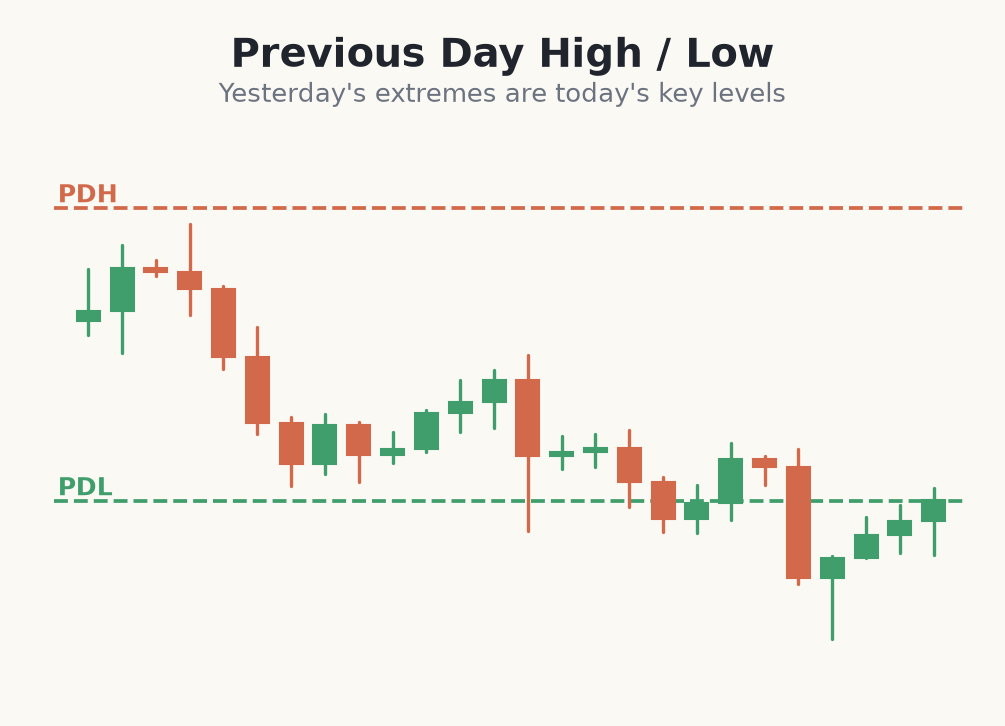
The previous day's high and low — often written PDH and PDL — are among the most-watched levels in intraday trading. They mark the extremes of the last session, so a huge number of traders and orders reference them, which is exactly why price so often reacts there.
Two ways price reacts
At these levels price tends to do one of two things: reject and reverse, or break and run. A rejection back into yesterday's range suggests the level is holding; a clean break beyond it suggests the market wants to extend the range in that direction. Reading which is happening is the skill.
Using the levels
Some traders fade a first test of the PDH or PDL, entering on signs of rejection with a stop just beyond the level. Others wait for a confirmed break and trade the continuation. Either way the level itself gives you a clean, logical place to put your stop, which is what makes PDH and PDL so useful.
- Mark PDH and PDL before the session starts.
- Rejection back inside the range → the level is holding.
- A decisive break → the range may extend that way.
- The level offers a natural, tight place for the stop.
Fading the previous day's high on a €1,000 account
- 1Before the session you mark yesterday's high — PDH at 1.09200 — on EUR/USD. It is a shared reference a huge number of traders watch.
- 2Price rallies into 1.09200 and stalls, printing a bearish rejection candle with a long upper wick — sellers defending the level. You enter short at 1.09180.
- 3Your stop goes just above the PDH at 1.09230 — a 5-pip risk. A close above there means the level broke and your fade is wrong.
- 4Risk 1% = €10 on 5 pips means ~0.20 lots (€2 per pip). Target the mid-range level at 1.09080, ~10 pips away — a 2:1.
- 5The PDH gave you a tight, logical stop — that clean invalidation is exactly what makes these levels so useful.
- 6The alternative play: if price instead closes decisively above 1.09200, you drop the fade and consider the break-and-extend continuation instead.
Common mistakes trading PDH / PDL
- Fading the level with no rejection. A touch of PDH is not a short. Wait for the bearish rejection candle, or you front-run a level that keeps going.
- Marrying the fade after a clean break. When price closes firmly through PDH, the level flipped. Keep shorting it and you are fighting a fresh trend.
- Placing the stop at the level, not beyond it. PDH and PDL attract stop hunts. A stop one pip past the line gets clipped by the sweep.
- Forgetting to remark the levels each day. Yesterday's high is today's reference. Trading last week's PDH by mistake is a needless error.
- Ignoring context. A PDL fade in a strong downtrend is countertrend guessing. The higher-timeframe direction still decides the odds.
Yesterday's high and low are shared reference points — price either rejects them or breaks them, and both tell you something.