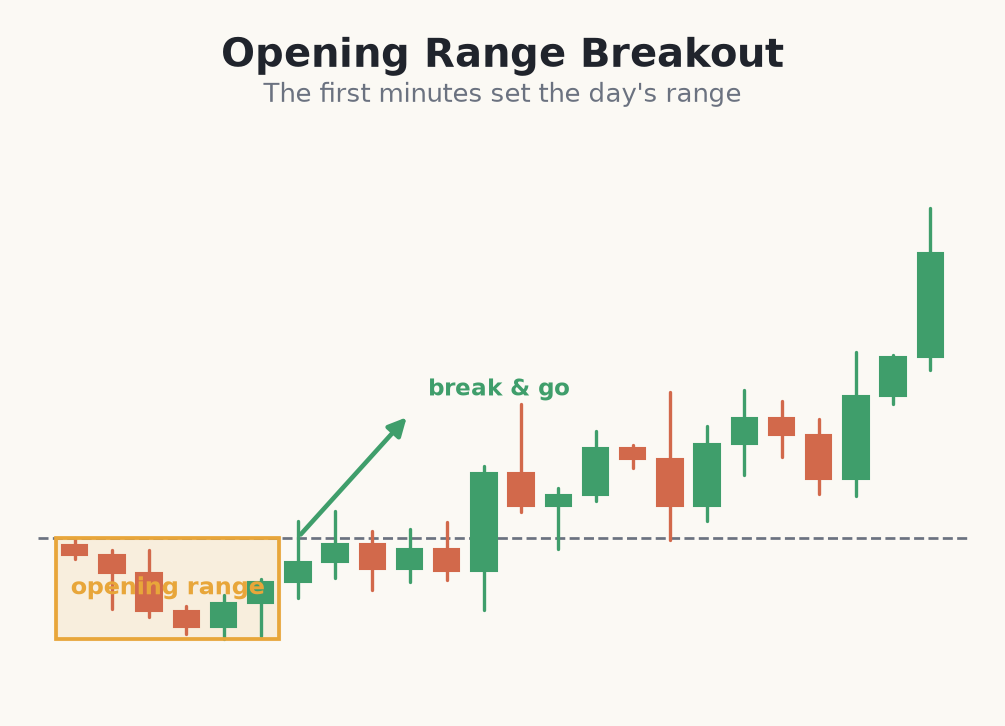
The opening range breakout, or ORB, is one of the best-known intraday setups. You take the high and low of the first few minutes after a session opens — often the first 5, 15 or 30 minutes — and treat that as the opening range. A break beyond it is your trade trigger.
Why the open matters
The open is when overnight news and orders hit the market at once, so it often sets the day's directional tone. The opening range captures that initial fight between buyers and sellers, and the side that wins the break frequently carries momentum into the session.
Entry, stop and target
Enter on a break of the range — either the breakout candle's close or a retest of the broken edge. Place the stop on the opposite side of the opening range, since price trading back through it invalidates the idea. Targets are often a fixed reward multiple or the next daily level such as the previous day's high or low.
- Define the range from the first 5–30 minutes after the open.
- Entry: a break of the range high (long) or low (short).
- Stop: the opposite side of the opening range.
- Beware the failed break — a tight range can whipsaw both edges.
An ORB scalp on a €1,000 account
- 1At the US index open you watch US30 for the first 15 minutes. It carves an opening range: high 39,050, low 39,010 — a 40-point box.
- 2Price closes above 39,050 with momentum. You enter long at 39,055 on the breakout candle's close.
- 3Your stop goes on the opposite side of the range at 39,008 — a 47-point risk. Price trading back through the range invalidates the break.
- 4Say US30 is ~€0.10 per point per 0.1 lot. Risk 1% = €10 on 47 points means roughly 0.02 lots so a hit costs ~€10.
- 5Target the previous day's high at 39,145, ~90 points away — a ~2:1. The next daily level is your logical objective, not a random number.
- 6If instead price breaks 39,050, fails, and closes back inside, you take the small planned loss — the tight-range whipsaw the setup warns about is real.
Common mistakes trading the ORB
- Entering before the range is defined. Jumping in during the first 15 minutes means there is no range yet — you are guessing, not trading a break.
- Trading a very tight opening range. A narrow box whipsaws both edges, stopping out longs and shorts in minutes. Skip breaks of an unusually small range.
- Putting the stop just past the break, not on the far side. The logical invalidation is the opposite edge. A stop too close gets clipped by the retest.
- Ignoring the higher-timeframe direction. An ORB long straight into daily resistance has poor odds. Favour breaks that align with the bigger picture.
- Chasing an extended break. If price is already far beyond the edge, the entry is late and the stop is now huge. Wait for the retest or let it go.
The opening range breakout trades the day's first decision — enter on the break, and let the far side of the range define your risk.