The Asian session is typically the quietest of the three, and price often drifts sideways in a relatively tight overnight range. That range becomes a reference: the high and low it prints are levels that later, busier sessions frequently test and break.
The idea behind the setup
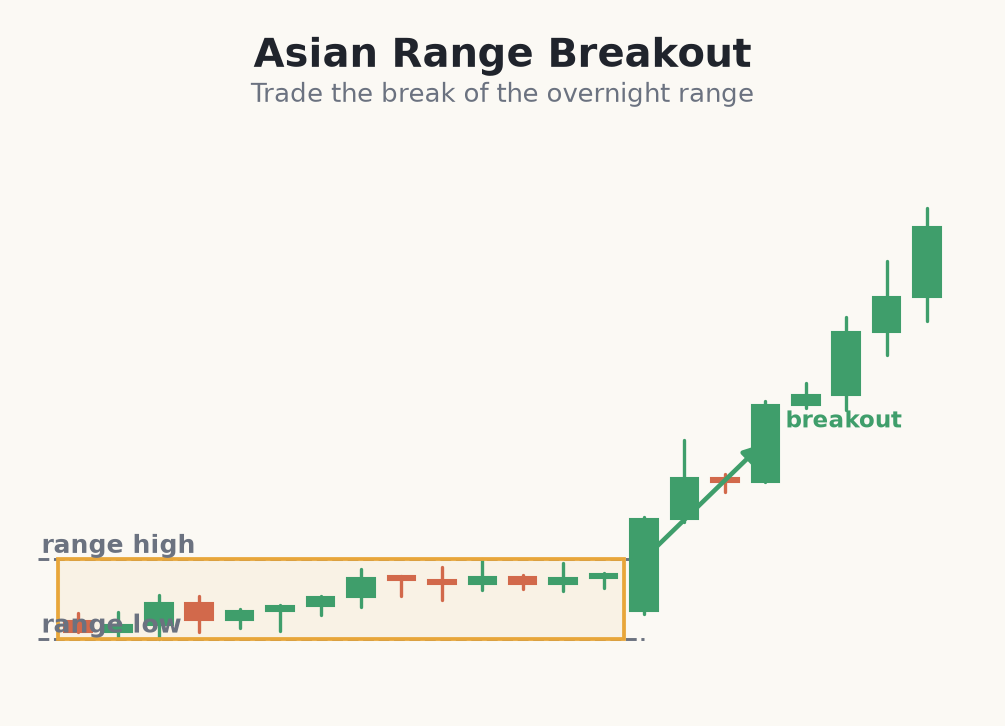
The logic is that a quiet range stores energy. When London or New York arrives with real volume, price may break the range and run. A common approach marks the Asian high and low as a box, then waits for a decisive break beyond one edge to signal the day's direction.
Entry, stop and the honest catch
An entry can be taken on a candle close beyond the range edge, or on a retest of that edge with a tighter stop. The stop logically sits back inside the range, since a return there means the break failed. The honest catch is the false breakout: ranges are magnets for stop hunts, and price often pokes beyond one edge only to reverse hard.
- Mark the Asian high and low as a box before London opens.
- Entry: a decisive close beyond an edge, or a retest of it.
- Stop: back inside the range — a return means the break failed.
- False breaks are common; a close-based filter helps but never eliminates them.
An Asian range breakout on a €1,000 account
- 1Overnight, EUR/USD drifts sideways. You box the Asian range: high 1.08550, low 1.08480 — a 7-pip box.
- 2London arrives with volume and price closes decisively above 1.08550. You wait for the candle close beyond the edge, not the first poke, then enter long at 1.08560.
- 3Your stop sits back inside the range at 1.08510 — a 5-pip risk. Price trading back inside means the break failed.
- 4Risk 1% = €10 on 5 pips means ~0.20 lots (€2 per pip). Target a measured move of the box height (~7 pips) beyond the break, to 1.08620 — roughly 1.2:1, or trail for more if momentum holds.
- 5Because ranges attract stop hunts, you use the close-based filter: it will not stop every false break, but it filters the worst pokes.
- 6If price instead pokes 1.08560 and slams back inside on the same candle, you skip it — that is the false break the setup warns about.
Common mistakes trading the Asian range breakout
- Entering on the first poke, not the close. Range edges are magnets for stop hunts. Buying the wick before the close is how you get trapped.
- Placing the stop too far outside the range. The logical invalidation is back inside the box. A stop miles away turns a small planned loss into a large one.
- Trading the break in dead hours. A 'breakout' with no session volume behind it usually fails. Wait for London or New York to supply the push.
- Ignoring how often ranges fake out. Many breaks reverse hard. A close filter reduces but never removes this — always define failure before you enter.
- Chasing a break that already ran. If price is 15 pips past the edge before you act, the good entry is gone and your stop is now enormous.
The Asian range stores energy for later sessions — but its edges attract false breaks, so define failure before you enter.