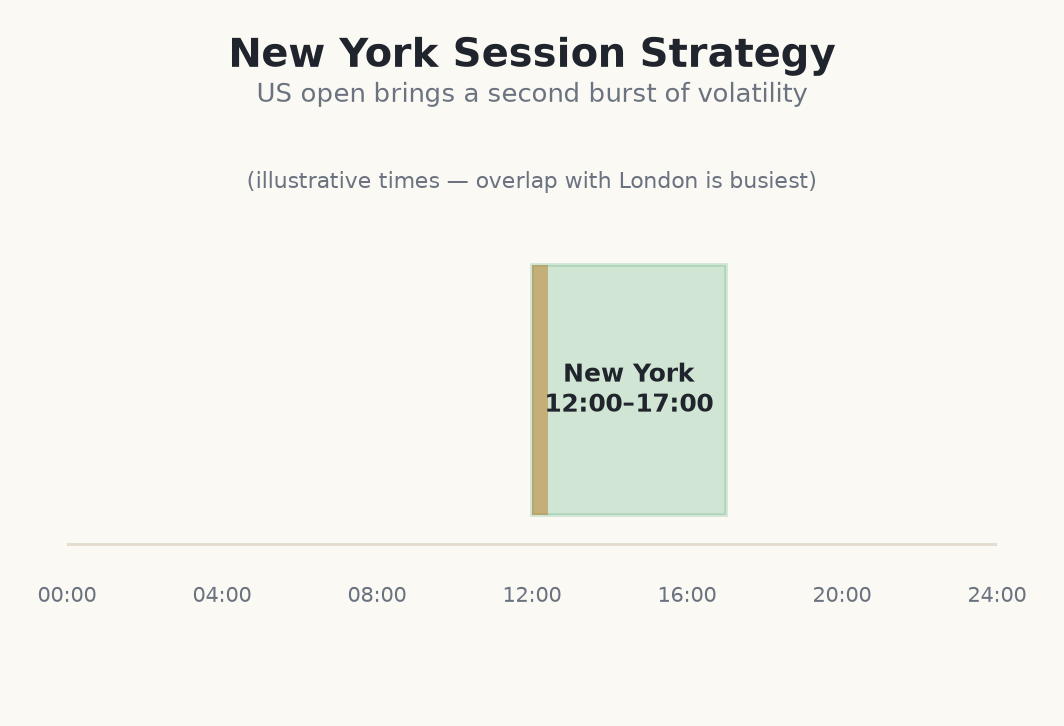
The New York session is the second great pillar of the trading day. Its early hours overlap with London, and this overlap is often the most liquid and active window of all, as the two largest financial centres trade at the same time.
Driven by US news
New York is heavily shaped by US economic data — employment figures, inflation prints and central-bank commentary. These releases can produce sharp, fast moves and, just as often, brutal whipsaws. Many scalpers avoid trading in the seconds around a scheduled release and wait for the dust to settle.
Later in the session, once London closes, liquidity thins and moves can lose conviction. As with London, the exact times are illustrative only: New York roughly opens around 08:00 New York time, but the hours you see depend on your broker's server clock and daylight saving. Confirm them yourself.
- The London–New York overlap is typically the busiest window.
- US data releases drive sharp moves and frequent whipsaws.
- Trading the exact moment of a release is a gamble, not an edge.
- Times are illustrative — they shift with daylight saving and server time.
Trading around a US release on a €1,000 account
- 1A US data print is scheduled. In the two minutes before it you do not open a trade — the release can spike either way with slippage that ignores your stop.
- 2After the print, EUR/USD spikes down, then reclaims a level at 1.08400 with a strong bullish close in the London–New York overlap. Now the reaction is readable.
- 3You enter long at 1.08420, stop below the post-news low at 1.08360 — a 6-pip risk. The volatile spike defines a clear invalidation.
- 4Risk 1% = €10 on 6 pips means ~0.16 lots (€1.60 per pip). Target 1.08540, ~12 pips away — a 2:1.
- 5You let the dust settle and traded the reaction, not the release. Entering during the spike itself risks a fill far from your intended price.
- 6Late in the session, once London closes, liquidity thins — you tighten up or stop, because moves lose conviction and spreads can widen.
Common mistakes trading the New York session
- Trading the exact second of a release. Spreads blow out and fills slip past your stop. That is a gamble on the number, not an edge.
- Ignoring the calendar. Getting caught in an unexpected high-impact print mid-scalp is avoidable. Check scheduled US data before every session.
- Scalping the thin post-London hours as if they were the overlap. Conviction fades after London closes; forcing trades into chop just pays spread.
- Trusting a fixed New York open time. The hours shift with daylight saving and your broker's server clock. Confirm them on your own platform.
- Widening a stop when news spikes against you. A volatile release is exactly when discipline matters most. Take the planned loss, never move the stop.
New York runs on US news — respect the releases, favour the London overlap, and confirm the real session hours yourself.