A reversal is a change in the overall trend direction — a downtrend turning into an uptrend, or the reverse. Called correctly, reversals are some of the most rewarding trades on the chart because you enter right as a new trend begins, near the extreme. Called badly, they are where accounts quietly bleed out, because traders try to pick tops and bottoms on hope, adding to losers as price keeps trending against them.
The difference between the two outcomes is one word: confirmation. Amateurs predict reversals — 'this has fallen too far, it must bounce'. Professionals react to them — 'the structure has actually flipped, now I can trade the new direction'. This module is about turning reversal trading from a guess into a rules-based sequence you can wait for.
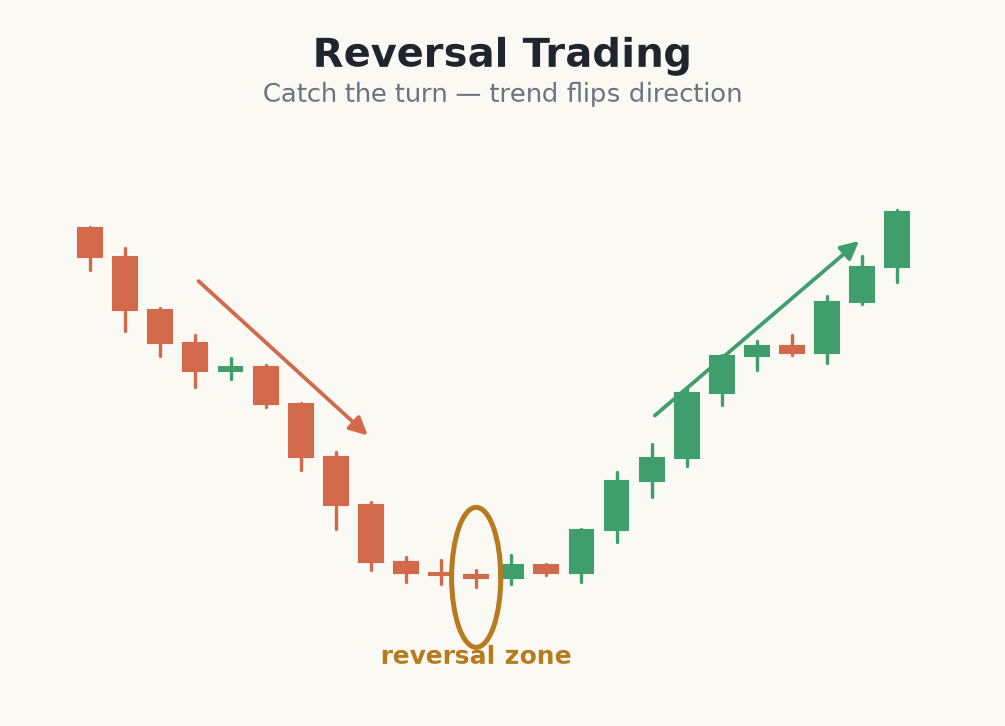
How to confirm a reversal with structure
The disciplined way to trade reversals uses structure, in two stages. First look for a change of character (CHoCH) — the first break against the prevailing trend, the first time price does something the old trend shouldn't allow (for a downtrend, the first higher high). A CHoCH is a warning, not a green light. Then wait for price to build the opposite structure: after a bottom, that means a higher high followed by a higher low. Only when structure has genuinely flipped — old trend broken, new trend confirmed — do you have a real reversal.
This two-stage rule is what protects you from the endless 'it looks like a bottom' traps. A single strong candle against the trend is not a reversal — downtrends are full of violent bounces that fail. You are waiting for the market to break its own structure and then confirm the new one, which filters out the vast majority of false turns.
Entry, stop and target
The safer entry is on the first pullback after structure flips — for example the new higher low that forms after a bottom — with a stop just below that low. This lets the market prove the turn before you commit a cent. Because reversals fail more often than trend-continuation trades, keep size modest and accept the trade-off: waiting for confirmation means you give up the exact low or high in exchange for far better odds.
Trading a confirmed bottom step by step
- 1GBP/USD has been in a downtrend, printing lower highs and lower lows. The last lower low is at 1.2400; the last lower high before it was 1.2520.
- 2Change of character: price rallies off 1.2400 and, for the first time in the move, closes above 1.2520 — breaking the last lower high. That's the CHoCH. You do not buy yet.
- 3Structure flip: price pulls back and forms a higher low at 1.2470 (above the 1.2400 bottom), then pushes to a higher high. Structure is now up.
- 4Entry: you buy the hold of that higher low, entering near 1.2485 as it turns back up.
- 5Stop & target: stop below the higher low at 1.2450 (35-pip risk); first target the next resistance at 1.2590, about 105 pips — roughly 3R. If 1.2450 breaks, the reversal has failed and you're out cheaply.
Common mistakes with reversals
- Shorting strength or buying weakness on hope. 'It's gone too far' is not a signal. A strong trend can run far past what looks reasonable — you need structure to break first.
- Treating one candle as a reversal. A single big counter-trend candle is a bounce until structure confirms. Trends are full of them, and most fail.
- Skipping the pullback. Entering on the CHoCH breakout itself, at the extreme, gives you a wide stop and worse odds. Wait for the higher low (or lower high) to form.
- Sizing reversals like trend trades. Reversal calls are wrong more often, so full size magnifies the extra losses. Keep them modest until you've proven the skill.
- Averaging down. Adding to a losing counter-trend position because you're 'sure' it will turn is the single fastest way to turn a small loss into a catastrophic one.
The honest truth about reversals is that they demand more patience than any other setup and still fail more often. That's not a reason to avoid them — it's a reason to wait for the structure and keep risk small. A confirmed reversal caught on the first pullback is a high-reward trade; a guessed reversal is just a bet against the market's own evidence.
Reversals are confirmed by structure, not predicted by hope — wait for a change of character, then a genuine structure flip, then enter on the first pullback with a small, defined risk.