A range is a market moving sideways between two levels — a fairly flat range high (resistance) and a fairly flat range low (support). Neither buyers nor sellers are in control, so price bounces back and forth between the ceiling and the floor. This is not a broken or 'boring' market to be avoided — markets spend a large share of their time ranging, so a trader who can only trade trends is sitting on their hands most of the year.
The logic of a range is the mirror image of a trend. In a trend you buy strength and sell weakness; in a range you do the opposite — you sell into strength at the top and buy into weakness at the bottom, betting that price will revert back toward the middle. Getting this backwards — buying breakouts inside a range — is one of the fastest ways to get chopped up.
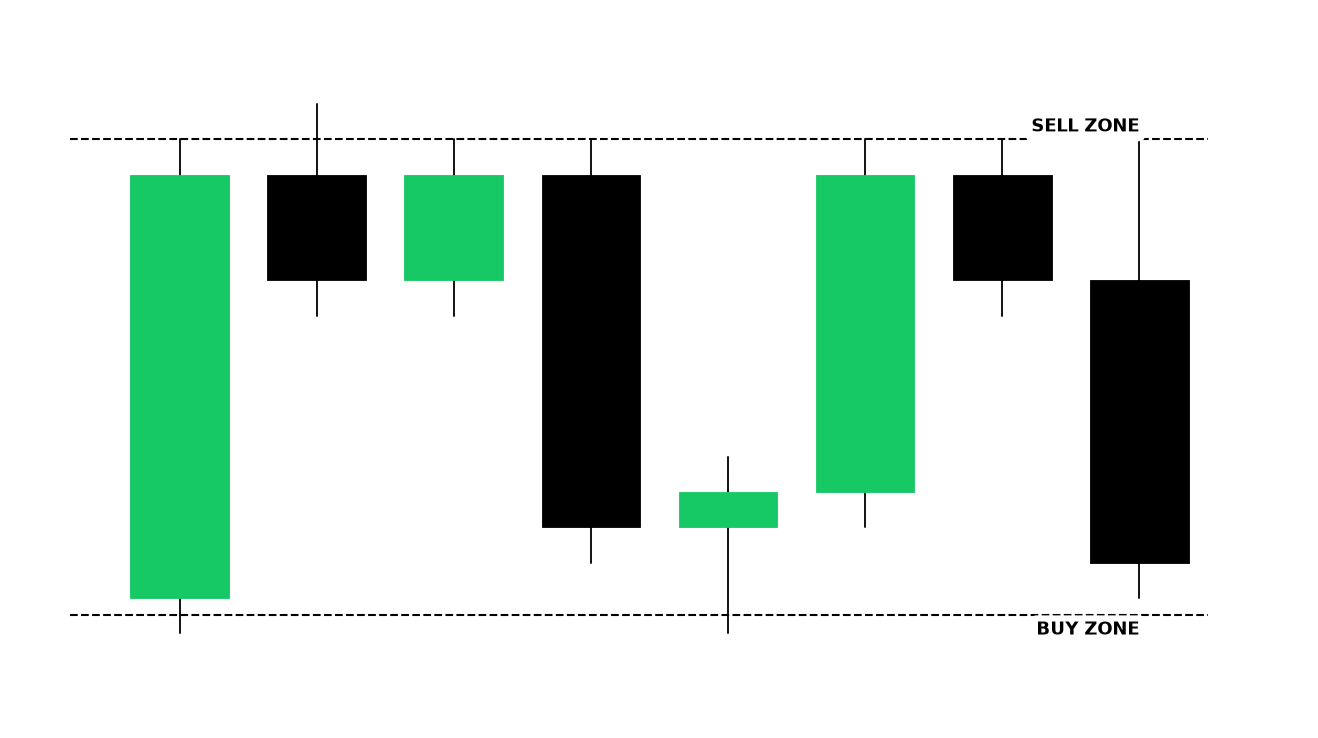
The basic range playbook
The core idea is to sell near the top of the range and buy near the bottom, fading each move back toward the middle. The single most important discipline is to trade only at the edges. The middle of a range is no-man's-land: there is no clear level to lean on, no obvious place for a stop, and price can go either way. Wait for price to reach an edge and, crucially, to show rejection — a wick that pierces the level and closes back inside — before you enter.
Entry, stop and the breakout risk
Enter near an edge on a rejection signal and place your stop just outside the range. This is what makes range trading efficient: because your entry is right at the level, your stop is tight, and your target — the opposite edge — is far away, giving a naturally good reward-to-risk. A close beyond the edge, by contrast, is not noise to ride out; it is the signal that the range is breaking and you should be out. Every range eventually breaks, so never fight a decisive breakout.
Fading the top of a range step by step
- 1Gold has been ranging for two days between support at $2,320 and resistance at $2,360 — a clean $40 range.
- 2Price rallies back up to $2,360 and prints a bearish rejection candle: a wick above 2,360 that closes back at $2,356.
- 3You sell the rejection at $2,356, with a stop just above the range high at $2,366 — a $10 risk.
- 4Your first target is the opposite edge (support) at $2,322, about $34 away — roughly 3.4R. Many traders take partial profit at the range midpoint (~$2,340) and trail the rest.
- 5Your rule is explicit: if price closes above $2,360, the range is breaking, your short is invalid, and you're out — no hoping it comes back.
Common mistakes with range trading
- Trading the middle. Entering in the centre of the range gives you no level to lean on and no logical stop. Only the edges offer an edge.
- Entering without rejection. Assuming an edge will hold and selling into it before price rejects means you're often short right as the range breaks up. Wait for the wick and close-back-inside.
- Stops too tight against the edge. Ranges are noisy and edges get probed. A stop one tick beyond the level gets picked off constantly — give it a little room just outside the range, not on top of it.
- Fighting the breakout. When price closes decisively outside and keeps going, re-entering the fade 'because it's still a range' turns a small loss into a large one. The range is over — switch to breakout thinking.
- Forcing a range onto a trend. Calling a shallow trend pullback a 'range' and fading it means selling in an uptrend. Confirm the highs and lows are genuinely flat first.
Range trading is high-probability but low-glory: many small, clean wins between the edges, punctuated by the occasional break that you must respect instantly. The traders who do well in ranges are the ones who are disciplined about the edges and quick to admit when the range is finished.
Fade the edges of a range on rejection with a stop just outside it — but the moment price closes decisively beyond an edge, the range is over and you switch to breakout thinking.