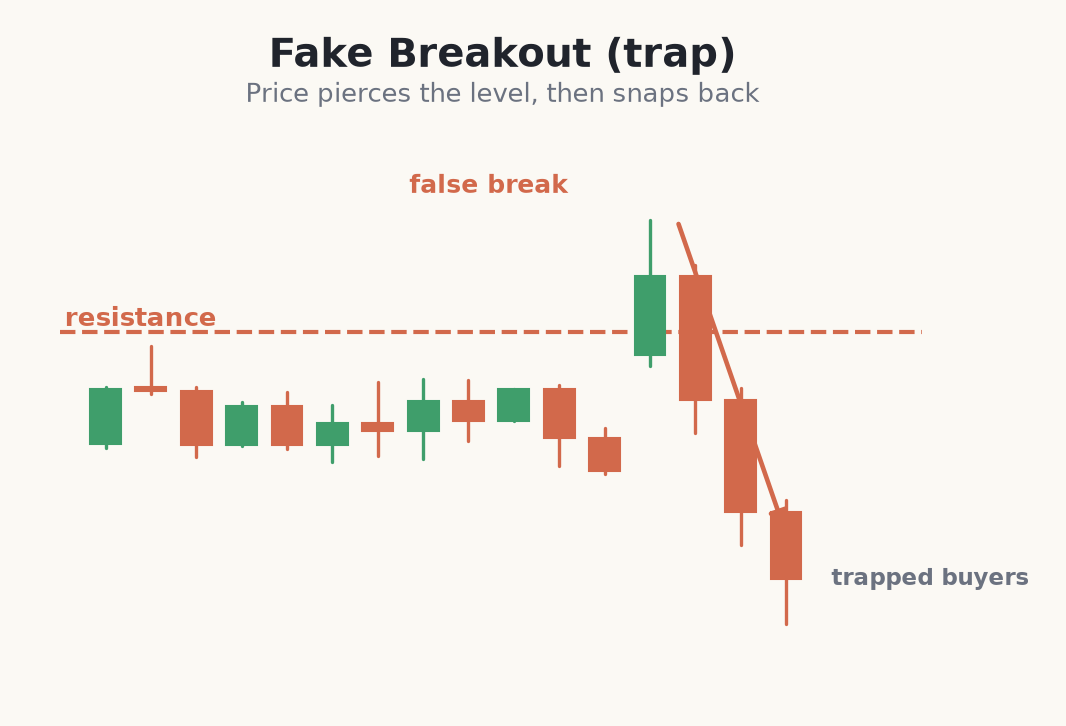
A fake breakout — also called a false break or stop-run — is when price pokes beyond an obvious level, triggers the traders who bought (or sold) the breakout and the stops resting there, then reverses violently back into the range. It is one of the most common and most expensive ways new traders lose money, precisely because it targets the most 'textbook' behaviour: buying a clean break of resistance.
What makes fakeouts brutal is the psychology. The break looks exactly like the setup you were taught to trade — price clears the level, momentum spikes, it feels obvious. You enter, and within a candle or two price is back below the level and heading the other way, with your stop directly in the path of everyone else's. Understanding why this happens is what turns it from a recurring trap into an opportunity.
Why fakeouts happen
Resting stop orders cluster just beyond obvious levels — the stops of range traders sit above resistance, and breakout traders place their entry orders there too. That pool of orders is a magnet: a push through the level triggers them all at once, providing a burst of liquidity that larger participants can sell into (or buy from). Once that liquidity is absorbed and there are no more buyers left above the level, price has nowhere to go but back down — and it snaps back, leaving the breakout crowd trapped on the wrong side, forced to sell at a loss and adding fuel to the reversal.
How to protect yourself — and profit
The primary defence is to demand a candle close beyond the level, not a wick. A wick through the level that closes back inside is the classic fakeout footprint; a strong close beyond it, ideally with follow-through, is a far more reliable break. Be especially suspicious of breaks on low conviction or after a long, tired run into the level — those are the ones most likely to fail.
The failure is also a tradeable setup in its own right. When price fakes out beyond a level and then reclaims it with force — closing back inside the range — you can enter in the reversal direction with a tight stop beyond the fakeout wick, targeting the opposite side of the range. Because the stop is small (just past the extreme) and the target is far (the other edge), these trades often carry excellent reward-to-risk.
Trading a failed breakout step by step
- 1EUR/USD has clear resistance at 1.0900, tested three times in a tight range with support at 1.0840.
- 2Price spikes up to 1.0915, running the stops above 1.0900 — breakout buyers pile in. But the candle closes back at 1.0895, below resistance. That's the fakeout footprint.
- 3You wait for the reclaim: the next candle closes firmly back inside at 1.0890. Now you sell, betting the trapped breakout buyers will fuel a drop.
- 4Entry 1.0888, stop just above the fakeout wick at 1.0920 — a 32-pip risk. Target the opposite edge of the range at 1.0845, about 43 pips, plus room if it breaks — roughly 1.3–2R to the first target.
- 5Your invalidation is explicit: if price closes back above 1.0900, the break was real after all and you're out. The trap only works while price stays trapped below.
Common mistakes with fake breakouts
- Reacting to the wick. Entering the instant price pierces the level, before any candle has closed, is exactly the behaviour fakeouts are designed to punish. Wait for the close.
- Chasing tired breaks. Buying a break of resistance after a long rally straight into it, on fading momentum, is low-quality — that's prime fakeout territory.
- No plan for the snap-back. If you're long the breakout and price closes back inside, that is your signal to exit, not to 'give it room'. Trapped traders who hope lose the most.
- Fading every break as a fake. Not all breaks fail — strong, high-conviction breaks with follow-through are real. Only fade a break once it has actually reclaimed the level, not on assumption.
- Stop on the wrong side of the wick. Placing your reversal stop inside the fakeout range means the next probe stops you out. Put it beyond the fakeout extreme.
The honest takeaway is that a level everyone can see is a level everyone's stops sit behind — which is exactly why price so often hunts it before the real move. Once you stop trusting the first poke and start waiting for the close and the reclaim, the fakeout stops being the thing that traps you and becomes one of your cleaner setups.
A break that snaps back into the range is a trap — demand a candle close before trusting any breakout, and when a break fails and reclaims the level, the trapped traders often fuel a strong move the other way.