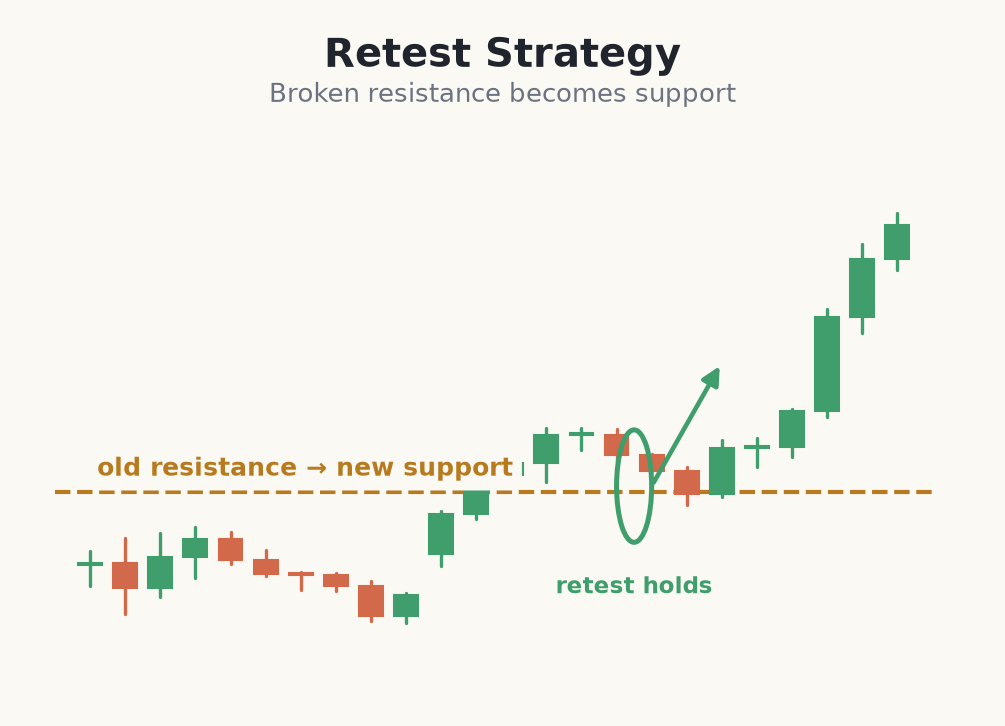
When a level breaks, it often flips role: broken resistance can become new support, and broken support can become new resistance. The retest is the moment price returns to that broken level to test it from the other side. It is one of the highest-quality entries in all of price action, because it combines a confirmed break with a precise, low-risk place to enter.
The retest solves the biggest problem with breakouts: where to enter without chasing. Instead of buying an extended breakout candle with a stop miles away, you let the break happen, wait for price to come back to the level, and enter only if the level holds in its new role. Your stop sits just on the far side of the level, so your risk is a fraction of what chasing the break would have cost — the same trade idea with far better numbers.
Why levels flip role
The flip is driven by order flow and memory, not magic. Think about who is positioned around a broken resistance. Traders who sold at that resistance are now underwater and want out at breakeven — if price returns, their buying-to-close adds support. Breakout buyers who missed the initial move want a second chance and buy the retest. And traders who were already long defend their level. All three flows push in the same direction, which is exactly why a broken level so often holds when it's tested from the other side. This role reversal is the same mechanism behind ordinary support and resistance — the market remembers price.
Wait for the hold, then enter
The discipline is patience. Rather than chasing the breakout, you wait for price to return to the broken level and show it holding — ideally with a rejection candle that closes back in the breakout direction. You enter on that confirmation and place your stop on the far side of the level, because price closing back through it means the flip has failed and your reason for the trade is gone. Done right, the retest gives you tighter risk than the initial break and a clean, objective invalidation.
Trading a broken-resistance retest step by step (EUR/USD)
- 1EUR/USD has repeatedly failed at resistance of 1.0900. A strong bullish candle finally breaks and closes at 1.0918 — a confirmed break.
- 2You do not chase at 1.0918. You mark 1.0900 as the level that should now flip from resistance to support, and wait.
- 3Price pulls back over the next candles and dips into 1.0902, right at the old level. You watch for it to hold.
- 4A bullish rejection candle forms at the level and closes back up at 1.0910 — the retest held. You enter at 1.0912 on that close.
- 5Your stop goes just below the level at 1.0888 — a tight 24-pip risk. On a €1,000 account risking 1% (€10), that sizes to roughly 0.04 lots.
- 6Target the next resistance or a measured move near 1.0972 (60 pips), giving roughly 2.5:1 reward-to-risk from a confirmed, low-risk entry — with one rule: a close back below 1.0888 and you're out.
Not every breakout offers a retest
Be honest about the trade-off: strong moves sometimes run without ever looking back, and you will miss those waiting for a retest that never comes. That is fine — skipping a trade that never gives your setup is itself good discipline, not a failure. The retest is a quality-over-quantity approach: you take fewer trades, but each one has a confirmed break behind it and a tight, defined stop. Don't force an entry just because you're impatient for the pullback.
Common mistakes with the retest strategy
- Entering before the hold. Buying as price falls back into the level, before it confirms, is guessing. Wait for a rejection candle that closes in your direction.
- Chasing when there's no retest. If a strong move runs without pulling back, jumping in late at the extreme abandons the whole point of the retest — a tight entry.
- Stop on the wrong side. Your stop belongs just beyond the level, because a close back through it means the flip failed. Placing it too tight inside the noise gets you stopped on a normal wick.
- Trading an unconfirmed break. A retest only matters after a genuine break — a candle close beyond the level, not a wick that pierced and snapped back.
- Forcing every level. Not every broken level flips cleanly. Weak, unclear levels give messy retests; favour the obvious levels many traders are watching.
Broken resistance becomes support and broken support becomes resistance — the retest lets you trade that flip with a confirmed break and a tight stop just beyond the level. Wait for the hold, and accept that some strong moves simply won't offer one.